


Bulletin E-3516
Bulletin E-3516 Used Farm Equipment Markets: Navigating the Options
DOWNLOAD
July 21, 2026 - Jonathan LaPorte
 Print
Print Email
EmailAs a new farm decision-maker, venturing into the used equipment market can be challenging. There are a number of equipment options to navigate that may or may not meet the needs of your farm, as well as several outlets that you can use to find or purchase farm machinery. Once you’ve identified a potential purchase, you want to ensure what you’re buying is worth the investment. Then you want to secure the purchase as quickly and securely as possible, especially if you hope to use it right away. All of these challenges can be amplified by the pressure of being a first-time buyer.
First-time buyers often run into challenges around capital availability, limited local options and uncertainty about pitfalls that may exist. Pitfalls are generally skills or knowledge that are not inherently known and an individual must learn. Common pitfalls often include a lack of understanding of equipment options, how to inspect equipment, negotiate prices, farm auction basics, and ensure legal ownership of purchased equipment.
This publication provides insight on how to navigate buying used farm equipment. This includes how to research potential options to find what fits your farm needs; an overview of how used equipment markets work and the buying channels available. Also included are the steps involved in equipment inspection, price negotiation, and securing a successful purchase; and lastly, how to protect and evaluate your investment to aid in future farm equipment buying decisions.
Research Used Equipment Options
Used equipment purchases are most effective when grounded in planning rather than simply price. The objective is to ensure that each machinery investment supports the farm’s operational, financial, and long-term business goals. To meet this objective requires two key elements: knowing your farm needs and researching options that align with farm needs.
Identifying your farm needs is covered in MSU Extension Bulletin E-3515 Used Farm Equipment Markets: Planning the Purchase. Review the bulletin at: https://www.canr.msu.edu/demand/. Researching options involves model reputation, parts availability and repair support, and investigation.
Model reputation
Once you know your farm needs, you can begin to research potential purchase options. Options are available from a variety of different company brands and equipment models. Each company brand and the models of equipment they offer will have similarities and differences that you’ll need to wade through. A helpful guide can be a model’s reputation. If a brand or model is known to be dependable and effective in achieving its primary purpose, it might be an option worth investigating.
An example for classic tractor enthusiasts is the comparison between International Harvester (IH) and John Deere (JD). Each company produced a line of tractors that were available to purchase that competed against one another. In the 1970s, a common comparison was between the IH 1066 and JD 4320 model tractors. The appearance or essential structure of each tractor was similar from one company to the next. Both models had large rear tires, a single engine, large fuel tank, rear transmission, and operator controls at the rear axles of the machine. Both engines were turbocharged with an initial rating of 116 horsepower (hp), and each model was available with two-wheel drive or modified four-wheel drive options.
The key differences between the tractor models were in the features that they offered. While both engines were initially rated at 116 hp, the IH 1066 engine was improved in 1973 and elevated to 125 hp. Although improvements led to the IH 1066 having higher horsepower, a common concern raised by operators was the lack of fuel efficiency compared to the JD 4320. This presented a tradeoff of value between field capacity (pulling power) and operating costs. At the same time, the JD 4320 was often complimented as having a more comfortable ride with controls that are easier to use. Easier to use controls made it more adaptable to a variety of tasks on the farm.
Note: Information on example tractors was obtained by Tractordata.com (www.tractordata.com).
The example tractors highlight the importance of model reputation as a key component of navigating purchase options. Both tractor models have a reputation of being durable, effective machines. In fact, both models have continued to see use on farms since their introduction in 1971. The IH 1066 is considered to be a viable option for farms needing medium to heavy tillage work. While farms that need a more versatile tractor to perform additional tasks may find the JD 4320 a better option.
This example also highlights one advantage of buying used machinery. There is often information available about uses and limitations, especially if the equipment has been field-tested for a number of years. When considering potential purchases of used farm equipment, it is important to spend some time searching for these types of information. This brings us to the next topic: Known Issues.
A word on known issues
Another key consideration is the known issues that equipment may have. Every model of equipment presents known issues that have to be weighed into a purchase decision. Age of the equipment, potential component failures (engines, transmissions, or hydraulic systems), or system design flaws that fail to align with operational needs. An example of a system design flaw would be hydraulic controls for loaders or hitches not working when a clutch is engaged. If the hydraulic system has a transmission-driven pump, the clutch disengages the transmission and stops all hydraulic flow throughout the machine. Wear parts, or parts that wear out from use, may also be a consideration. For tillage or harvest equipment, parts that wear down over time from consistent use may be a concern; especially if they are prone to wear out faster than comparable wear parts on another brand or model.
Parts availability & repair support
Parts availability is another key consideration to navigating purchase options. While the brand or model of equipment may be suitable to fit farm needs, long-term operation may be questionable if parts are difficult to find. For both old and newly used farm equipment, identifying the availability of parts is a critical step in your purchase decision.
Over time, every equipment company has had at least a few models of equipment that were discontinued and replaced by a newer model. Newer models often carry with them advances in technology and designs that are not compatible with their predecessors. Examples can include a different engine, new transmission, or reimagined harvest or tillage functions.
|
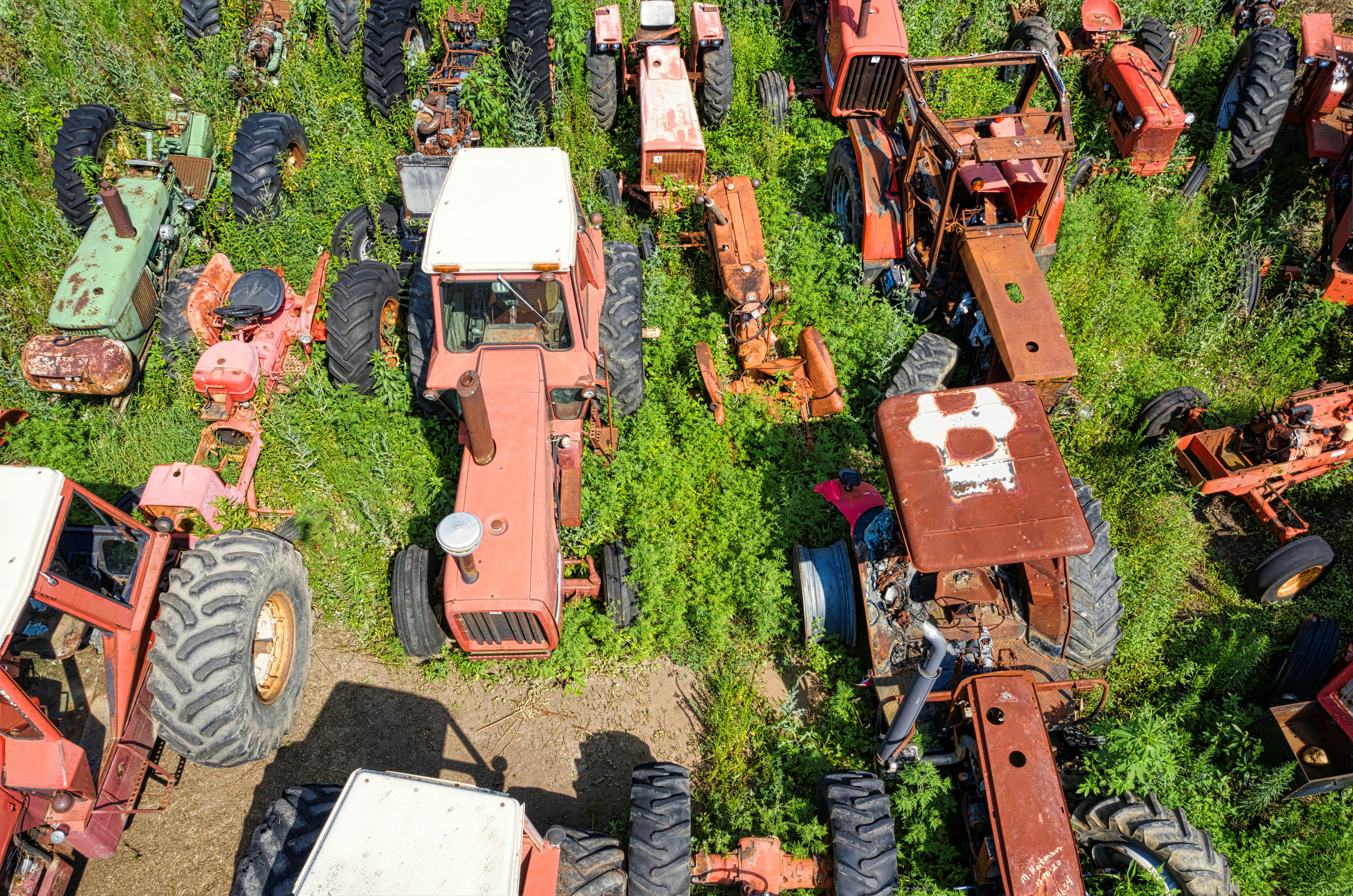
Figure 1. Drone captured image of a tractor junkyard. Photo credit: https://www.pexels.com/photo/rusty-tractors-parked-on-green-grass-9663606/ |
In the case of older machines, third-party parts companies and original equipment manufacturers (OEM) can potentially satisfy those concerns. Given enough time and interest for particular models, companies may acquire blueprints or manufacture replacement parts using updated technology. In the case of the JD 4320 example, parts availability was a concern due to its limited release from 1971-1972. Over the past half century, third-party and OEM parts have alleviated concerns for all but a few specialized components. For specialized components, parts may be available through equipment junkyards or parts salvage companies. Equipment salvage involves disassembling equipment and selling the individualized parts (Figure 1).
For newer, but still used equipment, parts availability may still be a concern because of limited access from the original equipment companies. The limited access is not just for physical parts but also for the software developed or diagnostic information owned by the equipment company. Right-to-repair is a common phrase used to highlight a movement to ensure farms can fix their own machinery or use independent repair shops of their choosing. The ability to repair includes parts, diagnostic tools, software information, and repair manuals for new, computerized equipment. When researching potential equipment options, it’s important to identify any right-to-repair concerns that may exist for a particular model.
In some situations, parts may be easy to obtain, but repair support is limited. Local dealers or independent repair companies may not exist in your area. Lack of local support can be a significant concern for breakdowns that happen in fields and require on-site repairs. Alternatively, if equipment can be relocated without an on-site technician, complete repairs may still require traveling or hauling equipment for long distances to obtain parts or service. The time lost in obtaining parts or service support could significantly impact production activities, leading to increased costs and reduced potential revenues.
Technology features and obsolescence (being outdated) should also be considered when purchasing used equipment. Even where technology is an upgrade to what is currently used on the farm, if parts and repair support are limited or no longer exist, the technology may be too outdated or obsolete to add significant value. In fact, older, used farm equipment may have technology that is still functional and should be considered.
An example of technology improvement and dwindling part availability has been seen in harvesting equipment for grain. Older combine harvesters used cylinder-concave systems for threshing and separating grain. In the mid-1970s, rotor designs were introduced to improve threshing and grain separation. As rotor designs became more common, less cylinder-concave parts became available from OEM or third-party companies.
The same can be true of newer, used equipment as technology advances and makes recent technology less desirable. An example of this situation was also seen in the early adoption of rotor technology in harvesters. Some harvester models utilized designs that were not adopted for long-term use by their companies. The discontinued designs led to parts availability becoming non-existent to owners or potential buyers over time. The lack of parts or repair service eventually led to those models being less sought after and often sold at discounts.
Investigation is the key to research
Understanding the reputation and remaining service support for used equipment may involve some investigative work. Dealerships, online forums, and trade publications can provide some of the best information on used equipment.
Dealers and technicians
Conversations with local dealers or technicians are a great starting point to find out about model history. Was the model dependable? Did it have known issues that could still be a concern today? Are parts readily available? What service options are available?
Online forums and social media
Online forums are often a great resource for peer experiences to compare with dealer or technician information. Current or former equipment owners, dealers, or technicians often make up the members of these online communities. The most common benefit is being able to ask questions about specific brands or models. If members have experience with the equipment, information received can range from how to diagnose issues and make repairs to guidance on where to find available parts.
These groups exist on social media platforms, such as group pages on Facebook (www.facebook.com). Alternatively, they may be part of standalone website platforms such as Reddit (www.reddit.com), Farmer’s Business Network (www.fbn.com), or Yesterday’s Tractors (https://forums.yesterdaystractors.com).
Trade publications
In some cases, there are publications that exist for specific companies or groups of equipment enthusiasts. These publications include articles that detail information about brands or models. Advertisements within the publications often include parts suppliers or service providers who may be able to provide additional insight. These publications may also have online forums that can be accessed for additional peer information.
How the Used Equipment Market Works
Once you’ve determined the type of equipment that fits your farm needs, it’s time to look at the used equipment market itself. The first thing to understand about used equipment markets is that they are fundamentally driven by supply and demand.
Supply and demand
Key market drivers of commodity prices and interest rates influence equipment demand. If commodities see an upward price trend or interest rates decline, farms are expected to lean towards purchasing new equipment. Conversely, if a downward price trend is seen or interest rates increase, buying decisions become more conservative and used equipment is considered more favorable.
Supply is often variable as there are no direct lines of inventory for every type of equipment a farm may need. The options that are available are influenced by the market channel potential buyers use to source equipment needs. The most common market channels are dealers, auctions, or private sales:
Dealers. Used equipment is often available as part of “trade in” on a new equipment sale. The value of the used equipment offsets some of the cost of new equipment. A single dealer is often limited on what they have in inventory. Dealers often use internal networks, or inventories between stores, to keep track of available equipment for potential buyers.
Auctions. Also known as consignment sales, these are public sales where equipment is sold to the highest bidder. Equipment is consigned or transferred to an auction company to facilitate the sale. The company handles marketing and conducting of the sale itself. Auction companies operate through either in-person or online events.
Private Sales. A private sale is conducted between two individuals directly. The seller handles any marketing and conducts the sales negotiation with the buyer. These types of sales often have an established asking price advertised but leave room for negotiation. Private sales can be transacted either in-person or online.
Sometimes these channels can interact, such as dealers moving older equipment into auctions to manage inventory levels. Dealers may also buy from auctions or private sales if they have a farm they are working with to locate a specific type of equipment.
Seasonal and cyclical sales patterns
Supply and demand within the used equipment market can also be influenced by seasonal or cyclical price patterns.
Seasonal sales patterns
Seasonal patterns are considered predictable or occurring at the same period each year. Detailed monthly sales percentages for used agricultural equipment are not publicly reported. However, multiple data sources including auction volumes, dealer insights, and equipment sales reports indicate higher sales activity in the first (January to March) and last quarter (October to December) of the year. The pattern aligns with fall harvest, end of year tax planning, and new production season demand. At fall harvest, farms may make or postpone equipment purchases to manage income tax liability. A new production season often leads to increased demand to replace equipment in order to ensure a successful start to the year. The distribution in Figure 2 and companion data in Table 1 reflects an illustrative seasonal pattern based on these observed trends.
Figure 2. Share of Used Equipment Sales Bases on Quarterly Data
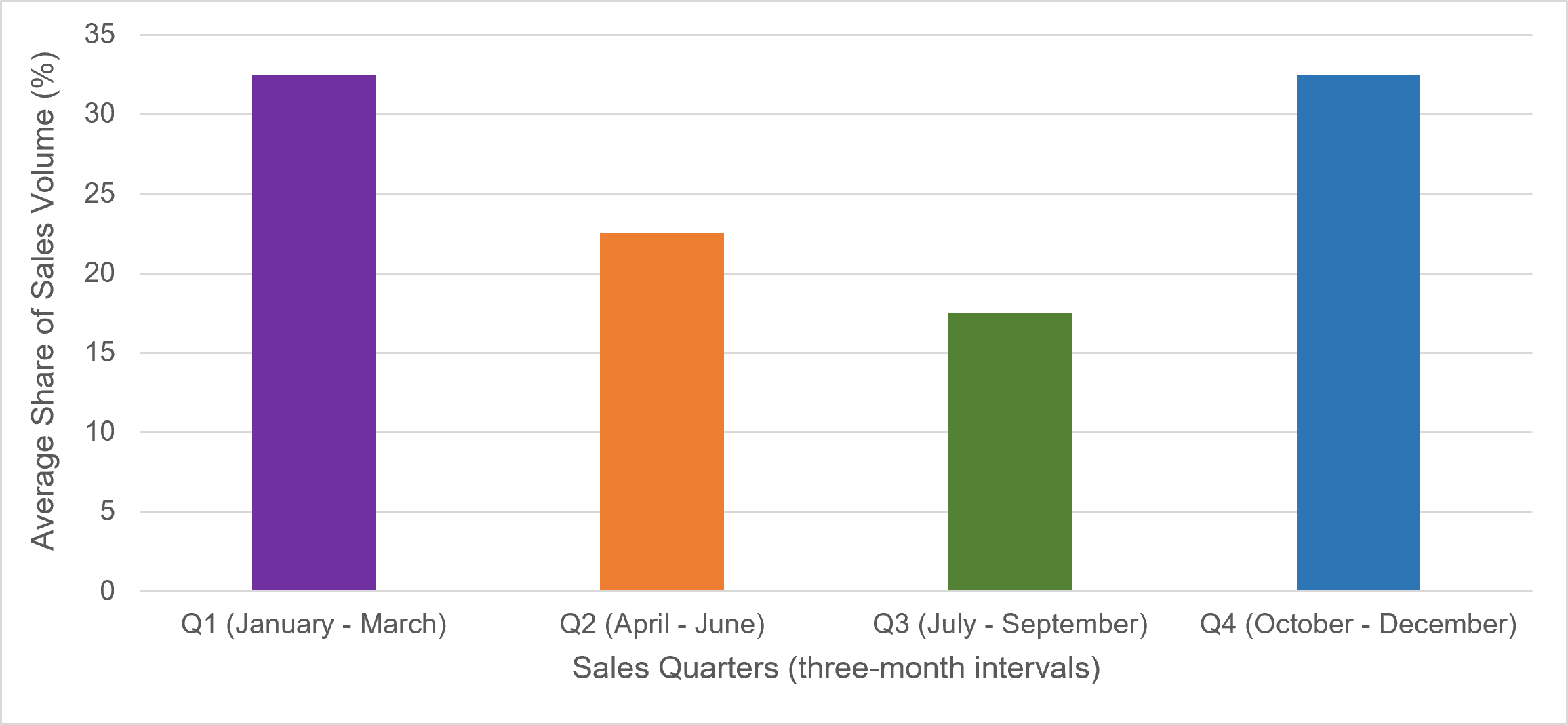
Figure 2. Share of used equipment sales based on quarterly (three-month intervals) data. Chart created by Jonathan LaPorte, Michigan State University Extension.
Table 1: Share of Used Equipment Sales Based on Quarterly Data
|
Sales Quarter (Q) |
Share of Sales Volume |
Factors Affecting Sales |
|
Q1 (January – March) |
30-35% |
Pre-plant demand, auction surge |
|
Q2 (April – June) |
20-25% |
Fieldwork reduces buying |
|
Q3 (July – September) |
15-20% |
Lower activity due to production uncertainties |
|
Q4 (October – December) |
30-35% |
Harvest + tax planning |
Table 1. Share of sales volume based on quarterly (three-month intervals) data and factors affecting sales.
Cyclical sales patterns
Cyclical refers to more irregular patterns that vary in length and are often driven by economic conditions. An example of a cyclical pattern is the impact seen from the Covid-19 pandemic that began in 2020. Supply chain disruptions lasted until 2022 and led to low inventory numbers at equipment dealers. Demand for used equipment significantly increased as a result. By 2023, full production of new equipment had resumed but purchases were limited due to significant drops in commodity prices across the nation. The demand for used equipment did not begin to stabilize until 2024.
Market channels may be affected differently by seasonal or cyclical patterns. Auctions may see more or less participation based on when they are held in the season. Less participation may mean lower demand for some auction items, leading to lower final bid prices. Dealers and private sales are often more concerned with cyclical patterns as they can influence their initial asking price for direct sales.
Buying Online vs. In-Person
Online market channels have seen an increase in popularity since the Covid-19 pandemic began in 2020. Several well-advertised options include Machinery Pete (www.machinerypete.com), BigIron Auctions (www.bigiron.com), AuctionTime (www.auctiontime.com), TractorZoom (www.tractorzoom.com) and Facebook Marketplace (www.facebook.com/marketplace/). These types of online markets offer a mixture of advantages and disadvantages over traditional in-person auctions or local dealer purchases. Understanding the pros and cons of online buying is important to ensuring safe and reliable transactions.
Note: the inclusion of specific online platforms is for example purposes only and not an endorsement by Michigan State University.
Advantages of online buying
A key advantage of online market platforms for used equipment is searchability. Online platforms allow farms to look for specific types of equipment on a global scale. In some cases, farms are able to search by specific brands, models, or descriptive keywords - increasing the likelihood of finding specific types of equipment compared to local options. In-person auctions and dealers are limited by their local inventories or equipment consigned to them for sale.
Another advantage is the time invested in searching. Farm managers don’t have to travel or take time from production activities to go to an auction sale. If a purchase is not made, travel and in-person attendance is time that could have been used more productively elsewhere. Online searches can reduce the time invested to find desired equipment. These searches can also be done more conveniently by a computer, tablet, or smart phone from any location, at any time.
Transparency can be another advantage. Many online platforms will offer detailed descriptions of the equipment they have listed for sale or auction. The details can be greater than those for in-person auctions or sales due to limited space in trade publications or advertisement flyers.
Disadvantages of online buying
One disadvantage of online purchases is the high risk of fraud. Fake websites and impersonations of legitimate dealers often lead to identity theft for targeted farms. Indicators of potential fraud would include misleading AI-generated or improved photos, requests for upfront payment, pressure, or urgency to purchase, or prices that are well below other market offerings (too good to be true).
Purchasing online can present logistical challenges. Once you’ve made an online purchase, you have to retrieve the equipment from its sale location. If that location is not local, arrangements must be made for pickup or delivery. If equipment has to be transported over large distances, retrieval can be expensive and involve more effort than local purchases. Transportation is often arranged by the buyer, which adds to the total cost and investment. Common challenges include travel route, hours invested, overnight lodging needs, and transportation equipment needed (trailer and truck).
The lack of physical inspection can be another disadvantage of online purchases. Especially when equipment is sold through an online auction or dealer that is not local to your location. Not being able to personally inspect machinery can create a risk of purchasing something that does not meet the online description.
Overcoming disadvantages
Information is the key to evaluating the existing or potential disadvantages of online buying. To determine if a used farm machine is worth pursuing, look for the following details in online listings:
Model & Production Year: Potential conditions or concerns about equipment can be determined simply by knowing the model and year it was produced. Some models may have a reputation for faulty components or parts that need to be investigated. Parts availability may be a concern if equipment is old enough or the model was only manufactured for a short time.
Hours of Operation: Engine or threshing (separator) hours are a useful indicator of equipment condition. Machines with “high hours” have been used to a point where major investments may be needed. Examples can include engine overhauls, transmission repairs or replacement, bearings, chopper knives, rotor components, and even grain floors in combines. General rule of thumb for “high hours” range between 2,000 to 3,000 hours for combine harvesters and 4,000 to 6,000 hours for tractors.
Location: Knowing where a listed machine is located is an important detail to consider before investing time in other details. Based on the distance, you can begin to identify the logistical challenges you’ll need to overcome.
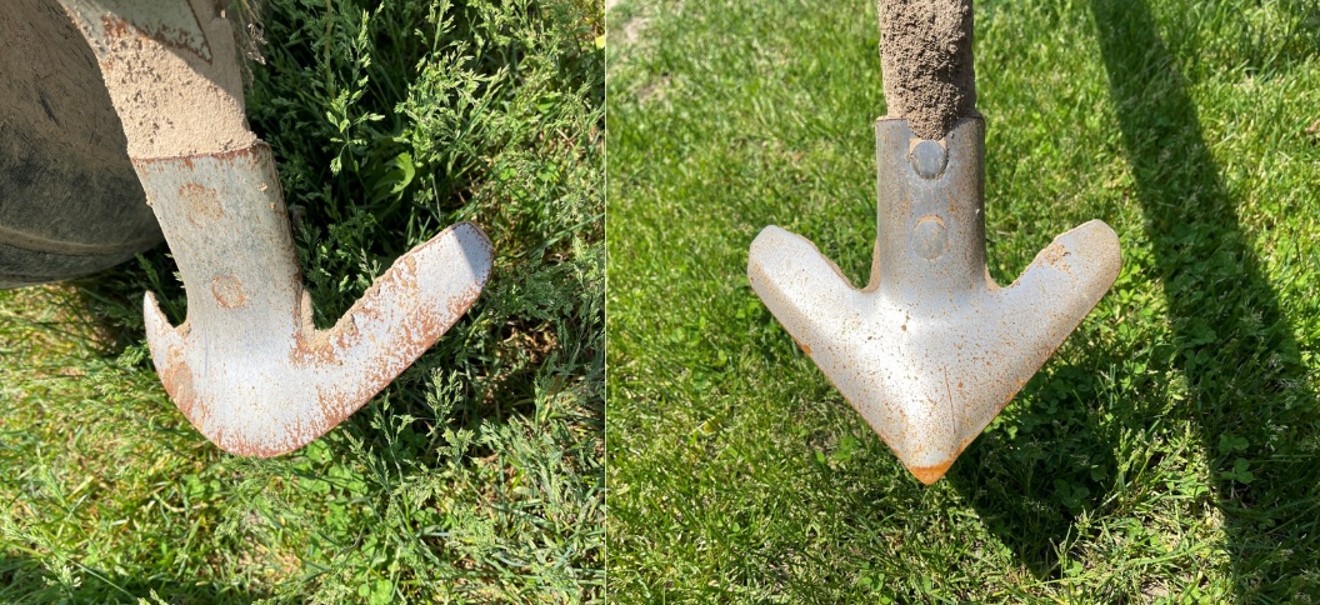
Photographs: The phrase “a picture is worth a thousand words” could easily refer to online buying of used farm equipment. While not a replacement for in-person physical inspection, photographs can help to see what you’re potentially buying. Often, the more photographs that show the equipment are considered better. However, the best pictures are those that specifically show areas of importance on machinery (engines sides, rotor components, grain floors, and wear or condition of knives or shovels). Being able to see as much of the equipment as possible helps to generate questions to ask of the seller (Figure 3). The seller’s responses can help in your buying decision.
|
Figure 3. Side-by-side comparison of field cultivator shovels. The shovel on the left is worn with rounded blades and needs replacement. The shovel on the right is newer with sharper, even blade widths. Photo credit: Jonathan LaPorte, Michigan State University Extension |
Also be on the lookout for photographs that are “too good” or enhanced. Image doctoring is becoming more of a concern with broader use of AI and may require third party detection to verify authenticity.
How to Inspect for Safety and Reliability
Most used farm equipment is sold using the phrase “as is.” The phrase indicates that the buyer accepts the equipment in its current condition. Condition refers to not only the visible repairs or maintenance, but also any internal repairs that may not be visible. In an “as is” sale, there is no warranty or contract to cover future repair needs. Any repairs are at the time and cost of the buyer once the sale is complete. With the cost of any repairs on the buyer, a thorough inspection of the equipment is critically important to your buying decision.
Note: Dealerships also sell used equipment in an “as is” manner. While dealerships will perform routine inspections, the primary purpose is to make necessary repairs to ensure equipment resale. However, any repairs are usually factored into the sales price, and equipment is then sold “as is” once any repairs are complete.
Visual inspections
The first step is to make an initial visual inspection of the equipment. Often called a “walk-around” inspection, this allows you to observe any noticeable concerns that need further investigating. Visual inspects should include:
Check the equipment body, frame, structural components, and welds. Any signs of structural damage, cracks, bends, rust, dents, or poor welded repairs can be areas of concern. If structural repairs (like welds) are visible, ensure they are smooth with no cracks or excessive slag. Structure concerns can lead to not only costly repairs but are also a safety concern.
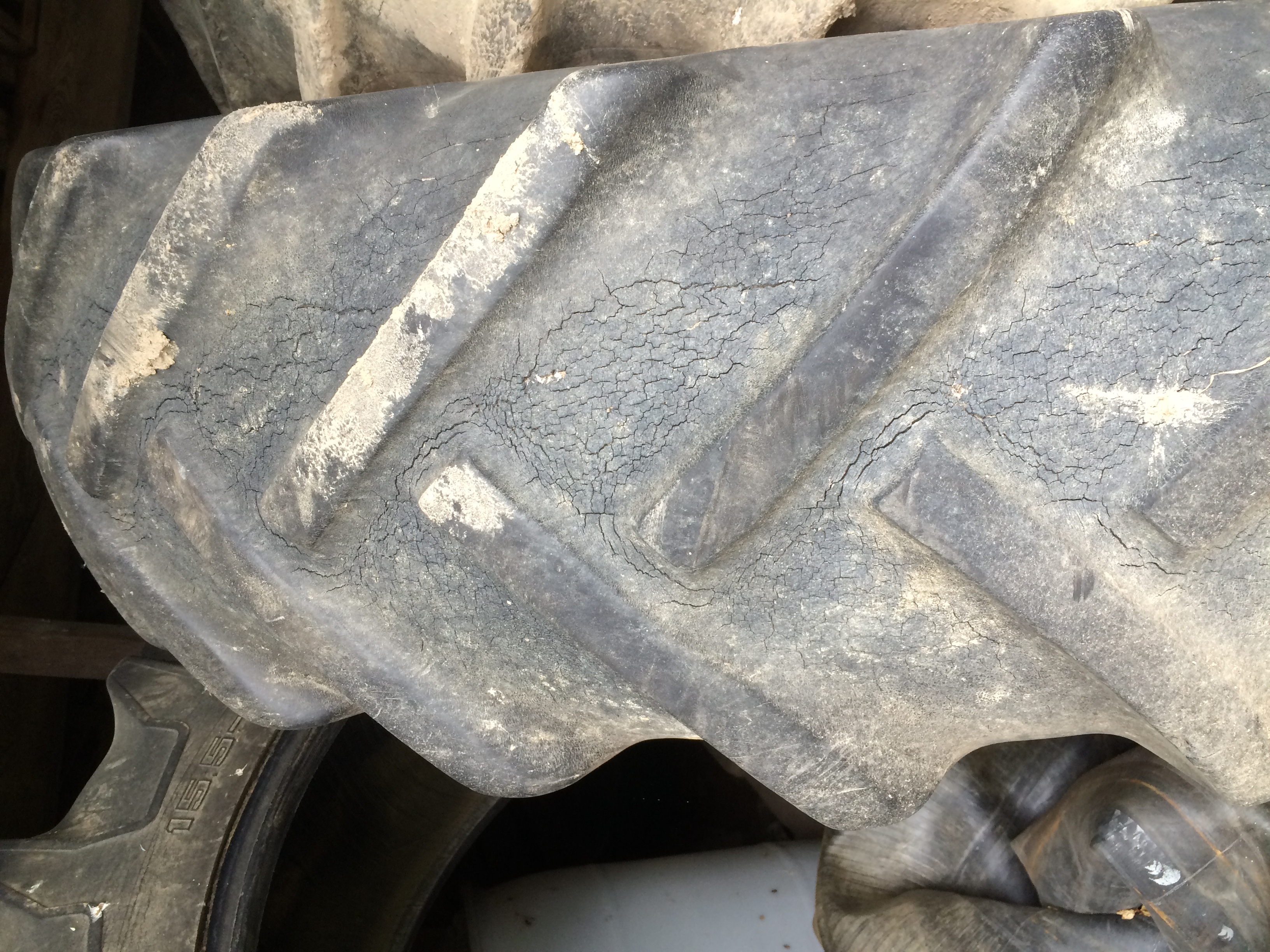
Examine tires or tracks for wear, mismatches, and remaining life. Look for signs of uneven wear on tire or track lugs. Lugs are large, raised, and often angled rubber that push against the ground to create traction. Uneven wear on lugs is a sign of heavy road use, which can cause additional wear on transmissions and other systems. Uneven wear can also indicate alignment issues. Look at tread depth, cracks, and sidewall damage to determine if replacement tires or tracks will be needed (Figure 4).
Inspect hydraulic controls, hoses, cylinders, and identify any visible leaks. Leaks, bulges, cracks, or loose fittings indicate that repairs to the hydraulic system may be necessary. Loose or worn hydraulic components can lead to inefficient or slow systems that restrict your intended uses. Hydraulic components can also be expensive to repair or replace.
|
Figure 4. Tire with worn lugs and cracks in between lugs. Photo credit: Jonathan LaPorte, Michigan State University Extension |
Evaluate power transfer parts and their condition. Power transfer refers to any mechanical part of a machine that receives power and transfers it to another. Examples include chains, sprockets, gearboxes, belts, pulleys, driveline or u-joint shafts, and augers. Lack of tension, cracks, uneven wear, and excessive looseness or “slop” reduces power transfer. Reduced power transfer limits operational use of equipment and can affect productivity. Many of the power transfer components also come with safety shields. Inspections should confirm that shields are in place and in good condition.
|
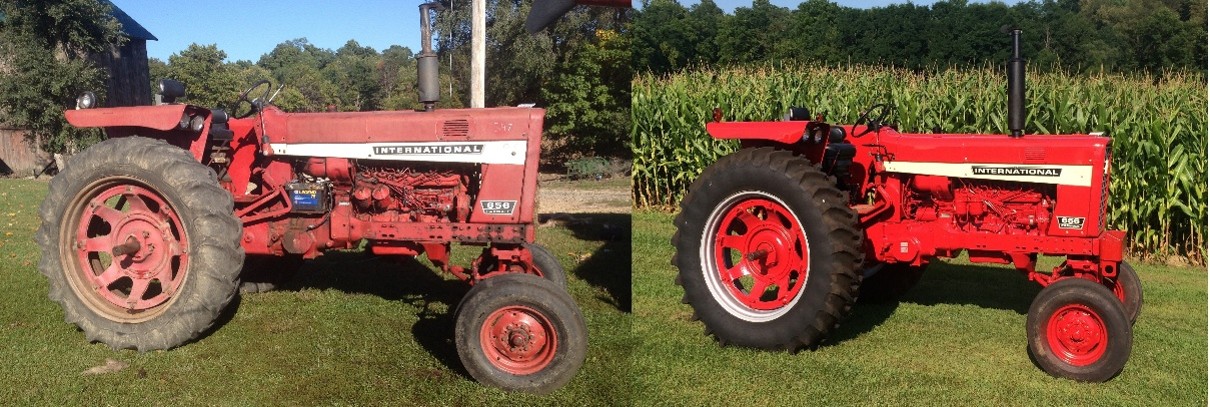
Figure 5. Before and after image of a tractor mechanically restored and painted. Photo credit: Jonathan LaPorte, Michigan State University Extension |
Inspect paint and panels for previous repair or outdoor exposure. Faded paint or panels indicate that equipment was exposed to excessive outdoor conditions. Heavy amounts of moisture, cold temperatures, and excessive heat can be damaging to various components of equipment. Repainted equipment can often indicate previous repairs were completed (Figure 5). It can also be used to mask necessary repairs a seller wishes to pass on. A thorough visual inspection can start to identify what story new paint is trying to tell.
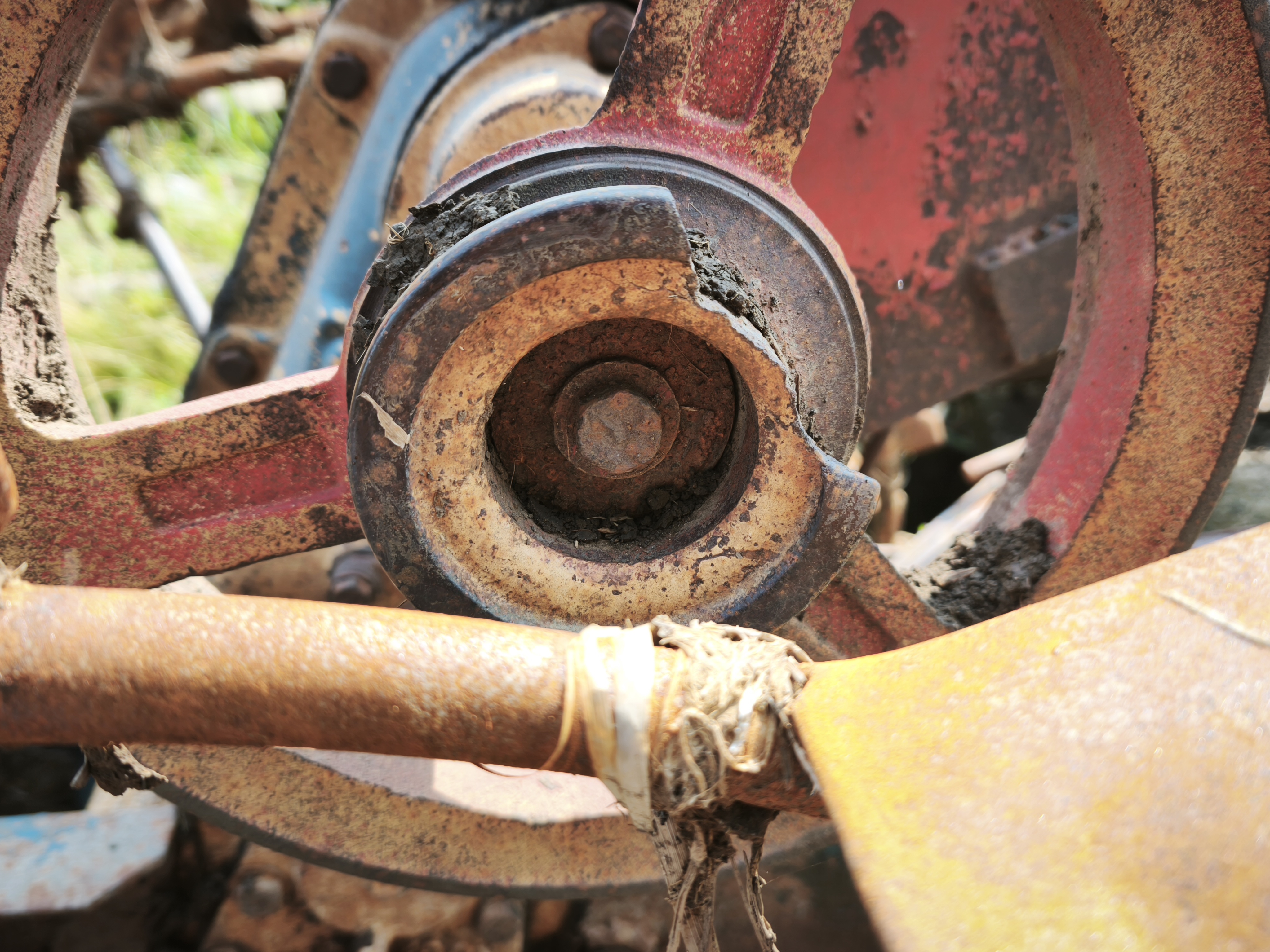
Examine implements and attachments for worn or broken components. Sometimes equipment is sold with implements or attachments as part of their listing. Inspect the mounting or hitch points to identify signs of hard use, such as bent arms, stretched pins, or excessive wear on surfaces (Figure 6). All other visual inspections noted in this publication should also be followed for implements and attachments.
|
Figure 6. Broken pulley on a farm implement. Photo Credit: https://www.istockphoto.com/photo/close-up-of-broken-and-rusty-metal-pulley-on-agricultural-machinery-detailed-texture-gm2271736784-684183050 |
Mechanical inspections
After a visual inspection, the next step is to see the equipment in operation and identify any mechanical issues. A mechanical inspection can provide either confirmation of visual concerns or help lessen them. Mechanical inspections can also help identify internal concerns based on sound or additional visual clues.
Mechanical inspections should include:
Examine lubricant systems for signs of routine maintenance. Lubrication is an important part of maintaining long-term use and condition of equipment. Inspect grease fittings to ensure components are properly receiving grease. Grease should be shiny, tacky, and clean. Check engine and transmission dipsticks to ensure oil reservoirs are at proper levels. Also check the color of oil. Creamy white droplets indicate water in engine oil and may indicate internal leaks. Dark colors, gritty texture, or low levels indicate a lack of routine maintenance. Hydraulic oil that is thick, sludge-like with a silver-grey color indicates poor maintenance.
Note: Some components of the lubrication system require the engine to be running to assess condition (checking engine oil). To protect individual safety, all other lubrication components should be examined prior to engine start-up. After starting the engine and checking remaining components, perform a follow-up visual inspection to assess the presence of any new leaks.
Inspect the engine, transmission, driveline, and cooling system. The inspection of these systems requires the engine to be running and an operator at the controls. Best practice is to have the seller perform the initial start-up of the equipment and demonstrate its operation. Demonstrations should include raising or lowering hydraulic hitches, turning the steering wheel, loaders, and shifting of transmission gears. Note: The machine’s transmission should be in neutral position with all parking brakes locked in place before proceeding.
During this time:
- Listen for audio clues such as unusual noises. If the engine starts hard, there may be electrical (battery), fuel, or compression concerns that need addressing. Sounds of grinding, knocking, or rattling in the engine, transmission, or power take-off (PTO) may indicate worn components. A ticking sound from the engine could indicate component (injector, filter, or spark plug) or fuel to air mixture concerns that need addressing. If the machine has a PTO, engage the system and inspect that it shifts smoothly.
- Look for any signs of leaks from lubricant or cooling systems. Leaks indicate worn gaskets, seals, or hoses that may be minor or major repair considerations. Some lubricant systems will develop minor leaks (slight seepage or oozing around components) and are too costly to repair on their own. However, leaks around gaskets or seals can also be a sign of internal concerns that need investigating.
- Check for visual clues of exhaust smoke. Exhaust smoke refers to smoke from the engine muffler above the engine that can indicate concerns based on color. Blue smoke indicates oil burning. White smoke is often caused by coolant or injector issues. Black smoke indicates fuel to air mixture is out of balance. If an engine is in good working condition, the exhaust should be nearly invisible.
- Check for visual clues of engine “blow by.” Engine “blow by” refers to combustion gases that leak between pistons and cylinder walls in the crankcase of an engine. An exhaust port on the engine allows some minimal gases to escape. Excessive gas leaks can affect gaskets and seals, leading to oil burning. Visible clues include smoke or vapor from oil filler cap or dipstick tubes, oil in air intake systems, and white smoke from engine exhaust port.
Note: For implements or harvest equipment, mechanical inspections may be limited if they aren’t connected to a tractor or harvester. For that reason, mechanical inspections tend to focus on drivetrains or their components, which include engines, transmissions, PTOs, and cooling systems on tractors or harvesters. Although drivetrains or components may be manually operated enough to identify worn components.
Electrical inspection
Electrical systems are a key feature of used farm equipment. Systems include batteries, alternators, operating lights, indicator gauges, on-board computers, and monitoring systems. These systems require a functional wiring system with appropriate connectors as well as suitable power.
Note: for some parts of an electrical inspection, you will need to be in the operator’s seat. The engine does not need to be running but may require the ignition key in the “on” position. Ensure transmission is in neutral position and parking brakes are engaged before moving into the operator seat.
|
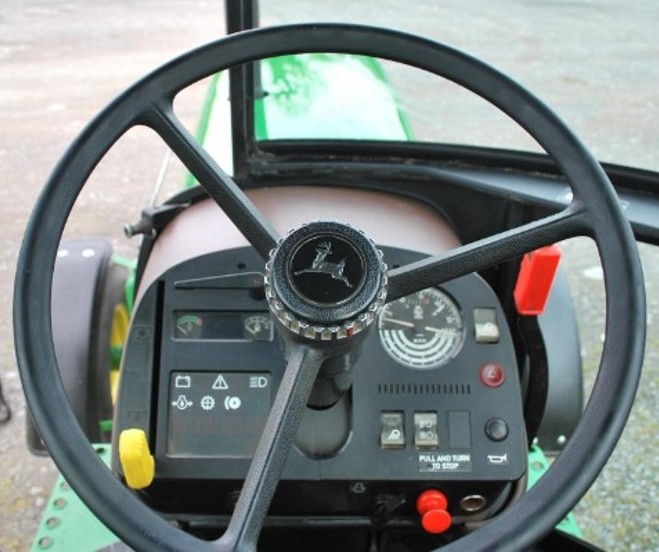
Figure 7. Indicator gauges as seen from operator’s chair on tractor. Photo credit: www.flickr.com/photos/peterm7/4022045713/ |
Check indicator gauges to confirm that they are operational. Most gauges are found from the operator seat of the tractor or harvester (Figure 7). The first gauge to inspect is the battery or electrical charging system gauge. The engine generates power through an alternator (or generator for older engines) that maintains battery levels while an engine is in operation. A working electrical system should read as “green” or positive charging on the gauge. Next, inspect any other gauges (fuel or air) to ensure they are working properly.
Inspect operating lights by turning the light switch to the “on” position. Some equipment will have separate switches or settings for hazard or turn signal lights. There may also be additional settings for “work lights” used for field conditions and lights for traveling on roadways. Test all switches to ensure lights are working properly.
Check any on-board computers for start-up or system function concerns. Ensure software starts up and runs as expected. If connected to an implement, verify any connections or monitoring systems are reading correctly. If a system check program is available, access the program and run to verify system is functional.
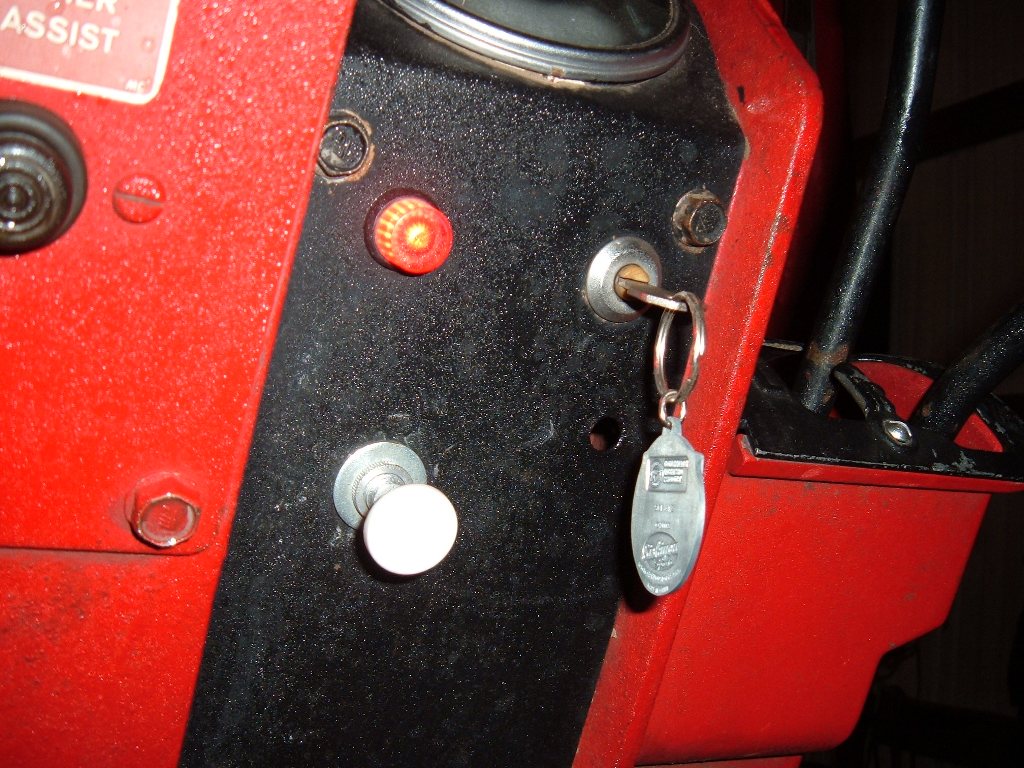
Examine any safety features that are tied into the electrical system. Depress clutch and brake pedals to verify any indicator lights for the transmission are functioning (Figure 8). If ignition key is in the “on” position, review other indicator lights that may be present, such as a check engine or oil pressure indicators that may be on. Engine or oil indicators should turn off once the engine is running.
|
Figure 8. Brake light (red) engaging when clutch pedal is depressed. Photo credit: Jonathan LaPorte, Michigan State University Extension. |
Control systems inspection
Inspecting the control systems involves starting and operating the machine. If equipped, fasten the seat belt securely prior to starting the engine. As the engine starts, take note of any unusual sounds or movement of the machine. These may not have been noticeable if the seller had started and operated the machine earlier. Review all electrical and system gauges immediately following start-up for indications of noticeable delays in start-up process. The start-up process can often be the first indication of mechanical or electrical concerns.
Evaluate the transmission by shifting into all gears. The clutch pedal should be depressed for each gear shift. With the clutch engaged, focus on how the transmission shifts from a stationary position. The transmission should shift smoothly into each gear without hesitation or grinding.
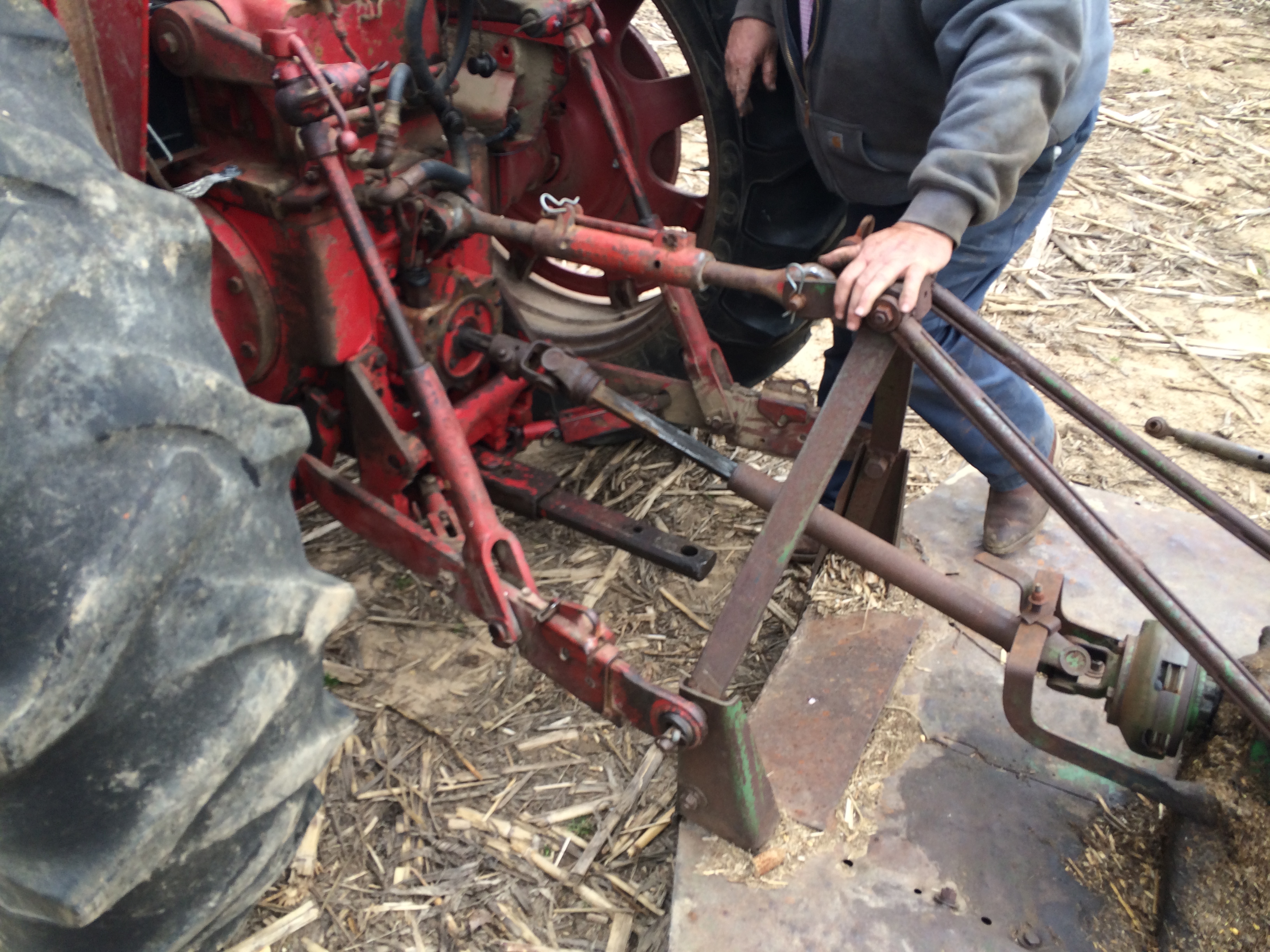
Operate all hydraulic, steering, and power take-off (PTO) controls. If equipped with a three-point hitch, raise and lower the hitch (Figure 9). The hitch should move smoothly without any jerking movements. Turn the steering wheel completely towards one direction (left or right) and then to the other direction. If steering feels loose or slow to respond, there may be problems with the linkage or power steering pump.
|
Figure 9. Hydraulic controlled three-point hitch connected to implement and power take-off (PTO) shaft. Photo credit: Jonathan LaPorte, Michigan State University Extension. |
Engage engine throttle to test responsiveness and audio clues. Some mechanical issues may not be apparent at low idle speeds. Slowly increase engine speed (open up throttle value) by moving the throttle control arm to full throttle position. Listen for any unusual changes in engine sounds or movement by the machine. Then slowly reverse throttle in the same motion until the engine is once again at an idle.
Final inspection…test drive
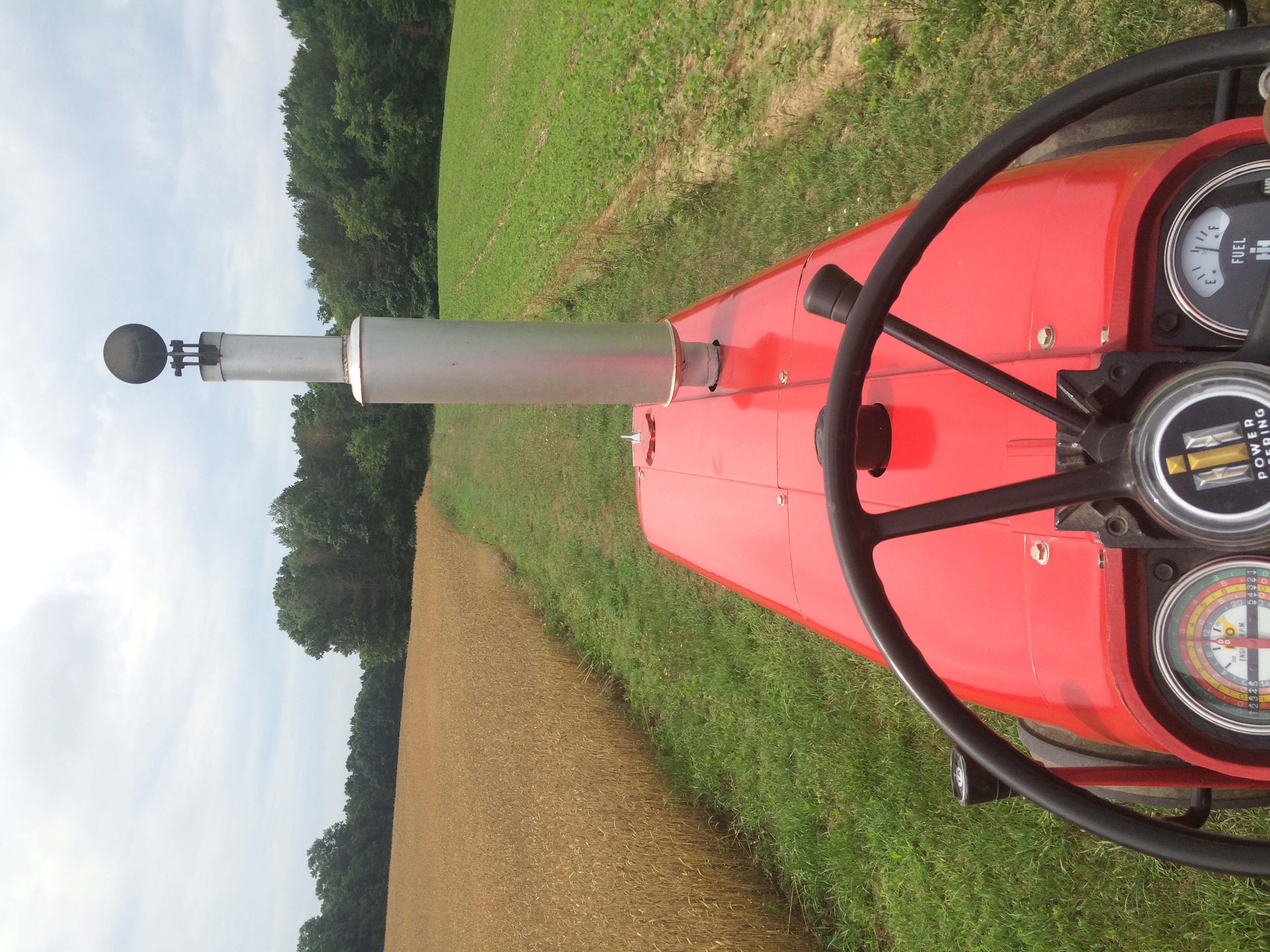
The final inspection should involve a test drive of the machine. The test drive provides you with an opportunity to reveal issues that were not observable while in a stationary position. Ideally, you would have an opportunity to test the machine in field conditions and on the road (Figure 10).
|
Figure 10. Test driving used farm equipment on a field lane. Photo credit: Jonathan LaPorte, Michigan State University Extension. |
Key things to pay attention to during a test drive include:
- Acceleration and deceleration of the machine in various gears
- Steering and braking performance
- Gear shifting, especially on roads or in field conditions
If purchasing from a dealer, there may be an opportunity to use the machine in actual field conditions for a limited time. Private sales often limit testing to driving tractors or harvesters on roads or around the seller’s property.
Farm implements are routinely not test driven, although opportunities to test hydraulic, electrical, and other systems may be made available by the seller. Inform the seller of your desire to test these systems prior to setting up an in-person inspection.
Additional helpful information
The seller should also be able to provide copies of any maintenance records, previous owner information, and history of use.
Maintenance and service records
Information on maintenance can be crucial to a buying decision, especially if there were indications of potential poor maintenance during any inspections. Records should be readily available on equipment for you to review if they are kept. Not all farms are diligent about keeping maintenance records. If records are available, that typically is a good sign that the machine was well maintained.
Maintenance and service records should include:
- Identification of make, model, and serial number
- A chronological log of all routine maintenance and major repairs
- Documentation of invoices or receipts
- Engine hours or acreage logs to indicate the maintenance schedule
Previous ownership and type of use
Sometimes information on previous owners can be found in maintenance and service records. In many cases, the information is offered through a discussion with the seller. Knowing where equipment came from and how it was used can be helpful information. If equipment was mistreated or used in extreme conditions, future repairs could be extensive; especially if service records don’t indicate any major repairs or records don’t exist at all.
For more information in inspecting used farm equipment, review Bulletin NRAES-025: Used Farm Equipment: Assessing Quality, Safety, and Economics. The bulletin can be obtained at: https://www.uvm.edu/aglabor/dashboard/sites/default/files/uploads/NRAES-025.pdf
Price Negotiations
Negotiating the price on used farm equipment involves identifying a base value, understanding market ranges, and how to adjust for wear or potential repairs. These pieces of information help to identify negotiation strategies to use and whether potential prices fit your purchase budget.
Establishing a standard market comparison
As you begin to research, you want to establish a standard comparison to help identify the base value of a particular make and model. The prices listed for specific makes and models of equipment will vary based on condition, age, special features or add-on attributes. Even included attachments will positively or negatively impact value. A base value removes the values assigned to any special features or attachments. What remains is the base value that can help establish price ranges for budgeting and negotiation strategies.
To establish a standard comparison, consider common identifiers about equipment. Common identifiers can include standard versus optional tire or engine sizes, standard versus optional drivetrains (rear wheel drive versus modified four-wheel drive), original software or technology offered by manufacturers, and equipment width or load capacity. Anything considered a special feature, or add-on attachment can either add or subtract from the base value. Note: How much value a special feature or attachment adds or subtracts from the base value will vary between sellers. Your view of the addition or subtraction of value may also differ from that of the seller.
Using auction history and regional comparisons
The standard comparison is immediately useful as you begin to research price listings and value ranges. Recent auction history and current market listings all provide valuable information to identify potential prices. It’s important to remember that price listings are a seller’s asking price for used equipment, whereas auction history details what buyers are willing to pay for used equipment. Sometimes these two values are similar, while other times they are far apart. Identify ranges for both sets of values help to gain an idea of possible discussion points in negotiations.
The prices seen between listings and history will also vary by region, based on availability and local market demand. As you consider distances that you’re willing to travel or discussion points for negotiations, the differences in price ranges by region should be kept in mind.
Adjusting price for known wear, repairs, or safety issues
Price adjustments are commonly associated with additional costs or investment needed after purchase. As you research historical sales, take note of the details on each sale listing. There is often a pattern of lower prices received for equipment in need of extensive repairs or maintenance. This pattern can help to establish a discount value or percentage for you to consider as you inspect a potential purchase.
Lower price patterns or discounts often do not reflect the true cost of repairs but a loss in value based on condition. As you consider purchasing equipment, it is recommended to identify the potential cost of any significant repairs. Knowing what potential costs may be is an important step in knowing your budget and when to walk away.
Knowing your budget, maximum price, and walk-away points
In order to identify your purchasing budget, you need to first know your farm’s cost of production. Buying farm equipment always involves additional costs beyond the final purchase price. Additional costs may be shipping or hauling, maintenance supplies (lubricants, filters, batteries), operational repairs (shovels, knives, bearings), and other miscellaneous costs. The additional costs are often paid for out of the farm’s operating funds. A key question is, does your cost of production offer enough cash to cover purchase needs?
In some cases, farms may plan to use working capital or cash-on-hand to assist with the purchase. Consider current market trends and operational costs as you decide how much to invest. If input costs have gone up and tighter profit margins exist, extra working capital may be needed to cover expenses and manage debt or family living costs. Tighter profit margins often limit how much extra cash is available to invest in equipment purchases.
Based on your available cash, auction history, and price listings, you can now establish a maximum purchase price. The maximum price is how much you are willing to spend on a purchase. It is limited by either your available cash or the highest price recently received for the make and model you are interested in. When you are considering a purchase, this provides the basis for negotiation and whether you accept or walk away.
Before going into a negotiation, it’s important to have established a set of walk-away points. There are non-negotiable points that will cause you to immediately turn down the opportunity to buy simply because they exist. Common examples include:
- Critical mechanical and structural red flags: Heavy engine smoke and knocking, difficulty shifting transmission, cracks or buckling frame, excessive rust at key structural integrity points, and excessive rearend housing or hydraulic leaks.
- Documentation and legal issues: Lack of documentation on oil changes or repairs, seller cannot produce a clear title or lien waiver as part of bill of sale, and hour meters are replaced or indications of wear do not match hours.
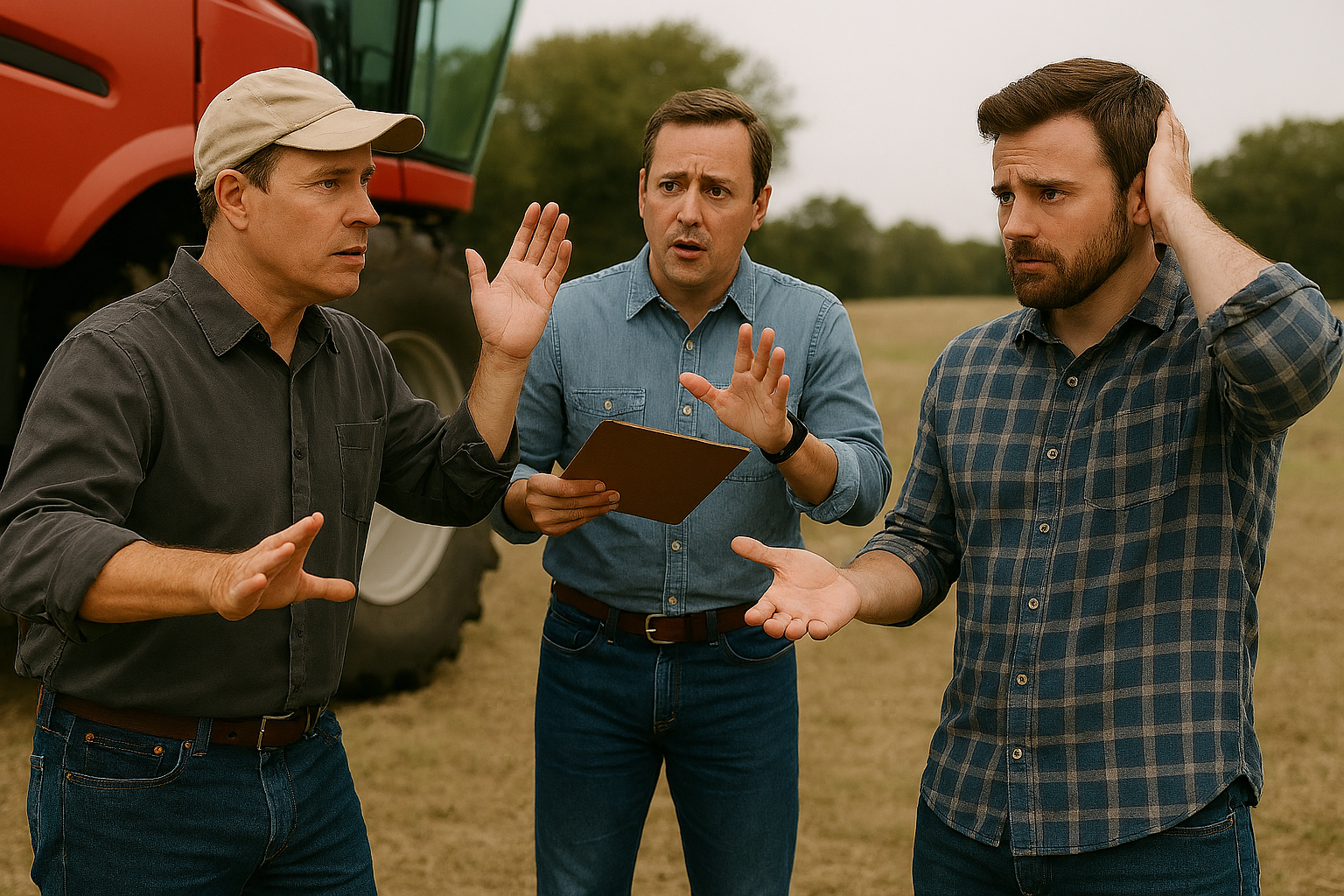
- Seller & transaction red flags: Seller will not allow you to operate or test the machine under load, limited time to perform an inspection, feeling rushed or pressured to make a decision, and inconsistencies in a seller’s story or inability to answer questions (Figure 11).
|
Figure 11. Image of tense negotiations between seller and buyers. Image generated by Microsoft Copilot (AI), 2026 |
Negotiation strategies for dealers vs. private sellers
Negotiation strategies are designed to identify a reasonable price that both parties can agree upon to complete the sale. Those strategies may be different depending on whether you’re working with dealers or private sellers.
Negotiation strategies for dealers, including:
- Leverage competition: You may find similar used equipment at competing dealerships. Compare prices and highlight lower prices found elsewhere for other options. Understand any key differences between models to discuss how they impact overall value.
- Establish a relationship: If you are searching for equipment, dealerships can aid in identifying suitable options. This builds rapport with the sales team about your farm goals, price ranges, and walk-away points.
- Inspect and counter: Inspect equipment to identify necessary repairs, then offer a counter price based on potential costs.
- Negotiate trade-ins separately: If you are trading in other equipment, negotiate a separate price to maximize value and prevent number masking. Number masking is where the trade-in value is hidden and may be reduced by discounts or other price adjustments. In some instances, the price of replacement equipment may be increased to offset the trade-in value. Establishing trade-in values separately and seeing how they are used in the final price calculation helps to ensure you don’t overpay for replacement equipment.
Negotiation strategies for private sellers, including:
- Build rapport: Discuss equipment history and intended uses to build trust. Private sellers are often other farms or retired farmers. Share your farm goals and how the equipment will help to meet hose. Farmers like to see other farms succeed, especially first-time buyers or new decision makers, which may lead to price flexibility.
- Verify condition: Ask specific questions about maintenance and use history to identify potential risks.
- Justify offer with facts: Make a price offer based on your research and not simply the lowest price you hope to spend (referred to as a “low-ball” price). Negotiations quickly fall apart if a seller feels you are trying to take advantage of them.
- Be patient: Private sellers may have emotional or sentimental attachments to certain equipment. If the price offered is reasonable, allowing them time to consider the offer can yield better results.
For both dealers and private sellers, identifying a reasonable price involves understanding not only your needs but the seller’s needs as well. Knowing the seller’s needs helps you to identify their price range and whether that range aligns with yours. It can also help you to understand their goals or motivations, especially if you may work with them again for future purchases. These may also be individuals in your community that you want to ensure regard you and your farm’s reputation favorably regardless of whether a purchase is made.
Documentation and Legal Considerations
Just as important as the inspection of equipment is to ensure all legal documentation is in order. Documentation should include evidence of clear title or ownership and a proper bill of sale.
Clear ownership and liens
When buying used equipment, it is important to ensure that you will receive clear ownership. Clear ownership refers to a clean title (if equipment has a title), that there are no financial obligations, or existing liens. Note: A lien is a legal claim on property, typically held by a lender or financial institution. Liens can list individual assets or be a blanket lien covering all types of assets. For farm equipment, the blanket lien is the most common form used.
Discuss with the seller the existence of any liens. You can also perform a Uniform Commercial Code (UCC ) search with the Secretary of State to identify if a lien exists. Documentation from the seller’s purchase of the equipment can also confirm if it was financed and if a lien exists. If a lien does exist, the seller will need to secure a lien waiver.
Bill of sale language
The final step in the purchase of equipment is when the seller provides a bill of sale. A bill of sale acknowledges the transfer of ownership from seller to buyer. The document should have several key pieces of information that detail the transaction:
- Buyer and Seller Info: Names and signatures of both parties. Ideally, full names and addresses would be used for legal identification.
- Detailed Equipment Description: Make, model, year, and serial number (or VIN if equipment is titled).
- Specific Identifiers: Engine or Operating Hours (mileage if odometer is available)
- Transaction Details: Date of transaction and final agreed-upon purchase price
- Condition of Sale: Information should explain equipment is sold “as-is” and that there are no implied warranties
- Ownership Warranty: Seller’s statement confirming they own the equipment, it is free of liens, and they have the right to sell
- Attachments/Accessories: Detailed list of any items included (front-end loaders, augers, or buckets)
Farm Auction Basics
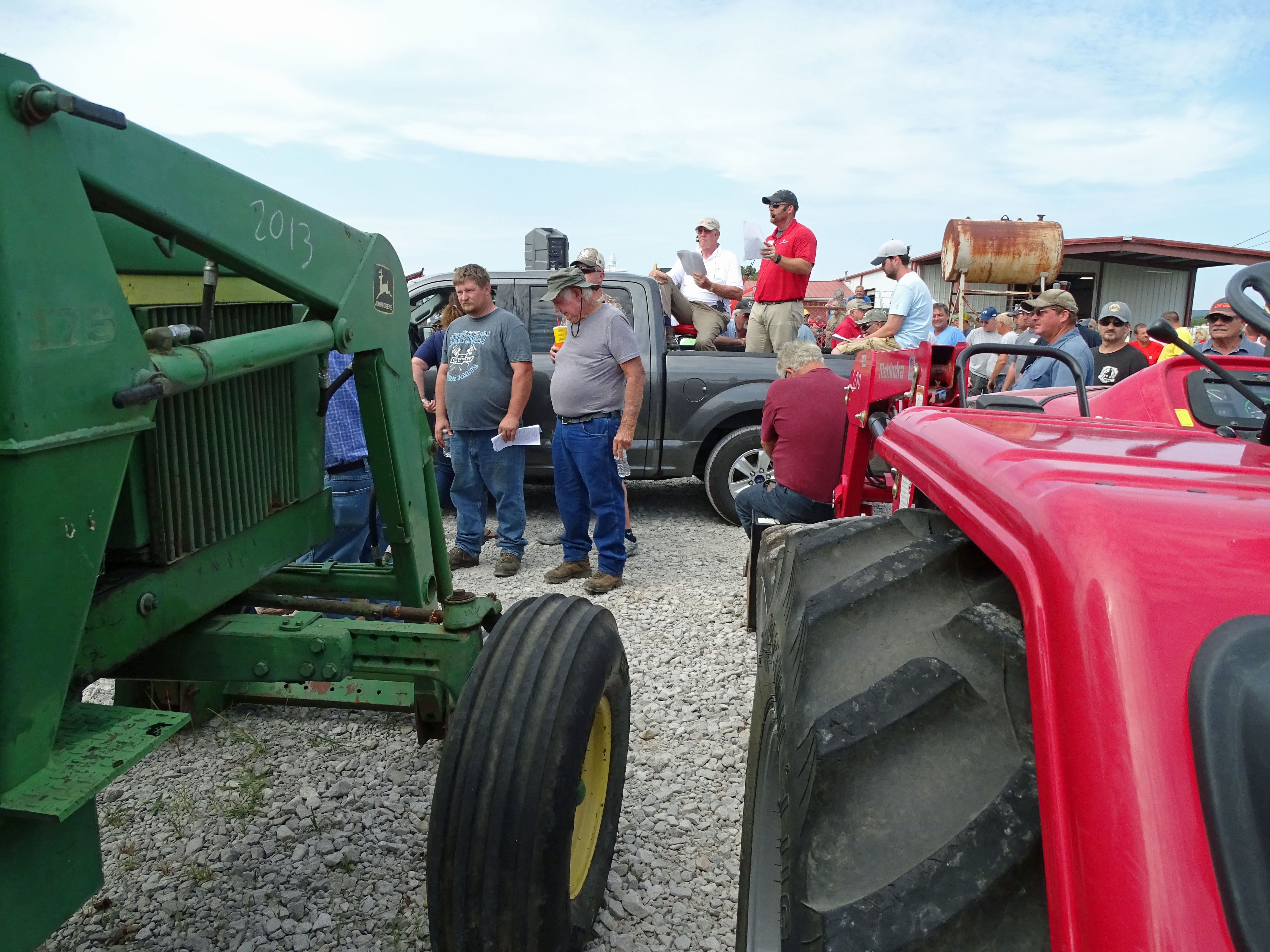
Farm auctions can provide greater opportunities to find used farm equipment. Especially if there are local companies that have routinely scheduled auctions or consignment sales. Knowing how to make a bid and the mistakes to avoid while bidding can help you to make well-informed decisions.
|
Figure 12. An auctioneer calls out bids at a farm auction. Photo credit: https://commons.wikimedia.org/wiki/File:DSC03242b_(37180888086).jpg |
Researching market prices and trends
The earlier sections of the publication highlight the importance of researching model reputation, knowing issues, parts availability, and price trends. Preparing to participate in an auction is where this information is put to use. Auctions typically provide a listing of the available equipment to encourage attendance. Some listings provide details on additional features or attachments as well as photographs to determine condition. For in-person auctions, you may also be able to visibly inspect equipment prior to the auction date. Having this information in hand prior to the auction helps you to determine how much you’re willing to spend.
Understanding auction terms
Farm auctions have their own terminology that needs to be understood prior to participating. Key terms include:
- Absentee bid is when a person can bid without being present or in-person. Online auctions often use this as a feature, but it may also be used by in-person auctions as well.
- As is, where is refers to the buyer accepting the auctioned item in its current condition. Items auctioned as is, where is often have no warranties or guarantees included and do not allow returns.
- Buyer’s premium is an additional fee paid to the auctioneer company by the winning bidder. The premium is typically set as a percentage of the winning bid with the most common range being 5% to 15%. For example, a winning bid of $25,000 with a 5% buyers fee would equal an additional $1,250 or total paid amount of $26,150.
- Hammer price refers to the final winning bid amount. It draws its reference from an auctioneer using a gavel to draw the crowd’s attention when announcing a lot has been sold.
- Lot refers to what is being sold. Lots can include a single item or group of items being sold together.
- Reserve price is the minimum or lowest sales price that a seller will accept. If no bids reach this value, then the item being auctioned does not sell.
Setting a budget to avoid overbidding
A budget should include the cost of the equipment purchase and any hidden costs, such as transportation, taxes, or repairs. It should also include any buyer’s premium that will be paid for having the winning bid. If pursuing multiple pieces of equipment, have a budget set for each item to avoid overspending.
Setting a budget helps to provide a limit and avoid overbidding. Farm auctions are high energy, competitive events that can lead to emotional or “heat of the moment” type reactions. Especially if other bidders are aggressive and bidding becomes intense. By setting a budget, you establish a maximum bid before the auction begins. If bidding reaches or exceeds your maximum bid, you’re better off letting it go knowing that you’d be overspending on the purchase. Sometimes the best bids are the ones that aren’t made.
Listen to auctioneer instructions
Auctioneers are a key factor in successfully participating in an auction. They provide information on lots being sold, reminders about payment options or buyer premiums, as well as announce any special rules, such as the existence of a reserve price. They call out bids, often in increments, and set the pace of the bidding. Often, they speak very quickly and try to set a bidding rhythm to keep the auction moving at a steady pace.
If you’ve never been to a farm auction before, it may be helpful to attend a few different auctions to observe and learn about the basics. Observing how different auctioneers handle the event will provide valuable knowledge when you later attend with a goal of buying equipment. It may also be helpful to bring along someone you know has auction experience when you’re ready to buy. They can help provide guidance to work through the basics and avoid overspending.
For more information, review the following article on common mistakes to avoid at farm auctions: https://www.underwoodlandcompany.com/blog/detail/7-common-mistakes-to-avoid-at-farm-auctions
Getting It Home
Transporting newly acquired equipment safely back to your farm is an important consideration in the buying process. Depending on the size of the equipment, and the distance you will need to travel to retrieve it, you will need to consider your transport method and any potential costs involved. Trailer selection, spotters, and the use of straps or chains to secure equipment are important considerations for transportation.
Trailers
Towing capacity or gross trailer weight (GTW) is an important consideration in trailer selection. The GTW is the actual weight of a loaded trailer when measured on a commercial scale and should never exceed a trailer’s Gross Vehicle Weight Rate (GVWR). The GVWR is the maximum allowable weight a trailer is rated to handle by the manufacturer and includes the trailer itself. Types of trailers are not universally rated for the same GTW or GVWR. Always check the rating for the trailer you intend to use. For more information on towing capacity considerations, review Kelley Blue Book’s Towing Capacity Guide: https://www.kbb.com/car-advice/towing-capacity-guide/.
Weight distribution on a trailer is also important to ensure equipment can be hauled safely and efficiently. A level trailer distributes the weight of the equipment so that it can be properly towed. If the tongue weight of the trailer is too heavy, the steering of the vehicle towing the trailer may be sluggish and difficult to control. If the tongue weight is too light, the trailer may sway back and forth (fishtail) at high speeds. A common rule of thumb is a 60/40 distribution where the heaviest 60% of equipment weight is in front of the trailer's axle towards the hitch. The remaining 40% of the equipment’s weight would be behind the trailer axle. Note: If using a trailer with two axles (sometimes called a dual axle trailer), adjust position on the front tire so that trailer remains level.
Hauling equipment back to your farm also involves selecting the right type of trailer. Trailer designs vary based on intended cargo size, height, and weight. See the section on the following page for a description of common trailers often used for hauling farm machinery.
|
Common Trailers Used for Hauling Farm Equipment
|
Spotters
Safety and visibility during the loading process are also important. Operators often have limited visibility of the trailer and potential hazards that may exist when loading, unloading, or backing up trailers. Getting help from a spotter can help to prevent accidents or improper loading or unloading of equipment. Spotters are people on the ground who guide operators using pre-determined hand signals. They help direct operators and alert them to any potential hazards or safety concerns. Hand signals can include pointing for turns or crossing arms for an emergency stop. You should have at least one spotter for small to medium size equipment. For large equipment or when backing up trailers for unloading, two or more spotters are recommended.
Straps and chains
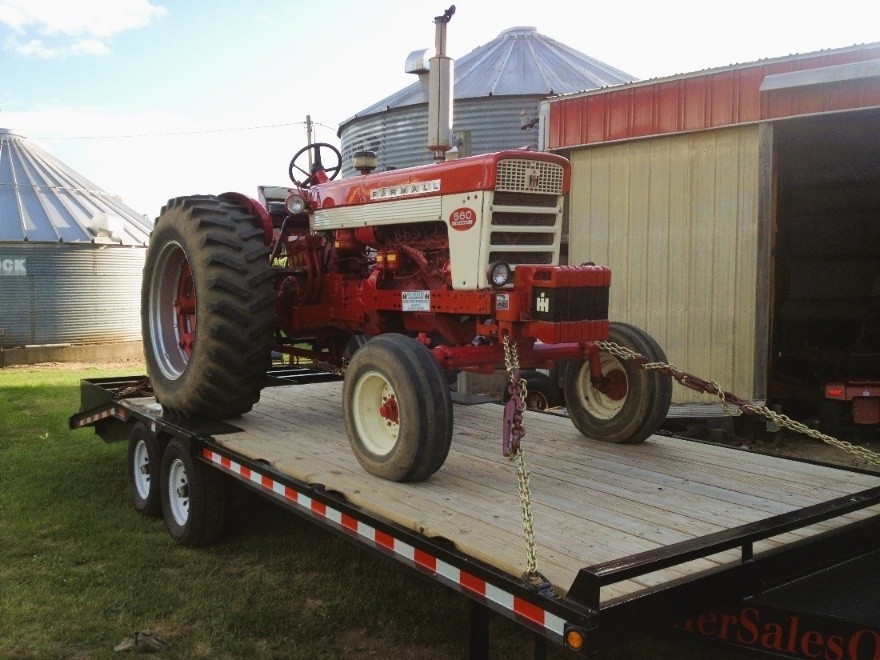
Sturdy straps and chains offer secure attachments. Ratchet straps are the most common form of strap used because of the ease of tightening with manual ratchets. When using ratchet straps, it is good practice to place the ratcheting side of the strap in clear view of the driver side rear-view mirror so that any issues with the attachment can be quickly spotted. Chains are often equipped with hooks to fasten to tie-down posts or slots on trailers. To tighten and secure a chain, a ratchet or lever binder is used (Figure 13).
|
Figure 13. Tractor in the process of being secured to a flatbed, deck-over trailer with chains and lever binders. Photo credit: Jonathan LaPorte, Michigan State University Extension. |
Each connection point on the trailer for a strap or chain is referred to as a tie-down. Tie-downs are points where equipment is physically secure to the trailer. When tying down equipment, ensure that requirements from the Federal Motor Carrier Safety Administration are followed:
- At least 4 tie-downs for any piece of equipment over 10,000 lbs.
- 1 tie-down every 10 feet of cargo.
- At least 2 tie-downs regardless of cargo size.
For more information, visit: https://www.fmcsa.dot.gov/regulations/cargo-securement/cargo-securement-rules.
In addition to straps or chains, it is recommended to lock any brakes and chock the wheels (use wedges to prevent wheels from moving). For more information on safely hauling farm equipment, review Purdue University’s “Gearing Up for Safety” lesson on Trailer and Towing Safety: https://www.asec.purdue.edu/tractor/s6.html
After the Purchase: Protecting the Investment
After purchasing the equipment, you want to ensure that it is maintained in good working condition. You also want to evaluate the investment over time and use that information for future buying decisions.
Operator manuals, training, and recordkeeping
After purchasing equipment, you will want to familiarize yourself with any specific information about the model. Information can include optional settings, maintenance recommendations, and any special features that may be available. An operator (and/or owner’s) manual are especially helpful for learning about newly acquired equipment. They may also have a recordkeeping worksheet in the manual itself for tracking maintenance and service. Operator manuals are provided by equipment dealers upon initial sale. If equipment has been bought and sold more than once, you may need to purchase a replacement manual.
Specific training may also be needed, especially for software or technology with which you are not familiar. In many cases, third party or manufacturer training courses may be available to help provide sufficient training.
Establishing a maintenance baseline immediately after purchase
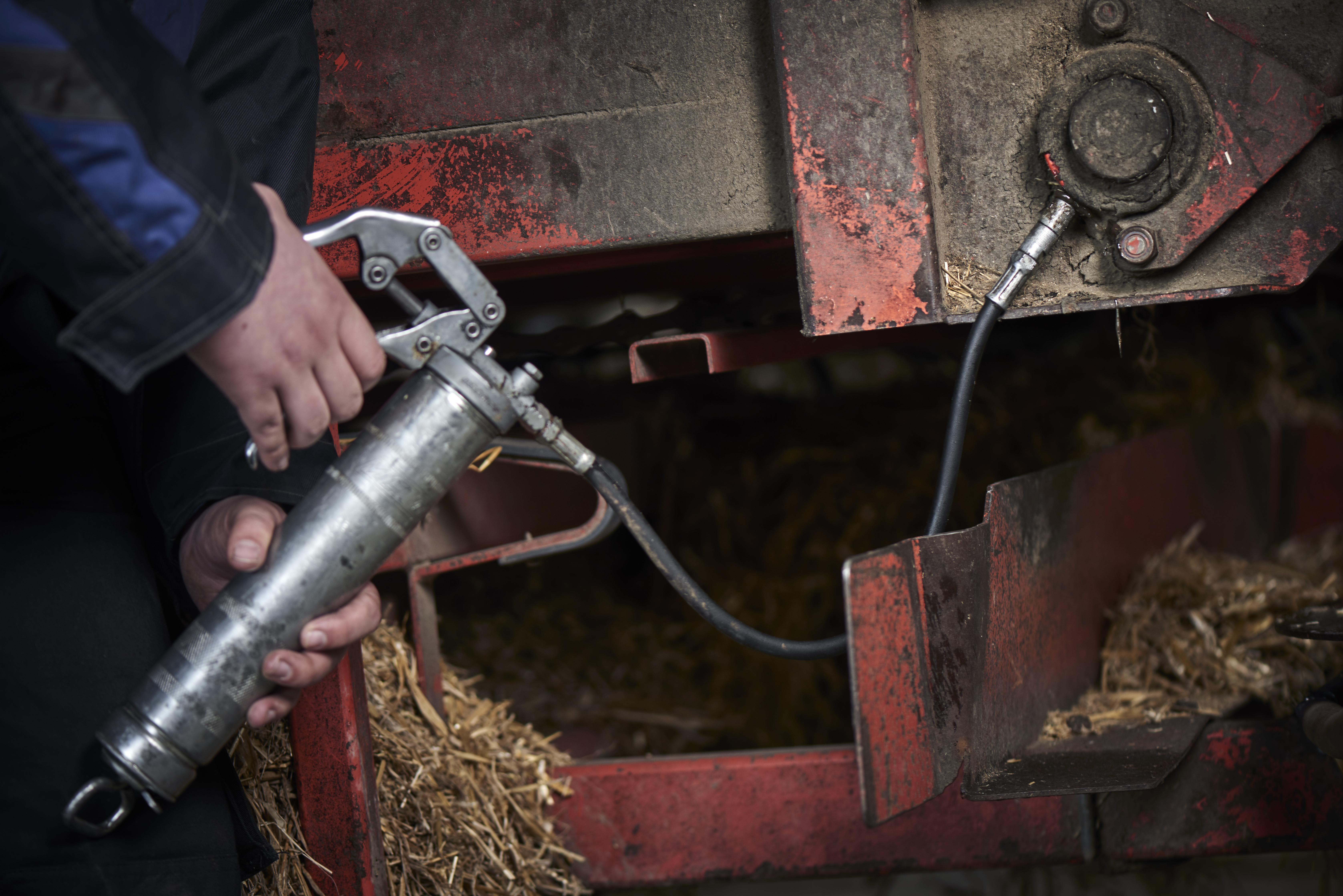
A common practice for newly purchased equipment is to immediately service it upon arrival at the farm. Service should include greasing, replacing worn components (blades, knives, shovels), changing lubricants and filters, and possible preventative maintenance like replacing batteries (Figure 14). This practice establishes a baseline to track when the next routine maintenance should be scheduled.
|
Figure 14. Farmer greasing farm equipment. Photo credit: https://www.istockphoto.com/photo/a-young-farmer-repairing-farmer-equipment-gm1133754603-301019217 |
Tracking repairs and costs for future decisions
Evaluating investments like equipment purchases takes time and detailed information. Maintain a log of routine maintenance costs and any major repairs, frequency of breakdowns, and downtime for parts or service. As you look to making future purchases, assessing costs helps to refine your buying decisions. If an opportunity arises to purchase another model similar to what you own, this information can help to decide if it is a worthwhile investment. If costs or frequency of repairs have been excessive, you may decide the purchase was not worthwhile and need a replacement.




.jpg)