Growing Grass and Alfalfa Hay Between Solar Arrays
 Print
Print Email
EmailFebruary 23, 2026
More Info
Two 2023 reports by Ohio State University Extension researchers found raising grass hay and alfalfa between rows of solar panels was feasible and that the harvest’s nutritive value was good. But that small-scale work at the Pigtail Farms site in Van Wert County used data from only a few test plots and controls. The Madison Fields agrivoltaics project was designed to test whether similar results can be achieved on a large scale. Now in its second year, the Madison Fields agrivoltaics project is yielding new insights into growing grass hay and alfalfa between solar arrays. This presentation will help Michigan farmers learn how grass hay and alfalfa can be grown successfully between solar arrays. Grass hay and alfalfa yield and nutrient content data will also be shared.
Eric Romich is an Ohio State University Extension Field Specialist for Energy Development. His background in renewable energy began during his former assignment as an OSU Extension Educator in Wyandot County. In this position he served as the Director of Wyandot County Office of Economic Development and was deeply involved in the details of finalizing the PSEG Wyandot Solar Project. The PSEG Wyandot Solar Project is a 12 MW 85-acre solar generation facility that is the largest solar facility in Ohio and one of the largest in the Midwest. Romich focuses his Extension efforts in the areas of renewable energy development, energy policy, wind energy, solar energy, and bioenergy resources. He works with elected officials, community planners, community residents, OSU faculty and Extension Educators, and state and federal government agencies to deliver educational programs.
Brady Campbell is an Assistant Professor in the Department of Animal Sciences at The Ohio State University College of Food, Agricultural, and Environmental Sciences Wooster Campus where he serves as the State Small Ruminant Extension Specialist. Brady has a unique appointment structure of 80% Extension and 20% Research. Brady is deeply rooted in agriculture, specifically livestock production. He and his wife add to the 4th generation of sheep and swine producers in Brady’s family who are located in southeastern Ohio. Within his Extension and research programs, Brady has two main focal areas; the first of which revolves around energy generation systems, specifically vegetation management within utility-scale solar sites. The second area focuses on the needs for increased efficiency of small ruminant production systems through outreach and research.
The 2026 MI Ag Ideas to Grow With conference was held virtually, February 23 - March 5, 2026. The program encompassed many aspects of the agricultural industry and offered a full array of educational sessions for farmers and homeowners interested in food production and other agricultural endeavors. More information can be found at: https://www.canr.msu.edu/miagideas/.
Video Transcript
My name is Charles
Gould, and I am a bioenergy educator
in the Agriculture and Agribusiness
Institute with Michigan State
University Extension. It is my pleasure to welcome you to
this session, Growing Grass Hay and Alfalfa Hay
Between the Rays. This session is
the first of four agribataic
sessions this week. Today, we'll
be hearing from Eric Romek and
Brady Campbell. Eric is an Extension
Field Specialist for Energy Education,
and Brady is an Assistant Professor
and State Small Ruminant Extension
Specialist. Both are with the Ohio State
University Extension. They will share
data and lessons learned from their
work in growing grass hay and
alfalfa hay in an Ohio utility-scale
solar project. Before we get
started, we'd like to take a moment
and thank our sponsors who are
shown on the screen. Due to their generous
support, we can offer this event at no
charge to participants. Now, let's jump into
today's presentation. All right, so
let's begin. Eric, the floor is yours. Thank you. Appreciate the introduction, Charles. Yeah, so Brady and
I are excited to be with you today and
share a little bit about some of the
research that we've been working on
at OSU related to utility scale solar
energy development. You know, this
is a topic that, you know, as many
of you are aware, is relevant in many
states across the Midwest. And so hopefully
there's something related to this
research that you can take and apply it
to your communities back home here in
Michigan or wherever it is that you may
be joining us from. So as Charles
mentioned, my name is Eric Romick
with OSU Extension. I've been working with energy education for, oh, nearly 18 years now.
And so, Brady and I are going to talk a
little bit about a project that we've been
working on since 2023. And Brady and I are
co-investigators on this project,
which is funding through the U.S.
Department of Energy. So, we do want to
recognize the FARMS program, which
is Foundational Agrivoltaics Research
at Megawatt Scale. In addition to DOE,
we really want to extend a thank you to
our project partners. This research would
not be possible without the support of Savion
Energy and Kubota. So Savion has partnered
with us in this research project in one of the
most critical ways. I, prior to this,
had been working with numerous developers to
try and do research in a similar fashion, but
it's been very difficult to strike that
agreement where we can get site access to do
this type of research. So we're very excited
to have a relationship with Savion and access
to a utility-scale photovoltaic solar site
that we can do some of this research in
real-life conditions. Just a quick overview of what we're going
to touch on. We're going to kind
of give a summary of the DOE research
project, so what it is that we're looking
to accomplish. We'll start out with
some pictures from field operations and
some of the equipment. We get a lot of questions
on that, so we'll just kind of open
with that and talk you through what some of
the research looks like. And then we'll jump
into a little bit of detail related to the
experimental design and a summary of our
forage field data. as well as an
overview of the design and summary of
some data related to our soil
compaction analysis. And then we'll
just wrap up with some closing
thoughts and then questions and
discussion. So as Charles mentioned, if you
do have questions, please hold those to
the end just based on the number of registrants
that we have. We want to make sure we
get through all the material. We do have
slide numbers on all of the slides. So if If
your question is specific to a slide that you'd
like us to pull up to reference at the
end, just jot down that slide number. And then
when we're talking at the end, we can pull
that slide back up. So, a real
quick slide that kind of addresses
the why. Why is this a topic that we were interested in? As I'm sure very
similar to many of you across the U.S., there's
a lot of development related to utility
-scale PV solar in Ohio. since 2015, we've had
over 95,000 acres of farmland that's in the
power siding boards, hopper, either operational
under construction or pre-construction
status. So a lot of development that's already
happened. And then, you know, looking
ahead, you know, there's upwards of 314,000
additional acres that have entered the PJM
interconnection queue for transmission
interconnection approval. Now, I do want to note
that based on historical trends, it's not likely
that all of those projects that have
entered that PJMQ will see it all the way
through to development. But there is significant
development pressure on agricultural
grounds, I guess is the point. So agrivoltaics
is a topic that many are looking at
to mitigate this land use pressure. And so
when we think about agrivoltaics, we're
talking about bringing together agricultural
production with utility-scale solar
energy production. But with that, there's
still some challenges. And so I just kind
of want to point out what we're talking
about with some of the challenges. As we think
about the agrivoltaics projects that we're
seeing across the country, there's, last
I checked, 637 that are registered on the DOE
agrivoltaics database nationwide. wide.
So 637 agrivoltaics projects registered with
the DOE database. But most of those are
small scale. And 95% of them are using pollinator
habitats and or grazing as their primary
agricultural side of that agrivoltaics.
And not that that's a bad thing, but we're
really interested in trying to find solutions
that are similar to the type of development
pressures that we're seeing here in Ohio.
And so, you know, when we filtered that
further, you know, to look at projects that
are large scale, so projects that are over
100 megawatt in size, and that were actually
using row crops as their agrivoltaic crop
production, there are only three projects of
the 637 that meet that criteria. And even
then, it's a little bit misleading to
suggest that those three were using agrivoltaics
in the entire site. So one of those three
was our project at our research project at
Madison Fields with Savion, which, you know,
we're very well aware of how much of that
overall site is used for agrivoltaics. And
it's not the entire site, as you'll see as
we move forward here. One of the other
sites was a 1300 acre site, and they listed
40 acres of that 1300 that was being
cultivated for crop production. And then
the third site, we just couldn't get
much information on. So that really drove
our team to look at solutions that met
two sets of criteria. Number one, is
it scalable? And number two, is
it economical? So as we were looking at
all the different agrivoltaic solutions
that are out there, and again, there's a
number of, you know, research projects and
different approaches that you can take
to agrivoltaics. And we're not suggesting
that, you know, one is right and the
other is wrong. But we were looking for solutions
that could meet the utility scale type of
development that we were seeing in Ohio.
And so that's why, you know, as you'll see,
we really focused on forage production
initially. We do think that there's opportunities
to expand that into other row crops in the
future, but that was kind of our starting
point. And so again, when you talk about,
you know, how much agrivoltaics is being
done, you know, this is an picture of the Madison
Field site, and I've kind of loosely outlined
where our research footprint is up
there in that red box. And so,
as you can see, you know, this is a
large-scale research project. I would
say, you know, you're probably not going to
find many agrivoltaics projects that are
doing more row crop production than this,
but it does give you a sense that this isn't
something that's been widely applied to
the entire site yet. However, we do
have some data that suggests we
can get there. Real quick overview on
our overall research project, we kind of
have four buckets of focus that we look
at, and those would include forage
production, so looking at replication of our forage
crops, complementary grazing. So one of
the things that we're interested in is the
idea of mechanically harvesting these
forages and then coming in to kind of do a
target graze after the harvest so that we
can help to minimize the stocking rates.
Brady can talk a little bit to, you know, the
amount of land that is interested in
grazing solar here in Ohio and the stocking
rates that go with that. So we feel like
a complementary grazing strategy is a good
fit to address that. Precision agriculture.
So we have a group in ag engineering
it's really looking at equipment solutions
to these cropping systems and then
finally soil health so looking at you know
what is the the impact to to the top soil
as it you know as we see these sites coming
out of construction and so today we're
going to share a little bit of data related
to these these two focus areas forage
crop and soil health and brady feel free to
jump in at any point in time um if i'm
overlooking something absolutely i can go
ahead and take over from here uh i guess
first and foremost uh appreciate the
organizers for inviting
us to today's chat and appreciate
the opportunity as charles mentioned
earlier my name is brady campbell i'm an assistant
professor in the department of animal
sciences where i serve as the state small ruminant
extension specialist um and perhaps the
title that I wear a bit more proudly is that I'm
also a fourth generation shepherd myself and
so as you can see you might be wondering
why is an animal scientist involved in some of
this and it really comes back to this this
forage crop or this nutrient that we are
creating and providing to our industry in
terms of offering a high quality feed stuff
and feed source to our ruminant livestock species
and of course as Eric mentioned earlier
thinking about those those grazing strategies
as well. But on the screen here, Eric's done
a nice job of outlining kind of that research
zone. So if you reference back to that
slide a couple pieces ago from that aerial image,
you can see Eric's running his cursor
around it. That's kind of that box that he was
outlining in that red. Just very, very quickly,
it's a randomized, complete block design.
We did have three forage species, the
alfalfa being our legume, our cool season hay
mix. That's going to mainly consists of
red clover and orchard grass there was a few
other species in there but when you look at
it from a composition standpoint those are
the two target forages and greatest proportion
of forages in that mix and then we did
try out a warm season annual teff grass
due to some of those environmental and climatic
conditions just as unfortunately wasn't
able to get that to establish so today's
discussion will just focus on the top two
we did take a look at different seeding
rates as well. We were interested in whether
these crops were in need of a greater seeding
rate or a lesser seeding rate due to the
location of them within these solar sites and
underneath and within these arrays. The
seeding rates that we chose was 75%, 100%,
125% of that standard recommended seeding
rate for each of those species respectively. We
did have control plots and it's outside of
this image here. It's more towards the
south of the screen if you would down where
Eric's cursor is at, those were plots that
were outside of the array. So they acted as
a control, if you would. And those plants were,
or excuse me, those plots were seeded at
100% seeding rate. So just some quick
pictures here from our initial data collections
to the far right. You can see us
measuring some of our forages out, or excuse
me, the far left, some of a forage is
standing out in the field. That's an alfalfa
plot. That's what we call a rising plate
meter. We do take clippings, as you
can see Eric in that slide next door there,
where we take a square of a known area.
We'll clip it to a harvestable level, if
you would, so a grazing level or a harvesting
level, if you're using some type of
mechanical machinery. And then we'll dry
that down in an oven and be able to
calculate our amount of yield of dry matter
per unit of area. Above that picture
where Eric's clipping that forage, you
will also see that we've got some
weather data sensors. We'll talk about that
here in just a bit. And then the three that
are off to the right -hand side of the
slide is us actually collecting data off of
those forages. And as you can see here, for
the purposes of our project itself, we
were collecting these forages and baling them
into small squares. Actually tripping that
baler every time we got to the end of that
row. So you'll see some big bales, some
short bales. But that gives you an idea
that we're able to capture all of the
forage harvested within that windrow from that
specific alleyway. And one of the things
to point out, so in year one, and we'll
discuss this as we get into some of
the data, we didn't necessarily harvest. And
so that's where we were using the rising plate
meter to estimate some of that forage
biomass and in addition to the clip
samples. And so any time that we took a sample,
we did take clipped samples. In year one,
we used the rising plate meter to go
with that data. In year two, we used the
actual bale weights. Yeah, so the rest of
the pictures here are just going to take a
look at some of our field operations and
equipment that we use. So, of course,
before we get into the meat and potatoes
of it, if you would, we've got to get these
sites prepared. We've got to get our forages
established. And so just an array of
different pictures here on the top end,
you can see where we are planting using
some smaller equipment. You can also see
that we did have to have some type of
herbicide control. We were able to do that
in some of our plots if they were roundup
ready. For example, our alfalfa was,
however, our cool season forages were not. So
in those areas down below, you can see we
were having to do some vegetation management
ourselves to control some of those weeds,
because that is a big challenge as we see
interseeding some of our forage crops. You
can see some of the weed pressure in that
photo specifically. And then as Eric
kind of talked about earlier, investigating
some alternatives, you can see that
we can get a variety of different
pieces of equipment up and down
through those rows. In terms of calibration
and testing this equipment, again,
different pieces, different parts to the far
left of the screen there. You can see
we've got our lineup of equipment there in the
forefront is going to be our tedder for our
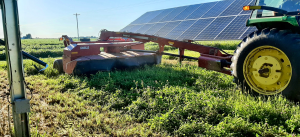
haymaking process. Our first cut was a
little bit on the heavy side. We did use a
tedder, but we found out that if we ran
that too quickly and too high of an RPM,
we were spreading that forage out too
far and ******* it into some of what we call
the ****. So that material, as you can
see in that middle picture, that's up
underneath those arrays near the pilings. And
so trying to keep it out of that, we've
chose not to TED any longer. It also
helped us with leaf retention as it related
to forage production. You can also see us
using some of that equipment, testing
it throughout those alleyways, understanding
end-of-row turn radius and how it would
function throughout. We also are using
GPS technology, as you can see in that
bottom right-hand picture, on some
of our equipment to better understand
field operations and field and
operation efficiency. this is exciting part
right we've been working on this for two three
four years and eric and some of his
colleagues far longer than that but this is really
where the rubber hits the road and we get
to talk about uh that that hay harvest which
really occurred during year two as eric noted
we didn't collect or we didn't harvest
any hay that first establishment year just
due to the severe drought that we had and we've
got some cool imagery and some information
that shows you where the the spigot finally
turned back on we got some moisture and we
got some growth but as you can see uh for me
uh this is some standard equipment right for
folks that are used to running larger pieces
of equipment under over larger tracts of
land these might seem a little bit small but
in terms of the haymaking process pretty standard
of what you would find here in the state
of ohio especially southeastern ohio where
i originate from top left hand corner you
can see that we are using some offset mowers
where we're going to go up and down through
those alleyways themselves understanding
efficiency we want to make sure that we're
getting the biggest bang for our buck so every
time we go down we're going to turn around
and come back and try to have two big full
swaths because we want to ensure that we are
efficient not only with our time our cut rate
but also the amount of fuel that we're
utilizing again the picture in the middle top
middle if you would is us tetting after that
mowing process the bottom left is us raking
we're using a rotary rake to get that wind
road up into the middle of that alleyway and
then there in the bottom middle as the cursor
moves forward you can see us running that
baler up and down through those alleyways we
were using an inline baler that allowed us
to run over top of that row rather than an
offset and then on the far right is simply
some of those forages that are being kicked
out the back end there. I was a part of this
process here. A lot of our colleagues had
some other obligations and that was quite
all right, but we just want to show you some
of the feasibility of doing this. This
was the really exciting part, again, for me, you
know, that the mowing and the raking, that
was fine and dandy, but being able to see
us produce a product that's viable in the
marketplace and is of good quality, which
we'll show here in a bit, that can be fed back
into our industry. This is what was really
exciting to me. So you can see us here after
we're done baling each row. We've got folks
that are riding around on some of these utility
vehicles, these side -by-sides, UTVs, if
you would. They'll collect all those forage
bales in that row and they'll drop them off
at the end of the row to allow us to know
what seeding rate it is and what forage species
that it's coming from and then the rest of
this imagery is collected from that very first
cut that we did in that site we were still
learning didn't know you know how this
would work and so forth it was a long day folks
as you can see here some of the challenges
were that we were there for quite some time
and so I think Eric brings up a good point
we need to understand what our limitations
are and what our access is to some of
these sites because farming doesn't work
from a nine to five schedule if you would
yeah that's a good point brady so i mean
in terms of that being a long day um you
know what time was it that uh that we
finally wrapped up and yeah 1 30 yeah 1 30
in the morning so um you know that's just
something to make sure that you know as
we're thinking about agrivoltaic projects
and and kind of having some of these agreements
that there's you know discussions that
all the stakeholders involved are aware um
you know what you know what type of of of
timeline and site access goes along with doing
this type of work so we'll move into
to looking at some of our our forage field
data and before we do we just kind kind
of want to use a couple slides to set
the stage and help you understand what's
going into some of the data that you're
going to see here. And so this first
slide's a little bit busy, but, you know,
we're looking at a couple of different
things here. So in purple on the bar chart
there, you're going to see the annual
precipitation in inches. We also have the
line up top that's demonstrating the
maximum temperature. And then we have the
KBDI drought index in the blue area
chart there. And so it was kind of, 2024
is kind of a goofy season in central
Ohio. I mean, we battled heavy
downpours in the spring and borderline
flood conditions. And then, as you can
see, kind of limited precipitation that really
had us in September and some drought
conditions. And so, to give you a little bit
of background on the KBDI drought index,
in case you're not familiar, it's a
formulation that's designed to reflect soil
moisture recharge and depletion, so not
just surface wetness. And as you can see in
the chart here on the right, it kind of
ranges from zero to 800. And one of the ways
to think of this is, So a value of
100 units correlates to one inch of soil
moisture deficit. So as an example, you
can see, you know, we're up nearly 600
here in September. So that would correspond
to approximately six inches of soil
moisture deficit. And, you know, that
400 to 600 range, they kind of classify as
severe drought conditions. And so, as Brady
mentioned, and I think I alluded to earlier,
we didn't necessarily harvest in that
establishment year 2024. Instead, we were really
managing weed pressure and just doing kind
of strategic Mons throughout the season.
We did get some good rain in late September
that really kind of gave the forage plots
a shot in the arm, and they really took
off in the late fall. So another thing to
kind of keep in mind when we're looking
at the yields, you know, sometimes you
might recognize that the yield data would
maybe seem slightly lower to, you know,
some Ohio averages and, you know, wouldn't
necessarily say that's because of a
poor establishment. Where we had
establishment, we had very good
establishment. But what you'll find
is there were areas where we just had
no establishment. And a lot of that
was due to moisture. So this on the right
is an aerial image, the greenness index,
where, you know, the yellow, green, dark
blue, purples are a very good establishment,
very good vegetation. And, of course,
the red and white is where there's no
establishment, no vegetation. And so you
can see where we would have, you know, some
alleys where there's really good establishment,
and then there would be a section
where there's none. know, a lot of that
is driven by moisture. And so we had some
images over here on the left just kind of show
what that looks like where, you know, a
lot of times on the entry way. So where
my cursor is here, you know, the access road
would be just to the south of, I guess, the
bottom of my cursor here. So as you're
entering that alleyway, a lot of times those areas
tended to be a little bit wet or hold a
little more moisture. And so, you know,
that was what it would look like in the
spring when we had a lot of that
precipitation. And then, of course, during
the season, it would, you know, you could
just see where there's no establishment
as a result. And so one of the
things to kind of keep in mind as
we share some of the yield data
moving forward here. So we're first going
to look at alfalfa. And here's a just
kind of a quick snapshot of a couple
of our alfalfa arrays comparing
year one to year two. You can see, you know,
a little bit spotty there in year one during
that establishment. But then, as
mentioned, we got some really good rain towards
the end of September, and our year two,
it really took off. So, we're going
to walk through the yield data,
the next two slides here, first looking
at year one, and then we'll
look at year two. And so, just to
give you a little bit of background,
or I guess help you digest this
slide a little bit, in red is going to
represent our control. And so, as we outlined
earlier, that's going to be at 100
% of the recommended seed rate. And then
the gray bars are representing our
three different seed rates in our experimental
units. So these gray bars would
represent the forage that is grown in between
the solar arrays. Now, our data points
with the same letters of significance are not statistically different. So that's suggesting
here is, so as an example, when you
see the A here for our control, you can
see that we also have an A for the 100%
in our experimental zone. So that's
suggesting that there's not a statistical
difference between the 100% seed rate in
the control versus the 100% seed rate in our
experimental zones. I think one thing to
point out here as well, before we switch over,
Eric, in year one, you can see yields are
extremely low right less than a ton an
acre as we take a look at some of those mean
values but again because of that drought
nothing grew over that time period so the fact
that we were able to get a tonnage per unit
of area in terms of an acre off of these
fields we were quite pleased with that and
again that's just year one so as we flip to
the next slide we'll take a look at year two
here in year two same story as what eric
was saying earlier the red being our control,
the grays being within our solar array,
working left to right, 75, 100 and 125 percent
seed rate. As you take a look at some of
those values within or some of those superscripts
within, all of them have the same
letter, right? A is all the way across. So from
a statistical model standpoint, we didn't see
any type of difference comparing our stuff
or our material grown in between the arrays
versus our control. And also, we didn't
see a difference as it relates to our seeding
rate. So that tells us a story as well,
right? Give the example of our 75% seed rate
on the alfalfa versus our 100% out in the
control. When you take a look at those means,
they're both yielding two tons per acre.
So that's quite good. And essentially what
this is saying is there is no
statistical difference between 100% seed
rate in the control versus our 75% seed
rate in the arrays. So you could actually
get the same amount of yield and save 25
% on your seed cost. Absolutely. Now, going into this
data here, just a little bit different. Again,
this is year two. We didn't collect
anything besides yield, if you would, there on
year one. But what we wanted to take a look
at was dive into this forge a little bit
deeper, understand its application in the
livestock industry and our best way to do that
for the purposes of this discussion is
taking a look at crude protein percentage when
we think about livestock diets whether
you're buying grains forages byproducts or
anything in between we're always interested in
what that crude protein is that nitrogen
percentage that is going to be the most expensive
cost in terms of our livestock diets
and so what you can see here again same
story red bar being our control our gray bars
being those that are within those alleyways
there's three different bars vertical bars
associated with each they're labeled first
cut second cut and third cut just as you
see as we work from left to right on our first
cuts very similar as we work across the
screen itself a little bit lesser on that
control area at 14 as we move into our others
upwards of 17 and 16 regardless still a good
high quality forage to be fed you look at
our second cut still a little bit lower on
that um that control area but we do see um
it not wavering if you would uh on that second
cut throughout our alleyways now as soon
as we get the third cut out in the control
area up to 17 and it matches the rest 18 and
17 as we work across that so as you're
thinking about growing a good quality feedstuffs
within these alleyways, alfalfa does a nice
job. It establishes well. It does well within
these areas. It has a good yield to it
and also good quality. So moving forward,
we're going to look at cool season hay and
the data that we'll be presenting is in
the same format that we just looked at for
alfalfa. So this kind of intro slide, we're
kind of comparing or just visually
year one to year two. We thought that that
kind of tells a story in its own right as
you're curious what that looks like in
the establishment year versus in year
two after, again, we had some really timely precipitation
late in the fall. And for the
cool season hay, again, year one,
we're looking at the estimated yield. So as
we've mentioned, we did not harvest in year
one. So we were using plate meter calculations
and then also the clipped samples to
estimate this yield. And again, our 100
% control in red compared to the
three different seed rates within the solar
arrays. And again, data points that share
letters of significance are not statistically
different. And so one of the things
that you can can see here is there is a
statistical difference between the yields that
we estimated. Again, whoops, sensitive button. And that is that
all three of our experimental units
were estimated to have more yield than what
the control did. Now, if we fast
forward to year two, tells a very
different story. Very similar to what we
saw with the alfalfa. You know, there's
a significant jump in yield. And so
these bar charts here are showing a
total of the three cuts for the year
two growing season. And you can
see the, again, the 100% seed
rate within our experimental unit
did statistically outperform our
100% control. And so, you know,
and you could say that the 75% seed
rate performed the same as what the
control did. And so, you know, in all three
instances, we did see better yields
in the experimental zones than what we
did in the control. The one thing I want
to point out here is that this is the total
yield out of three cuttings. And so, for
those that are familiar with forage production,
this still is a little bit lesser
than what we would see in some of our general
production systems. But the thing that we
have to realize is that drought year, it was
a hard establishment. This is the true first
year of this crop. The picture that Eric
has on the left-hand side also tells a story.
You can see we can't get all the way to those
pilings. There's some material in there. We
call that the ****. At the end of these
rows, as Eric showed earlier, they just
don't establish near as well. but we also have
to take that area into account so it may be
lesser than what we're seeing in some of our
open spaces or our control areas outside
of this research project but nonetheless
for an establishment crop it's doing really
really well coming into our our quality
data again just as we did with the alfalfa
taking a look crude protein a little bit
less and that's to be expected because this
is a grass legume mix. The grass being the
orchard, the legume being that red clover in
there. But as you can see, that first cut
just a little bit lesser. We got to it a
little bit later than we wanted to. That
clover was already into bloom anywhere from a
12 to a 14 percent on that first cut. We
were able to improve second cut anywhere from
14 all the way up to 17 percent and then
when we came into our third cut a little bit
more timely a little bit less mature our
control at 18 percent and the rest of them
at 17 percent. Charles asked a question earlier
if we could speak just briefly to what
species would require these types of crude
protein percentages absolutely these
are really good for beef cattle
small ruminants and probably our
horses as well a little bit low for some
of our high production lactation dairy
cattle. We would want that to be a little bit
less mature for those systems. It would be
good for some of our non-lactating cow feeds
or some of our heifer feeds. But there's
some other parts and pieces that we need to
take a look at. Our NDF, our neutral detergent
fiber, our ADF, our acid detergent fiber,
as well as our TDN, our total digestible
nutrients, to better understand the package
of this deal. For interpretation purposes
and for the length of time that we had we chose
to present on crude protein but as we start
to incorporate these forages into different
livestock diets we also need to account some
of those other factors to understand where
those forages work in our industry but just
strictly speaking on crude protein we've got
a wide range of ruminant livestock species that
would benefit from this for example for me
on the small ruminant side some of these
first cuts that we're seeing in both of
these examples will be offered to some of our
ewe flocks that are open or non-gestated or
not pregnant. As we work them a little
further into gestation all the way up to lambing,
we would be looking at some of these later
cuts that have a lesser fiber value, have a
greater crude protein percentage to incorporate
into their diets. so switching gears a
little bit we we want to share a few slides
looking at some soil compaction data and
then we'll we'll move into some some
questions and discussion so uh you know
a little bit of a background
and and you know one of the things
that i hear going around the
state and listening to to some discussions
and you know local communities that are
considering these projects or projects
that are presenting to these communities
is, you know, the idea that, you know,
on one side of the conversation, you
hear, well, you know, it's going into solar
production, and when it's done, we just
take it out and it can go back to
agricultural production. And on the other side
of that argument, I hear, you know, once the
solar companies touch it, we'll never be
able to farm it again. And there's not
a lot of data to support, you know,
one side or the other. And I think,
honestly, the truth probably resides
somewhere in the middle. But here are some
images of, you know, the utility-scale solar
construction process. Now, I do want to
note that, you know, these are images,
you know, taken from other projects that
I have, that I've been on site during
the construction. But a lot of
this is similar types of equipment
that we see. It's not uncommon to
see heavy equipment. There's a lot of
topsoil removal in Ohio that's very
much now kind of – initially, it was a
little more widespread. Now, it seems that
it's very much focused on access
lanes and laydown yards where we see that
topsoil removal. But then there's
also some compaction as you go up and
down the alleyways. And so, we wanted
to try and better understand what
that looks like and how bad is the impact
to the topsoils. And so when we
think about our soil compaction design,
we did have, again, a randomized complete
block. We were looking at seven different
cover crop species. And we were using a
cone petrometer to take compaction
readings on one-inch increments down to a
depth of 18 inches. And we were
fortunate in that we were able to get
pre-construction baseline readings before the solar development
ever took place. And then we were able
to do that annually post-construction to
try and see, you know, what happened after
the site was built. So just to kind of
walk through a little bit of what we're
seeing here in the slide, we're going
to focus on three different readings
here. So 2023 would represent pre
-construction. And so there you can see we were
taking a sample prior to the solar
company being on site. And that is kind
of so you can consider the red
kind of our baseline. And 2024 was our
readings, the first year post-construction. And
so, you know, one of the things you'll
notice is there is a bit of, I guess, what they
refer to as a compaction nose that's that's
present kind of at that two to eight inch
two to ten inch depth where we do see some
additional compaction and then in 2025 after
one year of of forage cropping on the on
the site you can see that we did see a fairly
dramatic reduction in and compaction it's
actually below our our initial pre
-construction baseline so So, you know, as a
point of reference, you know, I
think, you know, 200 PSI is a depth
that, you know, they're suggesting you can
start to see some restricted root growth.
And so that 200 line is one that's a
little bit of concern. So it is good to see
that, you know, again, after one year of
cropping, we start to see some reduction in that
compaction. Now, as we outlined in the
initial slide, we did have a number of different
cover crops that we were looking at, and so
this slide is looking at the compaction
results for our pre -construction compaction
in 2024 versus the one -year crop, after one
-year cropping in 2025. And so one thing to
note there that we did have, again, due to
environmental conditions, we did have three of
our cover crops that we really did not have
very good establishment. So we did want to
kind of note that. But really across the board,
you could see that, again, a similar story
to what we saw with the line graph, that
there's a significant reduction from the pre
-construction to the post-construction after
one year of cropping. Brady, anything to
add on that? Just a ton of variation,
but I think what you and I talked about
the other day, Eric, is demonstrating
that from this brief data set, anything
works in remediating compaction, given
our limited data. Good point.
And, you know, one of the things that, you know, we think
there's a lot of value in this data, not
just as we think about it in terms of how
do you, you know, how do you use this as
we try and go out of construction into an
agrivoltaic system. But I think also this is
good information to have in the future
when we think about, you know, sites that
might be coming out of utility scale solar
production altogether. So, if they do
decommission a site and look to remove and
remediate that site, I think that this data
helps us understand, you know, what practices
we might consider, you know, in the
first couple growing seasons after that
site is decommissioned. So, kind of wrapping up,
we did want to leave, you know, 15 minutes
or so for some Q&A. So just real quick
closing thoughts, you know, as Brady and
I travel around and others on our team
as well, I guess, Brady, we should have
recognized some of our other partners.
We have a long list of partners on this
project with us. But we get a lot
of questions as, you know, does
this work? And so, you know, is it
feasible at a commercial scale? And I think the
answer to that is yes. You know, we have
evidence that, you know, the equipment
works, you know, the forages grow. And so, as Brady
demonstrated, the quality is there. So, we do
think that there's a lot of potential for
this type of a system to be applied across
an entire site. So, that kind of addresses
one of the challenges that we opened up
with, right, was that there's a lot of these
agrivoltaic systems, but they're not being
applied across an entire site. And we
think this is a step in that direction that
we could apply these broadly across these
entire sites. But with that, there's
a couple of kind of absolutes or key
considerations as you would think about designing
these systems or these sites that is going
to require upfront commitments. And so
number one is drainage. We just, you know, as
we discussed and we showed some images,
we really need to make sure that these
sites are draining properly if we're going
to implement agrivoltaic practices across
the entire site. And so that includes both
surface and subsurface drainage. So as we
think about subsurface drainage tiles and,
you know, a lot of sites early on,
we're just, you know, looking at ways
that we can remediate and
repair damaged tile. You know, we're
hearing a lot more discussion around, you
know, if you really want to have the
site drain properly, abandoning an
existing tiling system and retiling the
site as you're constructing a utility
-scale solar project. And then also, as
you think about surface drainage and
making sure that we have culverts that
are in the right location so that
surface water can drain across access
lanes as necessary. So obstructions is
another big one. So here you can see kind
of a subset picture of a combiner box.
It's in the middle of the alleyway, which
you can kind of see at the far end of
this alley here where my cursor is. And
then also, you know, obstructions across
the alleyways. So here you can see some
hanging DC cables that are running perpendicular
to that alleyway. There's just no way
that you can run agricultural equipment
through this alley to do any type of agrivoltaics
on a large scale. turn radiuses at the
end of the the array so we when we talk
about turn radius we think about the
distance between the the edge of the panel at
the end of that array to the boundary fence
and so here you can see a tractor with
uh implement that you know we just we have
to back out it's you can't safely make that
turn and so making sure that we have
adequate distance there And again,
that's an upfront design consideration. And then the last
would be, you know, Brady alluded to this
earlier alley width. So when we think about
the distance post to post, having that
distance match to the best of our ability
equipment so that we're maximizing the
unit of diesel fuel, that we're not doing
a full cut on the way down and a partial
cut on the way back. And then something
that's not shown there is, you know, kind of
having straight access from one alley to
the next as you would cross an access lane is
certainly going to be a design consideration
that would make the site much more appealing
for agrivoltaics. So with that, Charles,
I think I'll go ahead and stop and
you can lead the Q&A. All right.
Thank you, Eric. Thank you, Brady.
Appreciate it. We do have a number
of questions here. Let's start with this
one in New York. We struggled to begin
farming shortly after construction due to
construction stormwater permitting. Is this an
issue with other states? If so, how did
you get your site? How did you get
into the site the year of construction? And I think you guys have a good answer
for that one. I'll let you go, Eric. I was hoping you
could take it because, honestly,
I was filling around with my slides and
didn't hear it. Yeah, so in terms
of construction, stormwater permitting,
and so forth, and what are some issues
that we ran into, you and your team
were more on the forefront with that
Eric and in terms of getting in there we
didn't have a delay conditions were dry
so we didn't have any challenges from
that standpoint no none none that
I'm aware of and I guess I would have
to go back to an Ohio utility scale sites
are any project any electrical
generation facility in Ohio over 50
megawatts goes to the the ohio power
sighting board for sighting approval
so a lot of that is permitted at the state
level and so that was done before we came
into the picture okay well maybe some who
are on the call could chime in there in the
in the chat box with uh their experience uh
the next question do you have any ideas for
improving efficiency transporting bales
from aisles to pick up lanes yeah absolutely
because this is a research project we have to
have those bales in every alleyway for us
to collect at the end and weigh each of them
to get a total tonnage or total pounds produced
off that unit of area but if you were
going to do this commercially i could see
this easily being done with the pull type
baler that inline heston that we were using
for example with a an accumulator attached
to the back of it so it would be in line as well
accumulating multiple bales at once. And
once you got to the end of the alleyway,
you could do a manual trip and trip those
bundles of bales at the very end. That would be
where my mind goes as we move forward. I know
that there are some self-propelled machines
as well, but they tend to get a little
big and a little wide, I think, as we gain a
bit more popularity. When there's a need,
that's the interesting and neat thing about
agriculture. When there's a need, somebody
will make it. So we just need to
prove that it is economical and is
of efficient manner. So, Brady, why don't
you talk about how wide your aisles
were? You were talking about the wide equipment
there. How wide are your aisles and how
wide was the widest equipment that you ran
through your aisles? Yeah, sure. So, I
believe from panel edge or leading panel edge
to the next panel is about 17 feet and
then from pile to pile being 22 feet.
Is that correct, Eric? i believe i know edge
to edge was was 17 and so yeah it was either
i think it was i do believe it was 22 post
to post yep so our widest piece of equipment
would probably be that one on that far
upper left hand corner is going to be our tractor
with our our offset uh dispine mower
itself i'd have to get some measures on the
tractor itself but i believe that's an eight
or a seven foot cut swath some of the
examples that eric showed earlier with the drill
that's a 10 foot drill and what was the
horsepower on that kubota uh we ran
a couple different ones was it upwards
of 90 to 100 trying to zoom in
and see i believe i believe that's
probably in the range brady yeah i was
wondering if we could see on that
image but i can't quite make it out
we should have quizzed andrew
before we jumped on well i think you're
in a park anyway yeah so okay do you have
the ability to control tilt on the section you
are running equipment do you struggle to
get all the way to the **** with equipment at
certain times of day no we don't have the
ability to control it the site has told us
that we could but we've never looked into that
we wanted to really see what it was in
real life situation without interrupting
the production of energy in these systems um
you're going to be mowing hay when the
dew is off you can see that that mower is
low profile so you can sweep up underneath
of there uh the rake itself is extended off
the side of that tractor it can sweep up
underneath of there so that's why we are liking
some of these wider pieces of implements
that are lower to the ground allows us
to hug some of those panels and really be
able to create some of that drag back in from
underneath of those panels the reality is
too is that there is some of the **** being
naturally left over and the reason being
is that we don't want a lot of those weeds
as you can see in some of these examples
brought into our hay because those can be
toxic and noxious to our livestock species,
and will also decrease the quality of some
of our forages. So we are working on methods
to clean that up a little bit better,
get rid of that weed pressure, so we don't
have those challenges. So Brady then, oh go ahead, Eric.
Yeah, real quick point to add to that, Charles.
So while we don't have experience with
it, our partners have told us that the
industry does have single access trackers
now that actually come with a technology that
has a quote-unquote harvest mode that
would, you know, put certain blocks into
stow modes momentarily while you're running
through there. So, you know, again, you
know, Brady talked about, you know, when
there's a need, there's a lot of times you'll
find a technological solution. I do
think that there's already some evidence
that, you know, that's being addressed. So
I'm hopeful that we'll get an opportunity
to to work with that technology here in the
near future yeah yeah one of the criticisms
i've heard though is that it takes so
long to go into stow mode that um you know
is it worth it and that's where i think
the value i mean event yeah eventually
technology is going to fix that but i think
the value of actually doing it the way you
guys have done it uh you know to show
that it works without having to move the
arrays is very valuable. When you think
about one of our key criterias being
economical, that's a main driving force in a lot
of what we do is we're looking for practices
that doesn't require the utilities to
make huge changes in how they design a
site. We don't want to go to the industry
and say, hey, can you do this? And it
requires a bunch of additional steel or
racking or, you know, something that we
wanted to try and stay within the parameters
of as much as possible how they're currently
designing sites. You know, the one
thing that we had to kind of ask for as
you look at that is no obstructions
in those alleyways. So, Brady, I want
to circle back to grazing the ****. So talk
about the opportunity to bring sheep
in there and kind of what you're thinking
in that respect. Yeah, absolutely. Yeah, good question,
Charles. And I think the reality is, folks,
the amount of solar that's being put into
the Midwest today and is currently online
or being constructed, we don't have
enough sheep in the United States to graze
it all. And so I think this idea of complementary
grazing allows us to build our ewe
flock and get the numbers of sheep
that we need for the industry in order to
fully graze these sites. But there's still
going to be some high-quality forage
there. I think that picture there
in the middle bottom shows it
really, really well. That's alfalfa
that's sitting there that's of
good, high quality. Haymaking isn't 100%,
and we get a lot of leaf shatter. That's
where the most quality is. So if we can flash
gray some of these sheep through some of
these systems, help bring that **** down,
clean up some of that material that's still
left within the windrows, they're still getting
a really nutritious bite each time. We get
to move those sheep through there a little
bit faster and allows us to kind of do this
in a piecemeal fashion that allows us to work
ahead of the sheep with the equipment and
also grazing behind them. It also saves
us man hours, time, fuel, whatever you want
to say, from keeping us to have to go back
through there and mowing that, weed whipping
it, and trimming it. As well as, it's just
easier and safer, right? If you're
not trying to get as close as physically
possible, it's okay to leave a
little bit of that. That's a good
point. Right. What do you think the
efficiency reduction is between trying to do
this in a solar array versus a typical ag
field, meaning if it takes two hours to
bale 10 acres, how long would it take to do 10
acres of a solar array? That's a question that
we set out to hopefully address this upcoming
season. Again, due to the nature of our
work and the way that we have to collect our
data, we're just slow, right? We want to make
sure that everything is precise. We want
to make sure that all the bales that are
being created of course they don't come out at
the end of the chamber at the end of that
row you've got to trip the baler tell it
that that bale is done you have to monitor it
once you get into the next alleyway itself
so at this point in time we don't know what
the reduction efficiency is if there is any um
one thing to add to that like so one of
the outputs that we're hoping to have um from
this work charles is you know ultimately
we'd like to have an enterprise budget sheet
that kind of shows, you know, what are the
input costs, you know, what's the anticipated
revenue. And, you know, so the missing
pieces of that formula, you know, we're
starting to fill in. And so, you know,
getting good yield data, getting good quality
data allows us to kind of estimate
what the value is. As Brady mentioned,
when we were talking early
on, we do have electronics on our
equipment where we can measure
the efficiency of managing that site.
So recognizing that there's going to
be an inefficiency. We don't have that
ready to share yet, but that's something
that we're collecting. And so, and then
the other missing piece of that
enterprise budget sheet that needs to be
considered is, so while there's going to be
an inefficiency in the management of
it, it's going to be more difficult to
manage. You know, I think everyone's going
to recognize that. At the same time, you
know, there's going to be a likely, and it
depends on how these agreements are
structured, but the land input value is going
to be lower, right? If we don't do
agrivoltaics, your project owners have to pay for
vegetation management in some fashion.
So there's already a cost that they're
taking on to manage these sites. And so
I think that there's an opportunity when
we think about the lower land input values
in that budget sheet that could help
offset some of our inefficiencies when it
comes to managing it. Good point. All right, let's end
with these two questions here. And then I know
we've got some CCAs on the call here, and
I need to get that slide up here. But
can you talk about the actual pound per acre
seeding rate? And then are all projects in
Ohio pre-tiled prior to construction, like the
Holiday City project? I'll tackle the first
one. I was doing some research in some of
our files as Eric was wrapping up our
presentation. As it relates to seeding rates, I can
share that. I'll share the 100% seeding rate,
the standard rate based upon our agronomy
guide. For the hay mix that we chose, we
also brought this from our manufacturer. It
was 25 pounds per acre on that hay mix. We
threw in some red clover at three pounds per
acre. And for our Roundup Ready alfalfa,
it was 15 pounds per acre eric do you want us
to touch on the tiling of the site yeah uh
yes i can um charles can you repeat that
part yeah are are all projects in ohio pre-tiled
prior to construction like the holiday
city project are they pre-tiled in the sense
that there's existing tile or the the they're
retiling the site as they're building it
yeah i understand so i know go ahead i i
would say that you know in terms of is there
existing tile many of these sites yes i mean
there is existing tile in a lot of um these
projects especially in the western part of
the state um in terms of the retiling, I'm
only aware of a couple projects that have
gone down that pathway. But I do think
it's becoming more and more common. Okay. So I want to give a
huge thank you to Eric and Brady for sharing
this information. It's tremendously valuable.
I've learned some things. I hope that
all of you that are on this call have learned
a few things as well.