


Managerial Economics for the Bioeconomy (B.S.)
The Managerial Economics for the Bioeconomy program is the Department of Agricultural, Food and Resource Economics' most flexible applied business major, giving students the opportunity to learn about business and managerial functions with a focus on the broader bioeconomy, but applicable to any industry or field.
The major gives students the opportunity to customize courses related to their individual interests in business, management, marketing, applied economics and policy for private industry, government or graduate school.
A general Economics degree is typically broader in scope, often with a more theoretical and policy-oriented perspective. It guides policy, studies social issues, and explains economic phenomena broadly, while Managerial Economics is more exclusively applied and business-oriented. It focuses on helping managers make informed decisions using economic principles — and in AFRE’s program, this is done using examples from the bioeconomy with real-world applications in agribusiness, food systems, and natural resources.
Learn more about requirements and courses in Managerial Economics for the Bioeconomy.
CURRENT STUDENTS: Connect with your academic advisor for advising appointments or to change your major/minor.
Set up a personal meeting to learn more!
Managerial Economics for the Bioeconomy Graduates
See career outcomes for MSU managerial economics graduates, including salaries, top employers and employment locations.
Career Opportunities
The U.S. Department of Agriculture estimates a shortage in qualified employees to fill managerial positions including business and financial specialties and marketing/sales representatives.
Managerial Economics for the Bioeconomy prepares students for a variety of career paths.
- Supply chain analyst/logistics coordinator
- Data management analyst
- Demand forecasting analyst
- Product Advertising
- Market research analyst
- Digital marketing specialist
- International trade specialist
Faculty members and advisors maintain close relationships with agribusiness companies, which can help with internships, scholarships and employment in related fields.
Student Stories
-
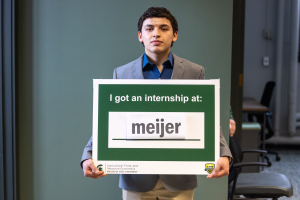
From Classroom to Store Leadership: AFRE Student Ruben Mireles Builds Retail Experience with Meijer Internship
Published on August 3, 2026
Through a Meijer internship, AFRE student Ruben Mireles turned classroom knowledge into real-world leadership experience while exploring a career in the food industry. -
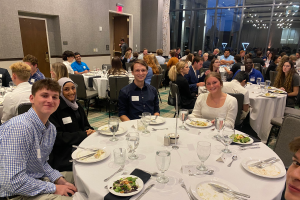
AFRE Undergraduates and Industry Partners Attend Annual AFRE Etiquette Dinner
Published on October 29, 2025
AFRE alumni and seniors gather each year for a networking and etiquette dinner aimed at preparing seniors for the careers after graduation. -
AFRE Undergraduates Attend International Fresh Produce Association Conference
Published on October 28, 2025
AFRE Undergrads travel to California for the Global Produce and Floral Show, hosted by the International Fresh Produce Association to explore the latest technology and new product trends. -
Food Industry Management Senior, Katherine DeLorenzo, is Supplying Food to Shelves as a General Mills Intern
Published on July 28, 2025
This summer Katherine traveled to Covington, GA where she is interning with General Mills as a supply chain logistics intern. -
AFRE undergrads lead the 97th Michigan FFA Convention
Published on March 31, 2025
Gretchen Gautz and Sara Dammann are agribusiness management students who also spent the last year serving as Michigan FFA State Officers. -
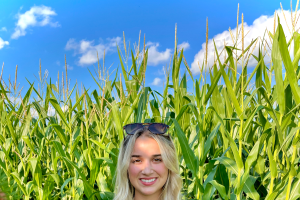
AFRE Senior, Allie Blanchard, Finds Passion for Crop Insurance Through Internship
Published on July 9, 2024
Allie Blanchard is completing her second internship as a crop insurance intern with GreenStone Farm Credit Services.



Managerial Economics for the Bioeconomy Advisor
-
Jennifer Petzko
Undergraduate Advisor / Senior Academic Specialist
petzko@msu.edu
517-884-8976

Student Life
In addition to student jobs and internships, there are education abroad and undergraduate research opportunities.
There are also a variety of student clubs and organizations including:
- Agriculture, Food and Natural Resources Education Club.
- Collegiate Farm Bureau.
- Food Marketing Association.
- Leadership in Environment and Agricultural Fields.
- Minorities in Agriculture, Natural Resources and Related Sciences.
- National Agri-Marketing Association.
 Print
Print Email
Email