Did your county trigger 2025 insurance payments from SCO and ECO?
 Print
Print Email
EmailYield was a major factor in which counties received payments.
While most of the growing season is now focused on maximizing yields and revenues on 2026 production, we’re not quite done with 2025. USDA’s Risk Management Agency (RMA) released county yield data for the 2025 production year which triggered payments in several county-based insurance policies. Specifically, the Supplemental Coverage Option (SCO) and Enhanced Coverage Option (ECO) will see payments in some of Michigan’s counties. Which counties receive payments depends on whether yield or revenue were low enough to qualify.
SCO and ECO basics
Both SCO and ECO are additional policies to a farm’s underlying insurance policy. Those policies are either yield protection (YP) or revenue protection (RP), which focus on a farm’s individual yields. The underlying policy determines how payments in SCO and ECO will be calculated. In both cases, county yields are used in place of a farm’s individual yields.
SCO, when based on a yield protection policy, provides coverage for a county once that season’s county yield falls below 86% of the county’s actual production history (APH) or yield history. ECO based on yield protection has two options available to farms. ECO 90 will provide coverage once a county’s yield falls below 90% of the APH yield. ECO 95 will provide coverage once a county’s yield falls below 95% of the APH yield.
For revenue policies, SCO and ECO both use futures market prices to convert yield to revenue values. Base prices are set in March using the average of futures contracts for the month of February. Harvest prices are set in October using November futures for soybeans and in November using December futures for corn. The base price for soybeans in 2025 was $10.54 compared to a harvest price of $10.35, leading to a 2% loss in the price used to calculate the year’s revenue for revenue policies. The base price for corn in 2025 was $4.70 compared to a harvest price of $4.31 or an 8% loss.
Similar to yield protection, if SCO for revenue falls below 86% of the expected county revenue, a payment is trigger. ECO 90 will trigger if revenue falls below 90% of the expected county revenue and ECO 95 will trigger below 95% of expected county revenue.
Counties receiving payments
In most cases, counties with SCO and ECO that triggered payments were mainly based on yield losses. Regardless of whether the underlying policy was yield or revenue protection, yield was a major factor. Especially in cases where soybeans received payments with only a 2% loss in price between base and harvest periods.
In several cases, data from USDA RMA indicates that yields may have actually been favorable enough to prevent some revenue policies from triggering a payment. This was noted in several cases for corn acres. In some places, yields were good enough that even with a low price, ECO 95 policies for revenue did not trigger a 5% or more loss.
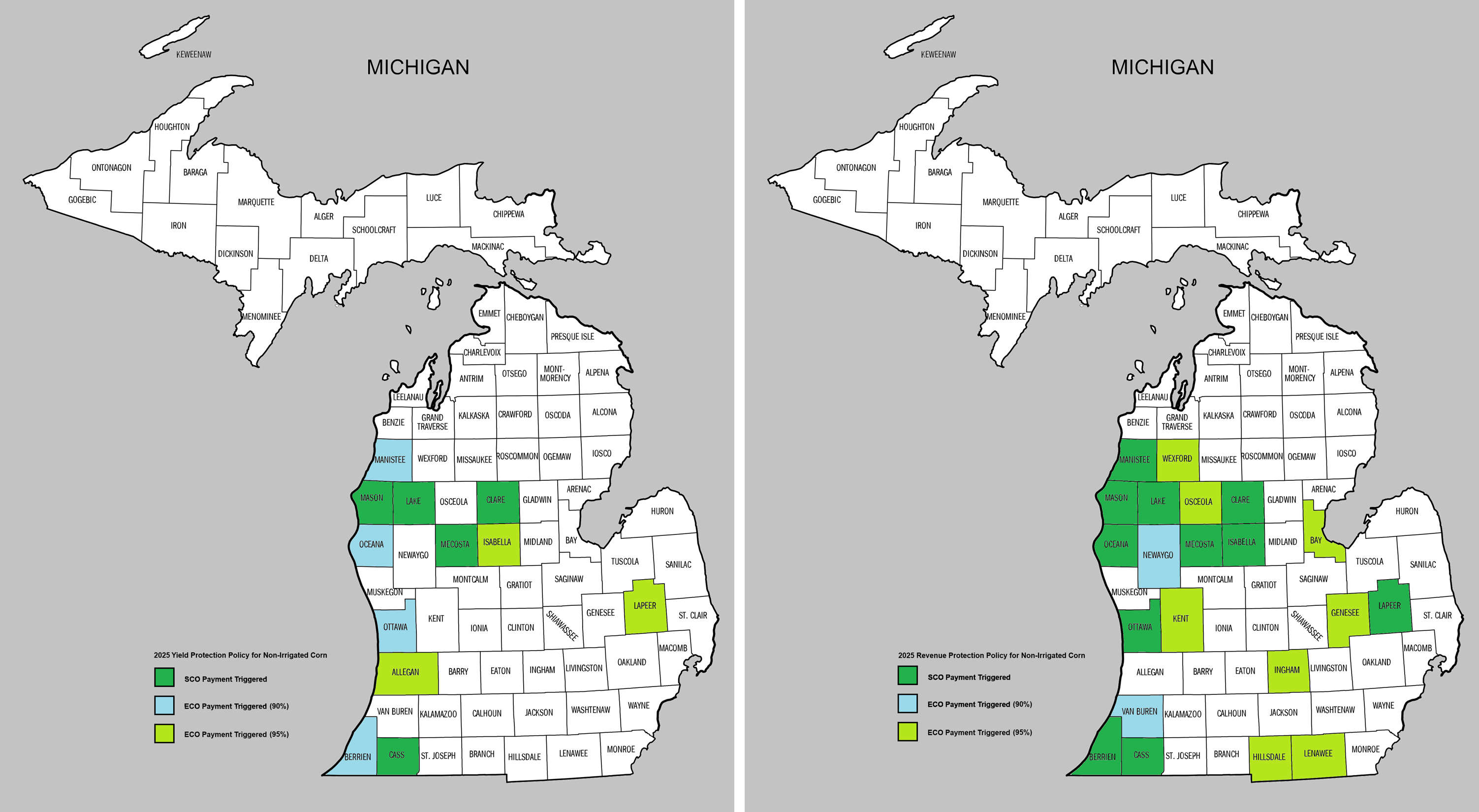
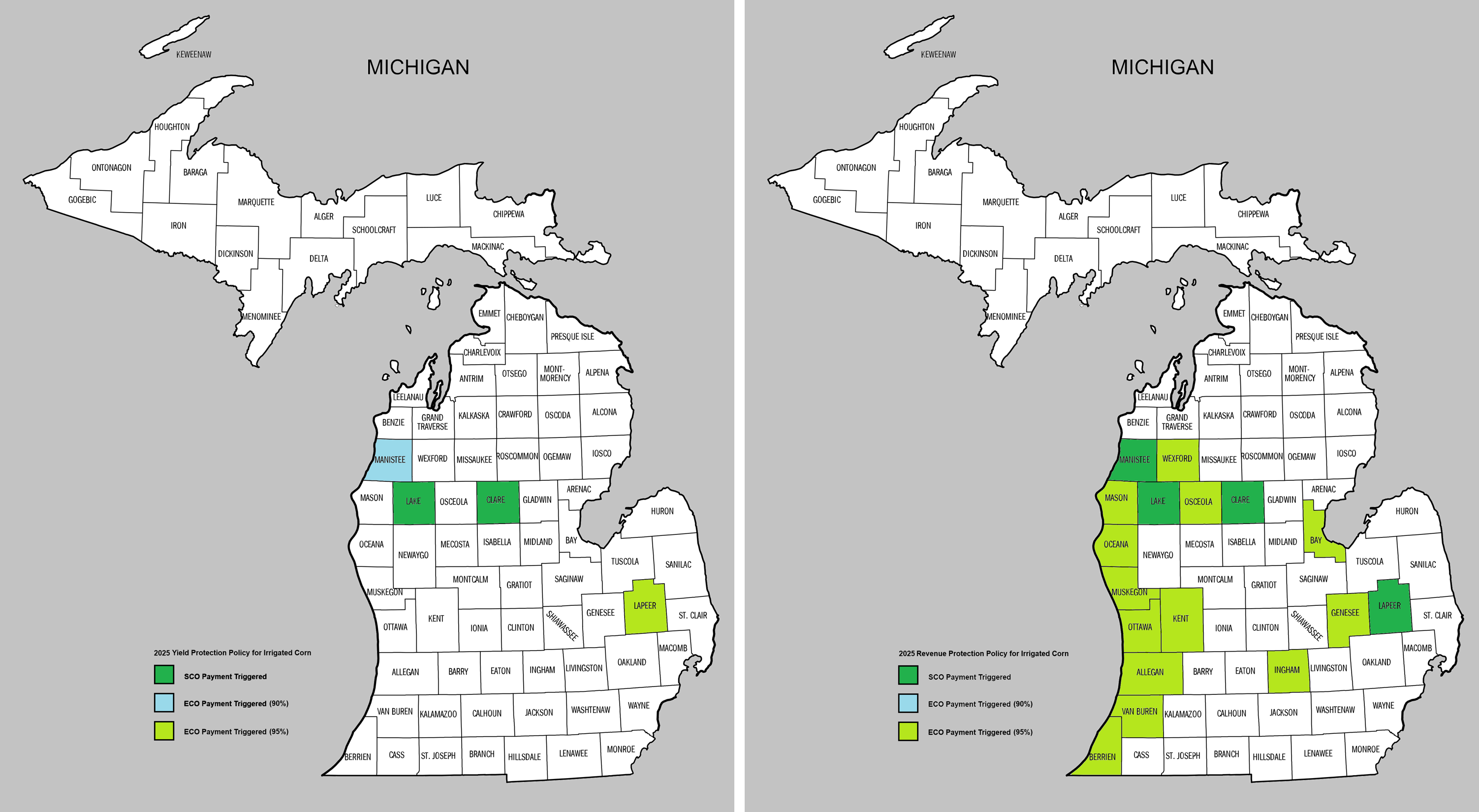
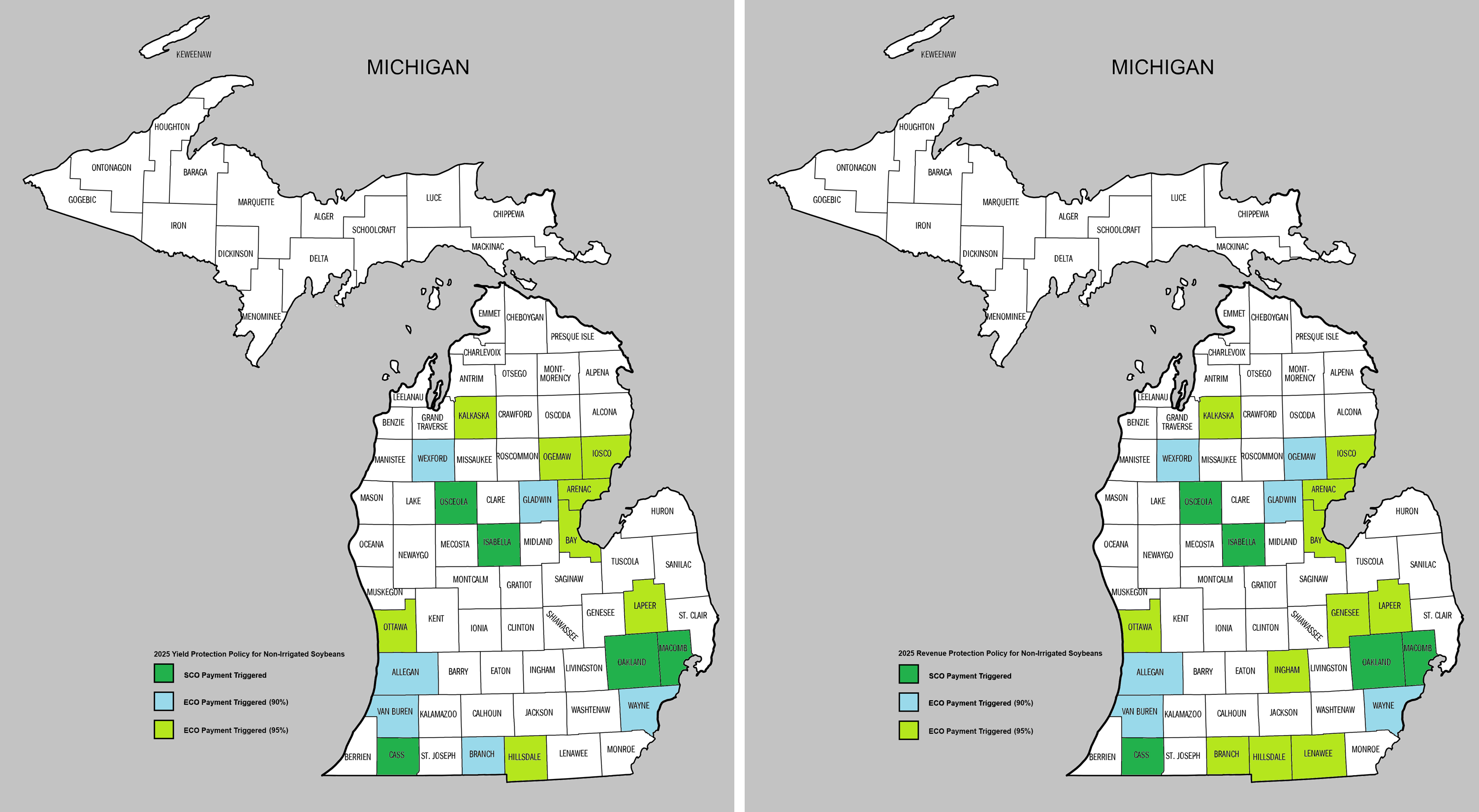
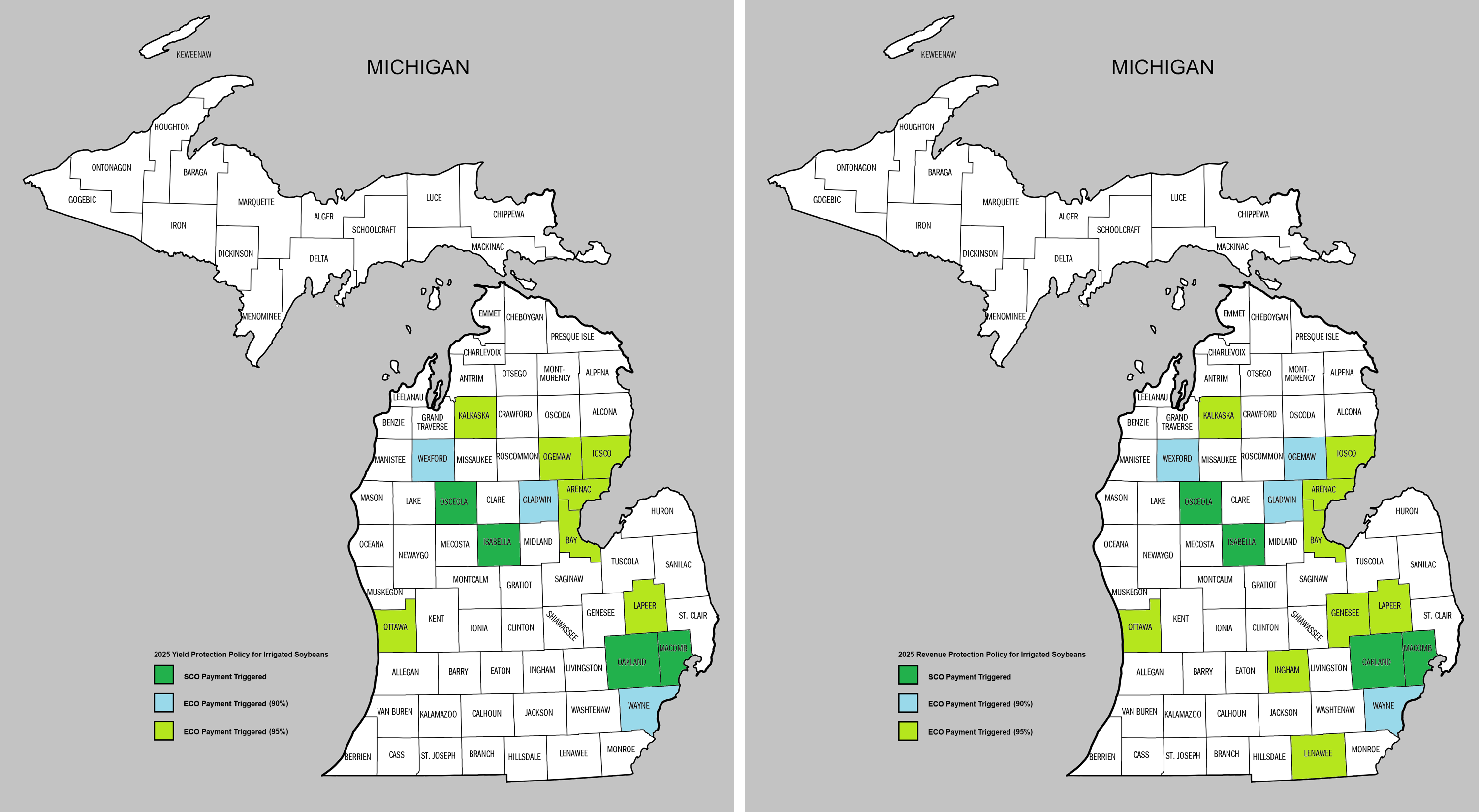
The following is a breakdown of which counties triggered payments based on irrigated and non-irrigated acres for both corn and soybeans in Michigan. Figures 1-4 provide a visual aid to highlight which programs triggered payments in Michigan counties.
Non-Irrigated corn (Figure 1)
Yield Protection (YP):
- YP SCO (Yield loss of 14% or more) - Cass, Clare, Lake, Mason, Mecosta
- YP ECO 90% (Yield loss of 10% or more) - Berrien, Manistee, Oceana, Ottawa
- YP ECO 95% (Yield loss of 5% or more) - Allegan, Isabella, Lapeer
Revenue Protection (RP):
- RP SCO (Revenue loss of 14% or more) - Berrien, Cass, Clare, Isabella, Lake, Lapeer, Manistee, Mason, Mecosta, Oceana, Ottawa
- RP ECO 90% (Revenue loss of either 10% or more) - Newaygo, Van Buren
- RP ECO 95% (Revenue loss of either 5% or more) - Bay, Genesee, Hillsdale, Ingham, Kent, Lenawee, Osceola, Wexford
Irrigated corn (Figure 2)
Yield Protection (YP):
- YP SCO (Yield loss of 14% or more) - Clare, Lake
- YP ECO 90% (Yield loss of 10% or more) – Manistee
- YP ECO 95% (Yield loss of 5% or more) - Lapeer
Revenue Protection (RP):
- RP SCO (Revenue loss of 14% or more) - Clare, Lake, Lapeer, Manistee
- RP ECO 90% (Revenue loss of either 10% or more) - N/A
- RP ECO 95% (Revenue loss of either 5% or more) - Allegan, Bay, Berrien, Genesee, Ingham, Kent, Mason, Muskegon, Oceana, Osceola, Ottawa, Van Buren, Wexford
Non-Irrigated soybeans (Figure 3)
Yield Protection (YP):
- YP SCO (Yield loss of 14% or more) - Cass, Isabella, Macomb, Oakland, Osceola
- YP ECO 90% (Yield loss of 10% or more) - Allegan, Gladwin, Van Buren, Wayne, Wexford
- YP ECO 95% (Yield loss of 5% or more) - Arenac, Bay, Hillsdale, Iosco, Kalkaska, Lapeer, Ogemaw, Ottawa
Revenue Protection (RP):
- RP SCO (Revenue loss of 14% or more) - Cass, Isabella, Macomb, Oakland, Osceola
- RP ECO 90% (Revenue loss of either 10% or more) - Allegan, Gladwin, Ogemaw, Van Buren, Wayne, Wexford
- RP ECO 95% (Revenue loss of either 5% or more) - Arenac, Bay, Branch, Genesee, Hillsdale, Ingham, Iosco, Kalkaska, Lapeer, Lenawee, Ottawa
Irrigated soybeans (Figure 4)
Yield Protection (YP):
- YP SCO (Yield loss of 14% or more) - Isabella, Macomb, Oakland, Osceola
- YP ECO 90% (Yield loss of 10% or more) - Gladwin, Wayne, Wexford
- YP ECO 95% (Yield loss of 5% or more) - Arenac, Bay, Iosco, Kalkaska, Lapeer, Ogemaw, Ottawa
Revenue Protection
- RP SCO (Revenue loss of 14% or more) - Isabella, Macomb, Oakland, Osceola
- RP ECO 90% (Revenue loss of either 10% or more) - Gladwin, Ogemaw, Wayne, Wexford
- RP ECO 95% (Revenue loss of either 5% or more) - Arenac, Bay, Genesee, Ingham, Iosco, Kalkaska, Lapeer, Lenawee, Ottawa
Premiums have final say on farmer benefits
Some farms in counties that triggered payments may not see an indemnity check issued depending on their premium costs for SCO and ECO. Premiums are based on underlying policies and may have payment limitations. Premiums are also not paid until payment determinations are made in June of the year following coverage. For example, both 2025 indemnity payments and premiums were not finalized until June of 2026.
Farmer-paid premiums are also still subsidized at 65% of the total premium cost for 2025. Starting in 2026, farmer premiums will be subsidized at 80% of the total premium cost
Insurance benefits vary by farm
Insurance and its benefits are determined on a farm-by-farm basis, even when using county yields as part of the payment calculation. As farms work through the 2026 growing season, taking note of whether or not these policies were beneficial for your farm in 2025 is important for their continued use. Recommended questions to consider include:
- What risks was my farm hoping to offset from use of SCO and ECO policies?
- Were those risks offset or was there a net benefit received in 2025?
- Would the lower premium available in 2026 have made a difference to my net benefit for 2025?
With much of the growing season to go, the answer to the previous questions may change for each individual farm. Work closely with your crop insurance agent to consider how potential scenarios may impact future use, especially if conditions begin to mirror those seen in 2025.
For more information on the SCO insurance policy, review MSU Extension’s article: SCO Insurance Program and its use in Michigan. Additional information on 2025 payments for SCO and ECO can be found via the University of Illinois’ Farmdoc article: 2025 RMA County Yields and ECO/SCO Payments.