Print
Print Email
Email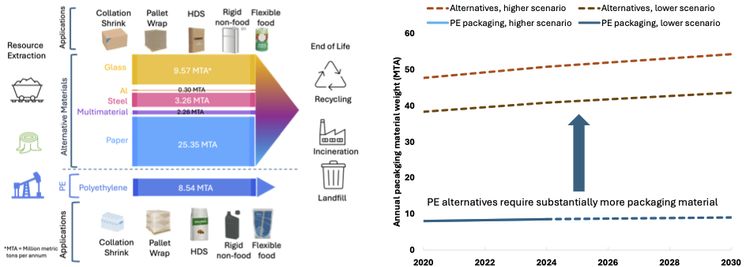
Environmental consequences of replacing polyethylene packaging in the United States and Europe
, , , , , , , , ,
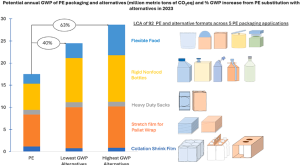
Substituting plastic packaging with alternative materials is increasingly promoted as a strategy to reduce environmental burdens and support resource conservation, yet broader trade-offs remain insufficiently understood. This study evaluates potential environmental consequences of replacing polyethylene (PE) packaging with alternatives in the U.S. and Europe using comparative life cycle assessment. Cradle-to-end-of-life impacts were assessed for five major packaging applications using region-specific inventories and midpoint indicators for global warming potential, acidification, eutrophication, water use, land use, and fossil resource use. PE demand and substitution scenarios were projected to 2030 to examine implications for material demand and resource-related impacts. Across most applications and impact categories assessed, PE packaging showed lower potential environmental impacts than paper, glass, and metal alternatives. Substitution could increase packaging mass by up to five to six times and double global warming potential, with increases of 190% in the U.S. and 50% in Europe. These findings indicate that material substitution alone is not necessarily a resource-efficient or environmentally preferable strategy. Packaging decisions and policies should therefore be guided by functionally equivalent, region-specific life cycle data that accounts for burden shifting across resource use, emissions, and end-of-life systems.
Affiliations:
- a Circular Analytics TK GmbH, Canovagasse 7/1/14, Wien, 1010, Austria
- b University of Applied Sciences, Favoritenstraße 226, Vienna, 1100, Austria
- c Trayak, Inc., 5700 Gateway Blvd, Suite 400, Mason, OH, 45040, USA
- d ExxonMobil Technology and Engineering Company, 22777 Springwoods Village Pkwy, Spring, TX, 77389, USA
- e Exxon Mobil Corporation, 22777 Springwoods Village Pkwy, Spring, TX, 77389, USA
- f School of Packaging, Michigan State University, East Lansing, MI, 48824, USA