Managing cucumber beetles and squash bugs at the same time
 Print
Print Email
EmailCucumber beetles and squash bugs often appear at the same time, but they do not respond equally to insecticides. Understanding your options can help improve control, reduce costs, and avoid unnecessary sprays.
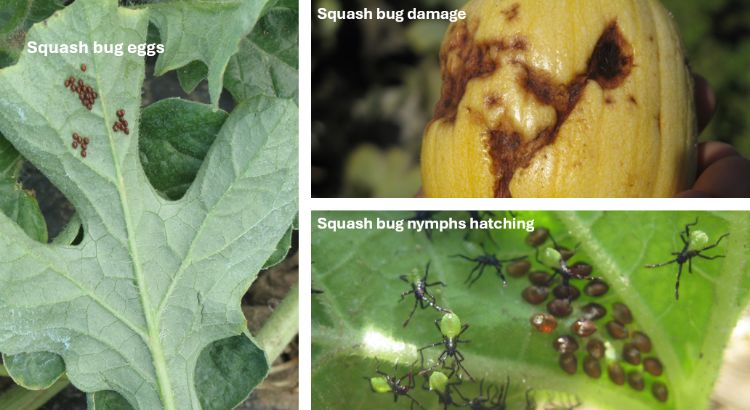
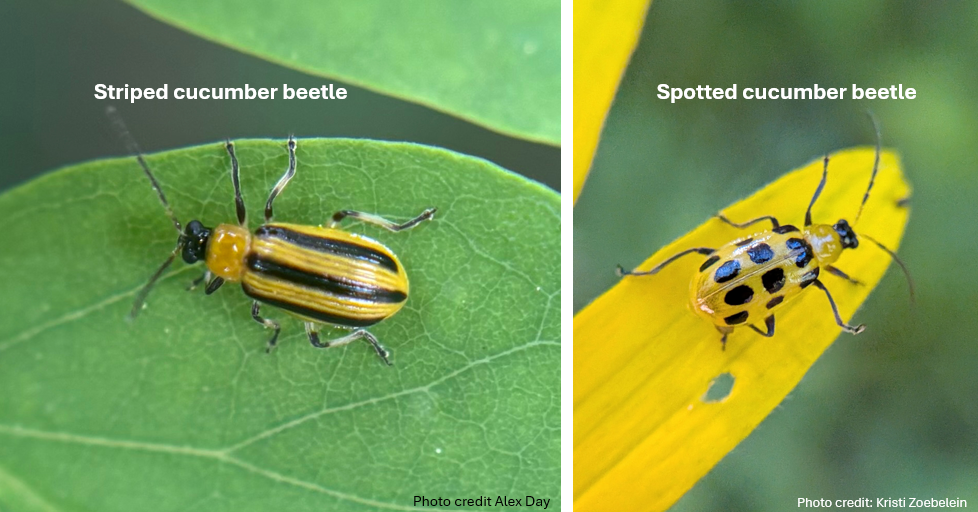
Cucumber beetles and squash bugs are among the most common insect pests of cucurbit crops. When both pests occur together, choosing an insecticide can be challenging because they belong to different insect groups and often respond differently to insecticide applications. Cucumber beetles are beetles (Coleoptera), whereas squash bugs are true bugs (Hemiptera). As a result, products that provide excellent control of one pest may not be the best option for the other.
Managing both pests at the same time with insecticides
If both pests exceed treatment thresholds and immediate knockdown is needed, pyrethroid insecticides remain one of the most reliable single-product options. Lambda-cyhalothrin (Warrior II and generic formulations) has demonstrated strong activity against both cucumber beetles and squash bugs. In a Virginia Tech bioassay, lambda-cyhalothrin caused 97.5% mortality of squash bug nymphs within 72 hours. Earlier field trials also found excellent squash bug control from pyrethroid insecticides, including lambda-cyhalothrin (Warrior), cyfluthrin (Baythroid), zeta-cypermethrin (Fury), bifenthrin (Capture), and the premix imidacloprid + cyfluthrin (Leverage).
The drawback is that repeated pyrethroid use can disrupt beneficial insects and may contribute to secondary pest outbreaks. In a Virginia summer squash trial, lambda-cyhalothrin (Warrior II) was associated with significantly higher aphid populations later in the season than were observed in untreated plots.
Focusing more on squash bug management
When squash bugs are the primary concern, several newer insecticides have shown activity against squash bug nymphs. A Virginia Tech bioassay found that the following insecticides provided greater than 80% squash bug mortality within 72 hours:
- Acetamiprid (Assail 30SG) – 100% mortality
- Lambda-cyhalothrin (Warrior II and generics) – 97.5% mortality
- Sulfoxaflor (Transform WG) – 95% mortality
- Flupyradifurone (Sivanto HL) – 87.5% mortality
Among all products tested, acetamiprid (Assail 30SG) provided the highest squash bug mortality, reaching 100% mortality within 72 hours. Although this laboratory study evaluated squash bug control rather than cucumber beetle control, the results suggest Assail may be a useful tool when squash bugs are the primary target and growers want an alternative to repeated pyrethroid applications. Acetamiprid, sulfoxaflor and flupyradifurone have the same primary mechanism to kill insects thus, they should not be rotated with each other to avoid developing resistance to Group 4 chemistries.
Other products tested against squash bug nymphs included cyclaniliprole (Harvanta), flonicamid (Beleaf), flupyradifurone (Sivanto Prime), pyrifluquinazon (PQZ), and afidopyropen (Sefina), but these products provided lower mortality than Assail, Transform, Sivanto HL, or lambda-cyhalothrin. Insecticides with the active ingredients like flupyradifurone, cyclaniliprole, flonicamide, and afidopyropen selectively control insects with piercing-sucking mouthparts; therefore, they also control aphids and preserve beneficial insects.
Use trap crops to manage both pests
One of the most promising integrated pest management (IPM) approaches for managing cucumber beetles and squash bugs simultaneously is trap cropping with Blue Hubbard squash.
Research conducted by Lincoln University found that Blue Hubbard squash is highly attractive to both pests because of its high cucurbitacin content. Compared with zucchini, Blue Hubbard squash was:
- 55 times more attractive to spotted cucumber beetles
- 25 times more attractive to striped cucumber beetles
- 20 times more attractive to squash bugs
The recommended approach is to transplant two-week-old Blue Hubbard seedlings around field borders or at row ends before or at the same time as the cash crop. The trap plants attract cucumber beetles and squash bugs away from the production field, allowing growers to concentrate management efforts on a small number of plants rather than spraying the entire field. Remember, trap crops must be managed. Pests concentrated on Blue Hubbard plants should be killed or removed, otherwise they can reproduce on the trap crop and eventually move into the cash crop. Growers have successfully managed trap crops using targeted insecticide applications, vacuuming, hand removal, or other methods.
Some growers have also used systemic imidacloprid (Admire Pro, Alias 2F, and other formulations) applied only to Blue Hubbard trap plants. In these cases, the trap plants attract cucumber beetles and squash bugs while the insecticide kills feeding insects, reducing the need for whole-field applications. Imidacloprid-treated trap plants may remain toxic to feeding insects for approximately three to four weeks.
In summary, when cucumber beetles and squash bugs occur together, there is no perfect insecticide. Lambda-cyhalothrin (Warrior II) remains one of the most reliable single-product options when both pests require immediate control. Acetamiprid (Assail 30SG) provided excellent squash bug control in laboratory bioassays and may be a useful option when squash bugs are the primary target. Blue Hubbard trap crops provide an effective IPM strategy that can reduce insecticide use while simultaneously targeting both cucumber beetles and squash bugs.
For growers who face chronic pressure from both pests, combining trap cropping with targeted insecticide applications may provide the best balance between effective pest control, pollinator conservation, and reduced insecticide inputs.
This work is supported by the Crop Protection and Pest Management Program (grant no 2024-70006-43569) from the USDA National Institute of Food and Agriculture. Any opinions, findings, conclusions, or recommendations expressed in this publication are those of the author(s) and do not necessarily reflect the view of the U.S. Department of Agriculture.