


Michigan chestnut crop report – July 16, 2026
 Print
Print Email
EmailContinue to scout carefully and prepare for tissue testing as terminal growth slows.
Weather review
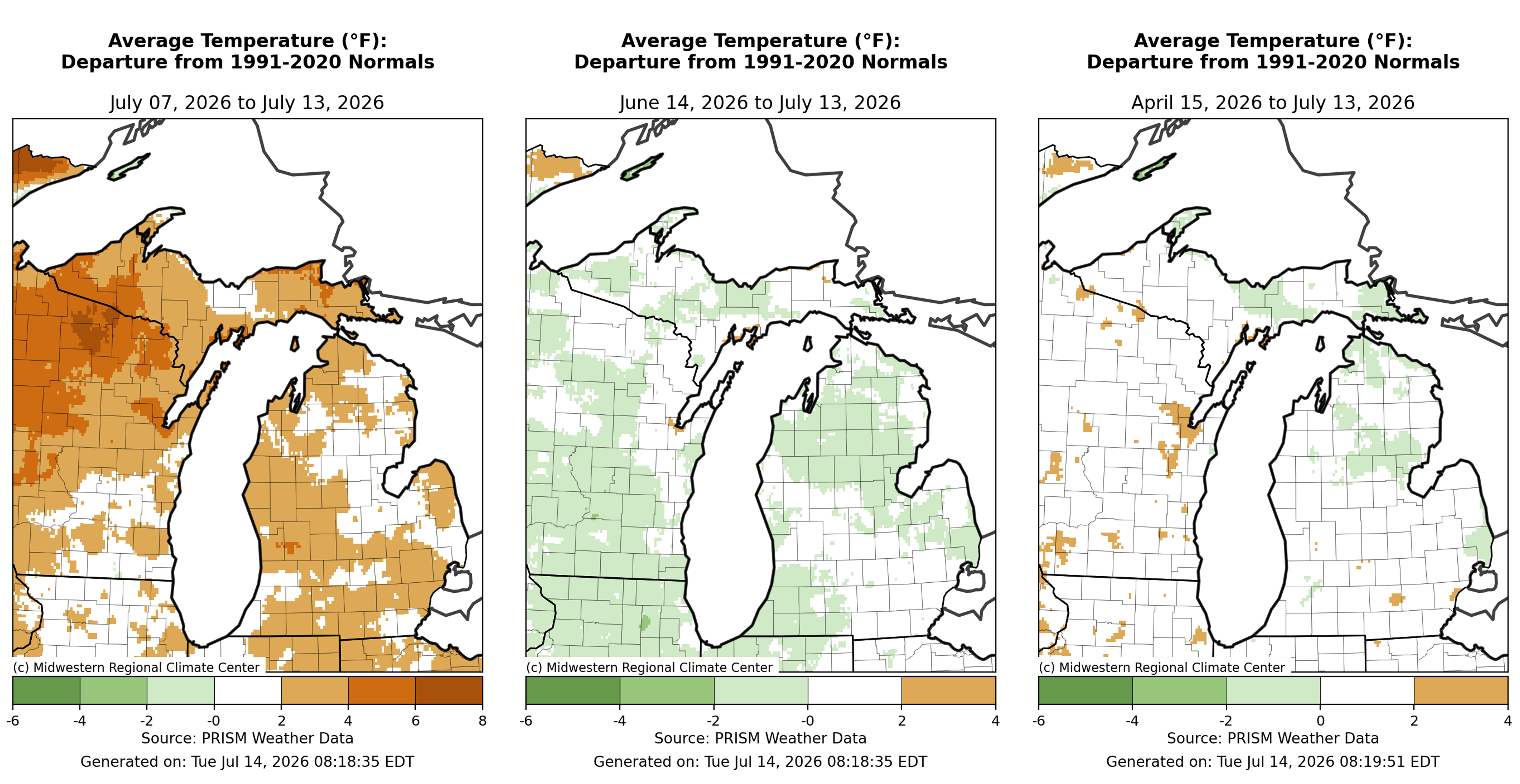
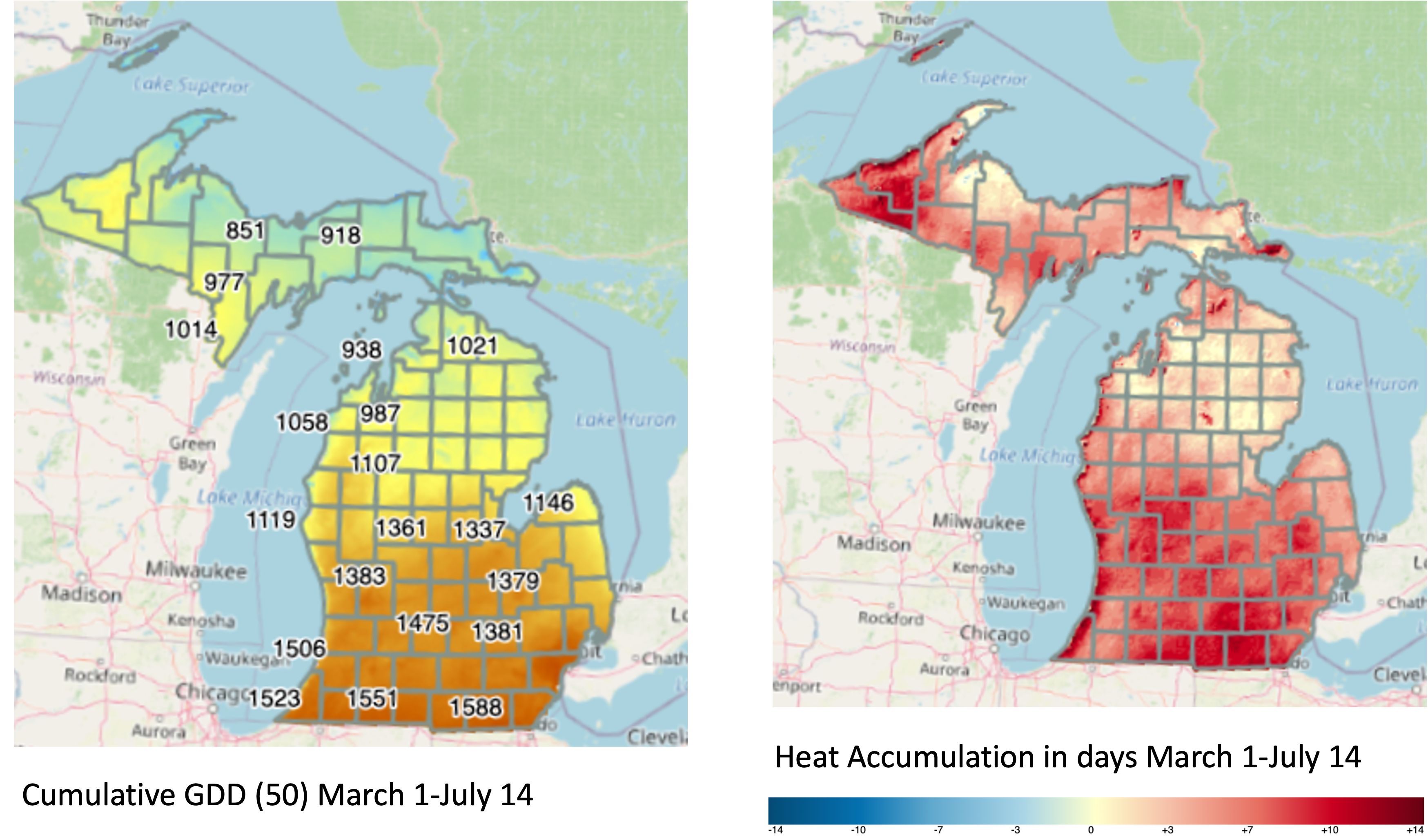
The last few days have been very warm, with National Weather Service’s major heat risk across the entire state. Several high temperature records were set across Michigan on July 13 and 14. Growing degree days (GDD) base 50 are ahead of normal in southern Michigan and the western Upper Peninsula, and slightly above normal in the northern lower and eastern Upper Peninsula.
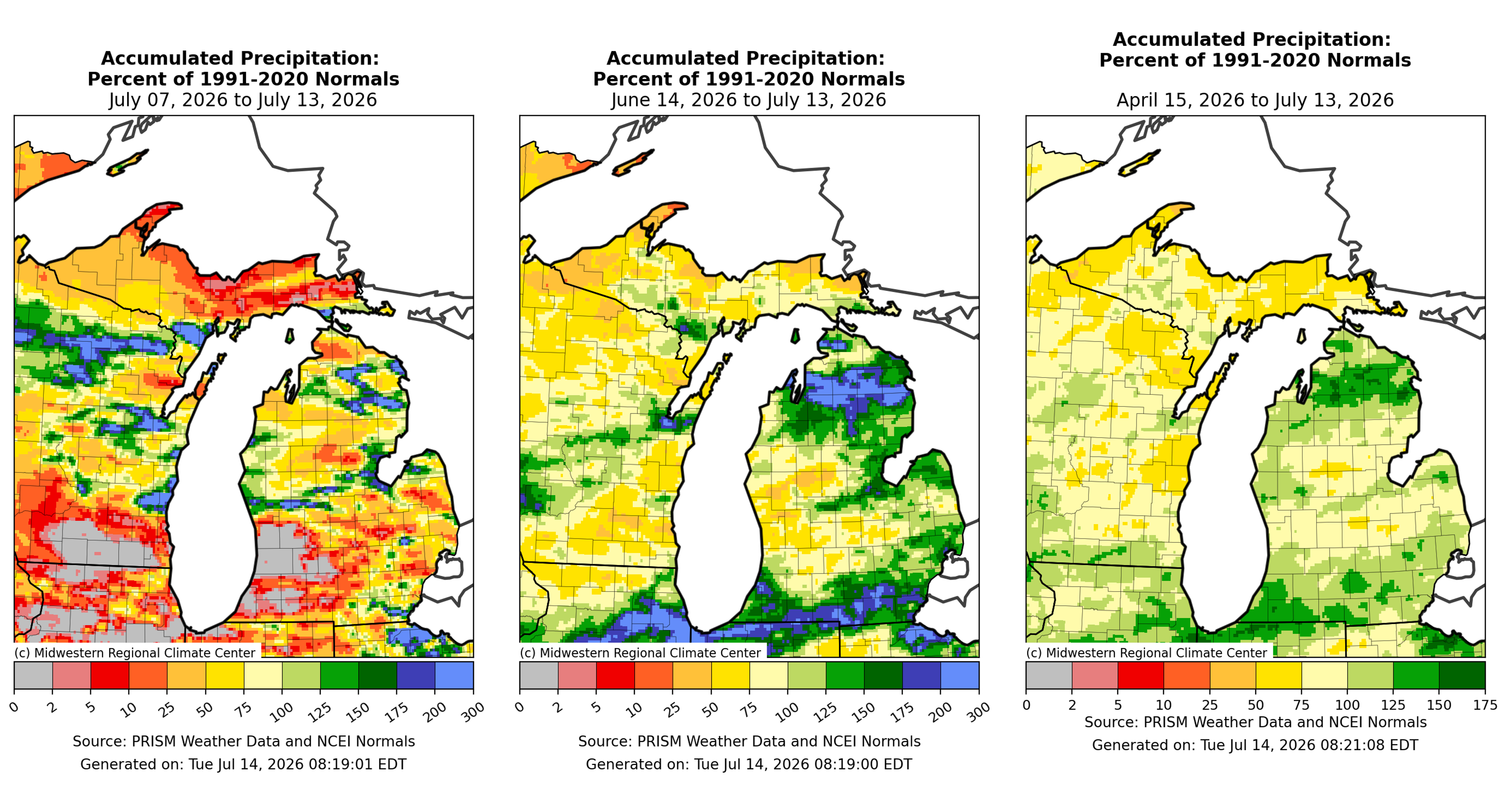
Accumulated precipitation over the last week was below normal throughout much of the state. Over the last 30 days, precipitation is normal across central Michigan to above normal in northern lower and southern Michigan. Over the last month, the Upper Peninsula has been dryer than normal. The 90-day average is close to average for most of the state.
Looking ahead
Compared to the excessive heat we’ve been experiencing, it will be a bit cooler this weekend and into next week. The 6-10 day forecast model is predicting slightly cooler than average temperatures and slightly wetter than normal conditions.
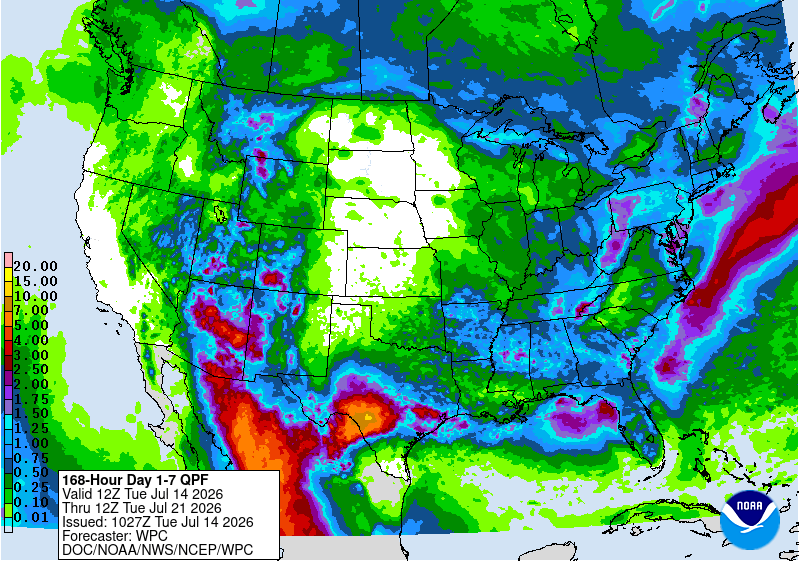
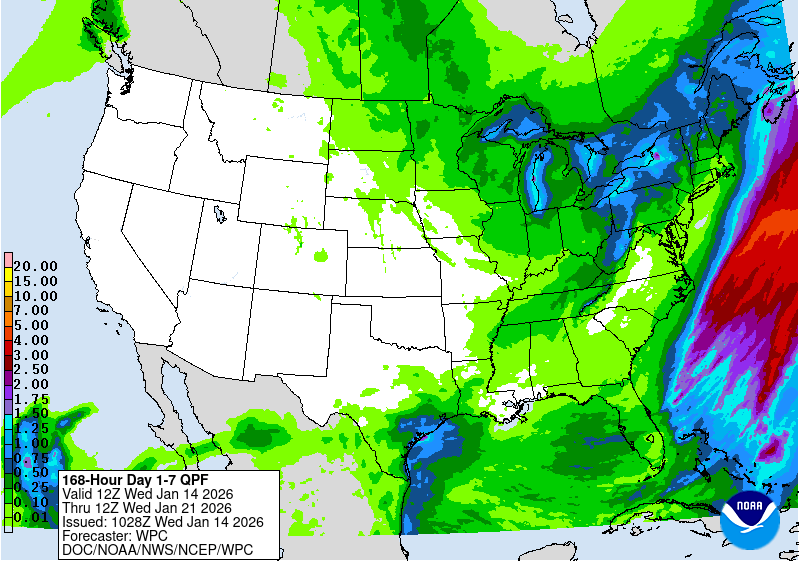
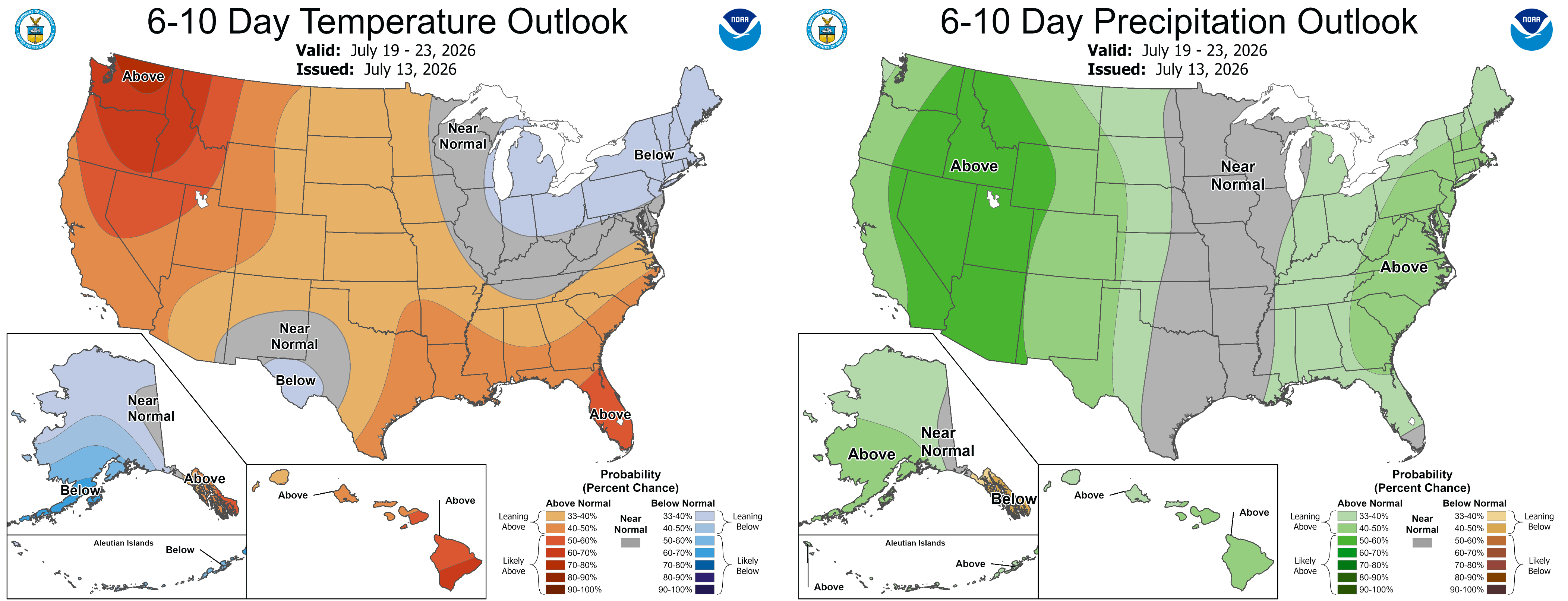
Visit MSU Extension’s Agriculture Weather page for the most recent agricultural weather forecast.
Management activities
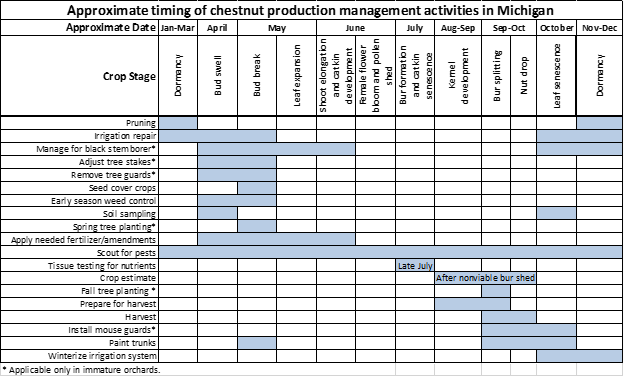
It is a busy time of the year for orchard scouting. Consider tissue testing in the following weeks. For information on chestnut management in Michigan, including nutrient recommendations, registered pesticides and support resources, refer to the Michigan Chestnut Management Guide.
Insect pests
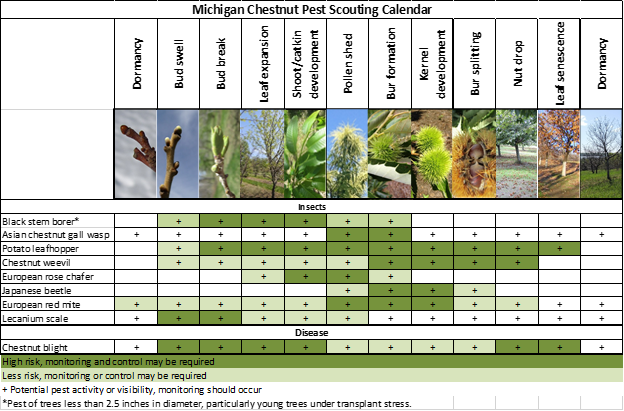
The list of potential insect pests in orchards is long this week and includes potato leafhopper, European red mite, Asian chestnut gall wasp, rose chafer and Japanese beetle. Black stem borer activity has ceased, and the primary chestnut weevil activity and management window will not open until August.
Potato leafhopper numbers are modest in most areas. Like many plants, chestnuts are sensitive to the saliva of potato leafhopper, which is injected by the insect while feeding. The easiest way to observe potato leafhopper is by flipping the shoots or leaves over and looking for adults and nymphs on the underside of leaves. Pay special attention to succulent new leaves at the end of branches. For information on insecticides for management, refer to the Michigan Chestnut Management Guide.
Growers are reporting substantial European red mites pressure. Summer generations are favored by the hot and dry weather and able to complete their life cycles much faster with as little as 10 days between generations under ideal conditions. With conditions forecasted to remain hot, high mite pressure is likely to continue. For information on miticides for management, refer to the Michigan Chestnut Management Guide.
Growers with Asian chestnut gall wasp populations in the orchard and those adjacent to known infestations should continue scouting. Chestnut growers with orchards in counties west of Highway 127, especially areas south of I-96 in lower Michigan, should be scouting their trees for evidence of the arrival of Asian chestnut gall wasp during the growing season and again in fall or winter, after leaf drop. Young trees are particularly susceptible to severe damage by Asian chestnut gall wasp due to the limited number of buds and the need to establish tree structure during the first years of establishment. For more information, check out the Asian Chestnut Gall Wasp bulletin.
Rose chafers are out and active. The adult beetles feed on foliage and blossom parts of numerous horticultural crops in Michigan and can cause significant damage to chestnut orchards. Rose chafers can be particularly damaging on young trees with limited leaf area. There are no established treatment thresholds or data on how much feeding damage a healthy chestnut tree can sustain, but consider that well-established and vigorous orchards will likely not require control. Young orchards with limited leaf area will need to be managed more aggressively. For more information on rose chafer identification and management, check out the MSU Extension Chestnut Pest Management webpage. For information on insecticides for management, refer to the Michigan Chestnut Management Guide.
Japanese beetles are emerging. There are no established treatment thresholds or data on how much Japanese beetle damage a healthy chestnut tree can sustain, but well-established and vigorous orchards will likely not require protection. Younger orchards with limited leaf area will need to be managed more aggressively. Managing Japanese beetles can be a frustrating endeavor, as they often re-infest from surrounding areas, especially during peak adult emergence in July. This re-infestation is often misinterpreted as an insecticide failure, but efficacy trials have shown several insecticides remain effective treatment options. For more information, refer to the MSU Extension article "Japanese beetle adults arrive in chestnuts." For information on insecticides for management, refer to the Michigan Chestnut Management Guide.
Disease
Many Michigan orchards may be in the treatment window for brown rot. In Michigan, various pathogens contribute to nut rots, but in recent years brown rot caused by the fungus Gnomoniopsis smithogilvyi, has become the leading cause of nut decay. Fungicide application at bloom is critical for control. For details, refer to the MSU Extension article “Chestnut brown rot management in the field.”
Growers should continue to scout for symptoms of oak wilt in orchards. Suspected new infections are being observed at this time. Oak wilt can spread overland by beetles or underground via root grafting. Overland spread occurs when tiny sap beetles known as picnic beetles. While this disease has not been well defined in Chestnut, we can learn from what is known in oak systems. Picnic beetles pick up viable fungal spores from oaks that have recently died from oak wilt, then feed on sap oozing from a wound on a live oak. The wound must be deep enough to penetrate the sapwood.
To reduce the risk of infection in chestnuts, pruning should be limited to the dormant season. An infected tree is often first noticed when leaves take on a wilted, light green appearance during the summer before progressing to yellow and brown and dropping prematurely. The presence of dark streaking under the bark on branches and between the cambium and bark on trunk cross sections are common symptoms of oak wilt. However, the only way oak wilt can be confirmed is through testing in a diagnostic lab. Growers who suspect they may have oak wilt affecting their chestnut tree may send a sample to MSU Plant and Pest Diagnostics following these guidelines. For more information on oak wilt and chestnuts, review the article MSU investigating oak wilt as the cause of sudden chestnut tree decline.
Existing chestnut blight infections (caused by Cryphonectria parasitica) can be observed at this time. There are no commercially available treatments for chestnut blight. Growers may prune out infected branches or cull whole trees as needed to limit disease pressure. Infested material should be burned or buried to further limit inoculum spread. Because tree wounds can be a pathway to new infections, pruning healthy trees should be limited to the dormant season. To learn more about chestnut blight, visit the pest management section of the chestnut webpage.
Looking ahead
As we move into August, chestnut weevil management will be in the front of minds. To read ahead, check out the MSU Extension article, “Biology and Management of the Lesser Chestnut Weevil in Michigan Chestnut Orchards.”
Stay connected
For more information on chestnut production from Michigan State University Extension, sign up for the Fruit & Nuts MSU Extension Newsletter, attend the MSU Chestnut Growers Chat Series and visit the MSU Extension Chestnuts website.
If you are unsure of what is causing symptoms in your field, submit a sample to MSU Plant and Pest Diagnostics. Visit the webpage for specific information about how to collect, package, ship and take pictures of plant samples for diagnosis. If you have any doubt about what or how to collect a good sample, please contact the lab at 517-432-0988 or pestid@msu.edu.
Become a licensed pesticide applicator
All growers using pesticides can benefit from getting a pesticide applicator license, even if not legally required. Understanding pesticides and the associated regulations can help you protect yourself, others and the environment. Michigan pesticide applicator licenses are administered by the Michigan Department of Agriculture and Rural Development. You can read all about the process by visiting the Pesticide FAQ webpage. Michigan State University offers a number of resources to assist people pursuing their license, including an online study/continuing education course and study manuals.
This work is supported by the Crop Protection and Pest Management Program (grant no 2024-70006-43569) from the USDA National Institute of Food and Agriculture. Any opinions, findings, conclusions, or recommendations expressed in this publication are those of the author(s) and do not necessarily reflect the view of the U.S. Department of Agriculture.