Michigan’s H-2A wage offers in first half of Fiscal Year 2026
 Print
Print Email
EmailRecent changes have important implications for Michigan growers, especially those hiring workers for harvest, equipment operation, trucking, packing and other tasks.

Michigan agriculture is entering a transition period following the United States (US) Department of Labor’s (DOL) October 2025 Interim Final Rule revising the methodology for calculating H-2A Adverse Effect Wage Rates (AEWRs). The rule changes how H-2A wages are determined for non-range agricultural occupations and shifts the program toward an occupational and skill-based wage system. For many years, most H-2A jobs were tied to a single statewide AEWR for most farm occupations. The recent changes have important implications for Michigan growers, especially those hiring workers for harvest, equipment operation, trucking, packing, and other tasks.
Background
The DOL’s new H-2A wage methodology was developed in response to the discontinuation of the USDA Farm Labor Survey (FLS), which had long served as the primary source for determining AEWRs. The revised approach aims to establish more consistent, occupation- and skill-specific wage rates across states by relying on an alternative federal wage data source. By aligning wages with the skills and occupations required in agricultural production, the rule is designed to help employers maintain access to a stable workforce and help American consumers maintain access to an affordable food source.
Under the new rule, all H-2A AEWRs will be determined from the United States Bureau of Labor Statistics (BLS) Occupational Employment and Wage Statistics (OEWS) survey while creating two broad skill-based wage categories for each state for most farm occupations. The two skill-based AEWRs correspond to “entry level” jobs (Skill Level I) that require less than three months of experience and “experienced” jobs (Skill Level II) that require at least three months of experience. The Skill Level I AEWRs are set at the 17th percentile of the OEWS wage distribution and the Skill Level II AEWRs are set at the mean. Job orders that include specialized duties such as truck driving, equipment operation, supervision, mechanics, or technical work may be assigned higher wages based on different job categories defined by the OEWS wage database.
Additionally, the new rule allows for a wage deduction, known as an Adverse Compensation Adjustment (ACA), to help employers offset the cost of free housing that is provided to H-2A workers at no cost. Across the U.S., the 2026 ACA ranges from $1.00 to $3.00 per hour. Michigan’s ACA for the first half of FY 2026 is $1.32. Importantly, if any of the AEWRs, whether adjusted for the ACA or not, fall below the applicable state or federal minimum wage, then employers are required to pay the applicable minimum wage.
Michigan H-2A wage distribution
Using data from the first half of fiscal year (FY) 2026, we analyzed 8,742 certified H-2A positions submitted through 377 applications in Michigan. The results indicate that most employers reduced wages relative to the 2025 Adverse Effect Wage Rate (AEWR) of $18.15 per hour. Although employers could have paid as little as Michigan’s $13.72 minimum wage under the Skill Level I AEWR with the ACA, only 15 positions were certified at that rate. Instead, the majority of jobs—6,433 positions, or 73.6% of all certifications—were approved at $13.77 per hour, the Skill Level I AEWR without the ACA deduction (see Figure 1 and Table 1).
Wages above the Skill Level I rate were less common. Approximately 6.6% of jobs (578 positions) were certified at wage rates between the Skill Level I wage of $13.77 and the ACA-adjusted Skill Level II AEWR of $16.15. Only 16 positions were certified exactly at the ACA-adjusted Skill Level II rate, while 175 positions (2%) were certified at wages between $16.15 and the Skill Level II wage without the ACA deduction of $17.47. Another 882 positions (10.1%) were certified at the full Skill Level II wage of $17.47.
Figure 1: Michigan H-2A jobs certified by wage category
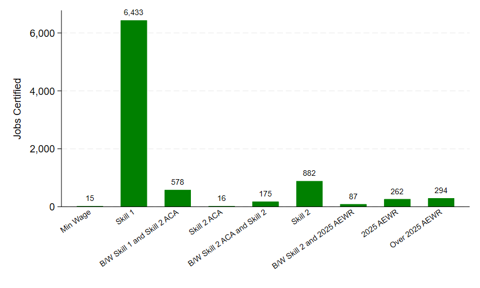
Table 1: Michigan H-2A wage distribution
|
Wage Category |
Jobs Certified |
Percent of Jobs |
|
Minimum Wage |
15 |
0.2% |
|
Skill 1 |
6,433 |
73.6% |
|
Between Skill 1 and Skill 2 ACA |
578 |
6.6% |
|
Skill 2 ACA |
16 |
0.2% |
|
Between Skill 2 ACA and Skill 2 |
175 |
2.0% |
|
Skill 2 |
882 |
10.1% |
|
Between Skill 2 and 2025 AEWR |
87 |
1.0% |
|
2025 AEWR |
262 |
3.0% |
|
Over 2025 AEWR |
294 |
3.4% |
|
Total |
8,742 |
100.0% |
Relatively few employers continued to offer wages near or above the previous AEWR. In total, only 643 positions (7.4%) were certified at rates that were above the Skill Level II AEWR without the ACA. Specifically, 87 positions (1%) were certified at wages between $17.47 and the 2025 AEWR of $18.15, while 262 positions (3%) were certified exactly at $18.15. An additional 294 positions (3.4%) were certified at wages exceeding the 2025 AEWR. These higher-paying jobs were concentrated in occupations requiring additional skills or responsibilities, including supervisors, equipment operators, mechanics, maintenance workers and truck drivers.
Wage savings during first half of Fiscal Year 2026
For H-2A applications submitted during the first six months of FY 2026, the estimated H-2A cost under observed wage offers and contract durations is approximately $147 million. If all the certified jobs in the first half of FY 2026 had instead been paid the 2025 AEWR of $18.15 per hour, the estimated wage cost would have been approximately $180 million. As a result, employers whose jobs were certified during the first half of FY 2026 saved approximately $33 million relative to what they would have paid if the 2025 AEWR was still in effect.
The first half of FY 2026 demonstrates that Michigan H-2A employers are actively utilizing the flexibility provided by the DOL’s new AEWR methodology. Most certified positions were offered at the Skill Level I wage rate, resulting in substantially lower wage offers than the 2025 AEWR. As a result, employers certified during the first half of the fiscal year are estimated to save approximately $33 million in labor costs relative to what they would have paid under the previous wage structure. At the same time, a smaller share of jobs continued to be certified at higher wage rates, particularly for occupations requiring specialized skills such as supervision, equipment operation, mechanics, and truck driving. These findings suggest that the new rule is shifting the H-2A program toward a more occupation- and skill-based wage system, increasing the importance of accurate job classifications and contract design. As employers and policymakers continue to adapt to the new framework, monitoring wage offers, labor availability, and farm-level impacts will be important for understanding the long-term effects of the policy change on Michigan agriculture.
Additional Resources
Adverse Effect Wage Rates
https://flag.dol.gov/wage-data/adverse-effect-wage-rates
https://www.dol.gov/newsroom/releases/eta/eta20230227
Related MSU Extension Articles
https://www.canr.msu.edu/news/explaining-the-new-h-2a-wage-rule-for-michigan-growers https://www.canr.msu.edu/news/farm-workforce-modernization-act-and-h-2a-visa
https://www.canr.msu.edu/news/what-are-adverse-effect-wage-rates
https://www.canr.msu.edu/news/an-overview-of-farm-labor-in-michigan