Michigan Sen. Sam Singh on MSU agriculture research, outreach: ‘There’s a need and a want’
 Print
Print Email
EmailSingh, who represents the 28th Senate District, touted MSU's work as essential to supporting the state's second-largest industry.
This story is part of a series highlighting the impact of MSU AgBioResearch’s work with Michigan agriculture and natural resources told through our stakeholders' perspectives. Through partnerships with the State of Michigan and industries, MSU AgBioResearch is finding solutions to some of the most timely problems facing our state. To view the entire series, visit agbioresearch.msu.edu.
In addition to the written story, listen to the below podcast with MSU AgBioResearch Director George Smith and Michigan Sen. Sam Singh on Spotify, Apple Podcasts and YouTube.
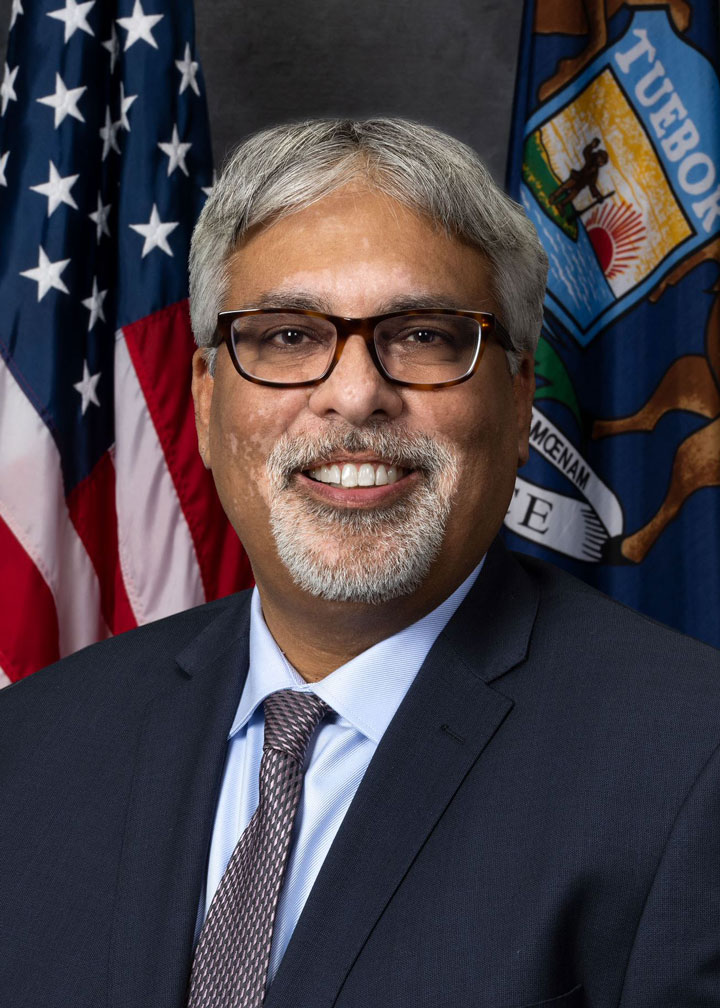
EAST LANSING, Mich. — Over his decade spent in the Michigan Legislature, Sen. Sam Singh, 28th District, has learned a lot about the state’s farmers and the challenges they face. But his agricultural education began during his initial foray into politics, serving as a city council member and later as mayor of East Lansing.
Representing the area in which Michigan State University resides and a region with an abundance of farms necessitated a crash course in all things agriculture, from talking to local farmers and industry organizations to interacting with university leaders.
“I grew up in a suburban area, went to MSU and didn’t have an ag background,” Singh said. “But when I began representing the area and eventually joined the legislature, first for six years in the House and now in my Senate term, I wanted to ensure I understood everything happening at the university. I threw myself into that, and I had a lot of good local farmers who helped educate me about agriculture. It’s a challenging business, but it’s one that’s undeniably important to Michigan.”
Agriculture is the state’s second-largest industry, delivering more than $125 billion in economic activity each year. Michigan also ranks second nationally in agricultural diversity — No. 1 with reliable access to water — producing more than 300 commodities. For Singh, this meant he wanted to have his finger on the pulse of what Michigan’s farmers need and how MSU is responding.
In addition to a wide range of other assignments, Singh is a member of the Senate’s Natural Resources and Agriculture Committee, as well as the Agriculture and Natural Resources Appropriations Subcommittee. These groups dictate policy and funding for Michigan agriculture, including programs through MSU that support the industries.
“Early on in my time in the legislature, what I was hearing from farmers and food processors was about talent,” Singh said. “They always need workers and wanted us to look at how the state could help them with workforce development.
“Now, it’s very clear that climate has become an issue. Extreme weather has affected planting and harvesting seasons. The third area is a set of economic factors with changes in tariff policy, inflation and other costs. It’s impacting our farm communities in a variety of ways. They need help to understand how those measures will affect them moving forward. I’m hearing these questions coming up about how to deal with it, and I know that’s why farmers have a great relationship with MSU Extension and AgBioResearch because there’s a need. There’s so much change that’s happening all across the country, so having a state resource like we do with MSU is very valuable.”
The relationships cultivated by MSU in the agriculture community are essential, Singh said. Having growers and industry organizations develop priorities that are then addressed through research and outreach is the model upon which AgBioResearch and MSU Extension are built.
“We’ve done a good job over time of building a strong network in the ag community,” Singh said. “The ag community isn’t like some others that may have research done and it sits on a shelf. They will take what they can get in terms of research and outreach support from MSU, and they implement it. If it doesn’t work, they’ll come back and let you know. That’s what I really enjoy, that sense of, ‘We need to do this together.’ I think that’s what makes Michigan agriculture special.”
MSU AgBioResearch and MSU Extension administer three state-funded signature programs that are partnerships among MSU, the Michigan Department of Agriculture and Rural Development, and industry groups: Project GREEEN, the Michigan Alliance for Animal Agriculture (M-AAA) and the Agricultural Resiliency Program.
Project GREEEN and M-AAA are geared toward emerging production challenges in plant and animal agriculture, such as input recommendations and mitigating pests with plants, and animal disease responses. The Agricultural Resiliency Program was established in 2024 to tackle long-term plant agriculture issues related to extreme weather and water.
Through Project GREEEN, MSU researchers have generated resources and recommendations on how to deal with some of the state’s primary agriculture obstacles. One such initiative supported by Project GREEEN called Enviroweather delivers weather information directly to growers via a website and a newly created mobile application.
With more than 100 strategically located weather stations that cover Michigan’s growing regions, Enviroweather delivers information on temperature, rainfall, humidity, dew point, wind direction, soil conditions and more. Built-in models also help growers with timing of sprays for insects and diseases.
On the animal agriculture side, producers have looked to M-AAA for disease management strategies and other production challenges. A notable example is the 2022 outbreak of highly pathogenic avian influenza, which posed lasting problems for poultry and dairy producers.
Singh said that Project GREEEN, M-AAA and the Agricultural Resiliency Program have been a major priority for Michigan growers, producers and ranchers, who have conveyed a consistent message.
“Every budget cycle, we hear about potentially not funding programs fully given the state’s limited resources,” he said. “Then we hear from our local farmers about putting these programs back in. Whether it’s myself, Sen. John Cherry or my friend Sen. Roger Victory, it doesn’t matter what side of the aisle. We’ve been able to put those dollars back together, and it’s because there’s a need and a want.
“Things are changing so rapidly here in the state, whether it’s weather-related or other economic factors. In my time in the Senate, we’ve been a strong champion of protecting these programs. They’ve shown results, and I see great opportunity coming in the future.”
MSU AgBioResearch Director George Smith said the partnership with legislators is foundational to the university’s success. That support has remained strong because MSU has demonstrated the value of research and outreach to communities statewide, a critical aspect of the organization’s mission.
“We’re extremely appreciative of the efforts of Sen. Singh and all our partners in the Michigan Legislature,” Smith said. “I’ve said many times that research for the sake of research is a waste of time and taxpayer dollars. We must be good stewards of the funding we receive, and we do that by directly targeting the issues Michigan agriculture is facing. Our legislators have recognized that farmers throughout our state are dealing with a whole host of challenges that need answers. We’re dedicated to providing those solutions through research and outreach, and we couldn’t do that without the support of lawmakers.”
While the legislature has provided continual support for MSU programs and Michigan agriculture, Singh said the advocacy work isn’t done. Each election brings new faces to state government, and those individuals may not have a deep understanding of the agricultural landscape and its importance.
“I think our ag community has to be really vigilant about educating lawmakers,” Singh said. “I would encourage people to continue to reach out to legislators. We need to understand agriculture, appreciate it and support it.
“Legislators want to know if they make an investment, what’s the return? I think MSU does a good job of that, but having the local partner echo that to the local legislator is really important. When you have that partnership between the work that’s done at the state level and the local groups who see the impact at their level, that’s a really powerful message.”
Michigan State University AgBioResearch scientists discover dynamic solutions for food systems and the environment. More than 300 MSU faculty conduct leading-edge research on a variety of topics, from health and agriculture to natural resources. Originally formed in 1888 as the Michigan Agricultural Experiment Station, MSU AgBioResearch oversees numerous on-campus research facilities, as well as 15 outlying centers throughout Michigan. To learn more, visit agbioresearch.msu.edu.