MSU releases Margin Goal Worksheet for Grain Marketing
 Print
Print Email
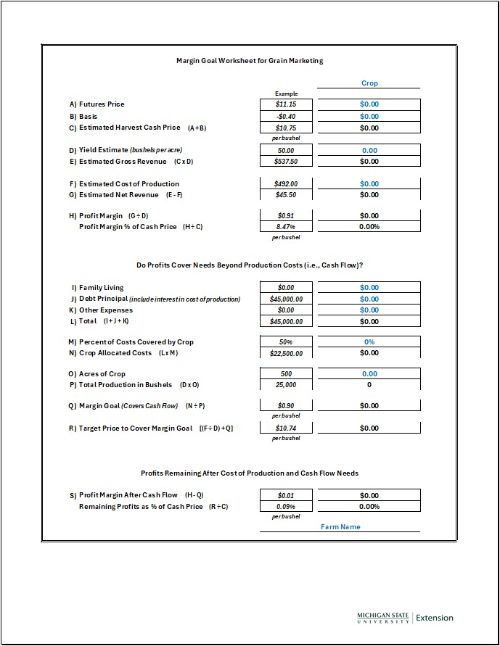
EmailThe Margin Goal Worksheet helps to identify a crop’s profit margins and margin goals.
Profit margins and margin goals are important parts of identifying potential grain profits and can be a strong guide for planting intentions. Crops are raised to be marketed at profitable prices. Profitable prices mean that operating costs are covered and the farm has money left over for its cash flow needs (such as debt payments). Of course, profits can also be used for non-farm expenses, such as any family living costs the farm will provide. Looking at profit margins on a per bushel basis helps to determine if market prices offer enough profit for these additional needs.
Once total cash flow needs for each crop are calculated, a per-bushel cost can be determined by dividing those expenses by the crop’s total production (yield x acres). The per bushel cost is often referred to as a margin goal. Margin goals illustrate the additional profit margin needed to cover cash flow needs or non-production costs.
Download Margin Goal Worksheet
The Margin Goal Worksheet helps to identify a crop’s profit margins and margin goals. To use the worksheet, the following information is needed:
- Futures price
- Basis charge from local grain buyer (i.e., elevator)
- Yield estimate for the crop
- Cost of production estimate for the crop
- Cash Flow needs:
- Debt principal
- Family Living estimates (if applicable)
- Other expenses (if applicable)
- Percent of cash flow needs covered by crop
- Acres of crops to be grown
For best practices, cost of production should also consider typical charges from grain buyers (i.e., elevators) on delivered bushels. Examples: discount schedules (moisture, test weight, damage), hauling distance/mileage, commercial storage (if used), etc.
Percent of costs covered by crop will vary based on acreage splits and portion of cash flow being covered by off-farm income.
Futures prices and basis values are best obtained from price listings offered by intended grain buyers. For additional assistance in identifying potential basis, review Purdue University’s Crop Basis Tool. Additional resources can also be found at MSU Extension’s Commodity Marketing website.