Newly uncovered records reveal how MSU Extension and 4-H mobilized Michigan women and children on the WWII homefront
 Print
Print Email
EmailRecords from MSU Libraries and Archives show how MSU (then Michigan State College) and MSU Extension organized communities and sustained the wartime food supply.
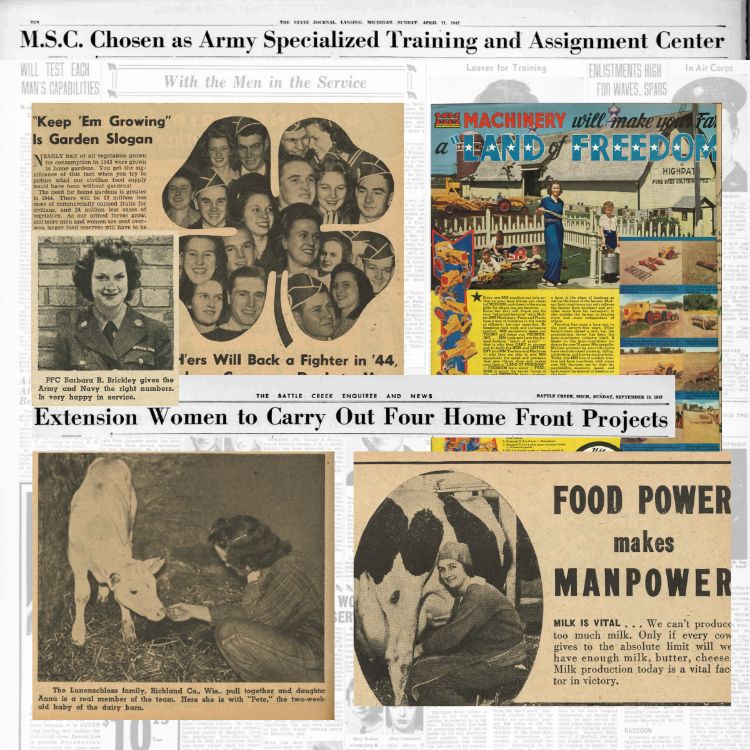
Michigan State University Extension has been strengthening Michigan communities for more than 100 years, bringing real life solutions to real-world problems. While today, those challenges span everything from agriculture and the environment to healthy living, the 1940s presented a singular test: mobilizing communities to support efforts in World War II.
In those trying times – as it still does today – MSU Extension got to work helping Michiganders solve problems, seize opportunity and thrive. Newly surfaced archival materials now offer a clearer picture of just how central that role was, particularly in supporting women who stepped into critical roles across Michigan.
Records were recently rediscovered when MSU Libraries and Archives staff were asked to find primary evidence of MSU’s (then known as Michigan State College, or MSC) and MSU Extension’s impact during the second World War. What they uncovered shows a coordinated, statewide effort to equip women and youth with the skills and support needed to sustain agriculture, households, and local economies during wartime.
On March 13 of this year, people across Michigan gathered in Lansing to honor women who supported our nation’s efforts during this war – women known as Rosie the Riveters. At this event, MSU Libraries shared evidence of MSC’s work through archival photos, newspapers and more.
Fueling the homefront with victory gardens
As World War II intensified and men were deployed overseas, women and children stepped into new (but essential) roles in the home. While some women went to work in manufacturing to build aircrafts, ships and weaponry, others took to planting “victory gardens,” fortifying the nation’s rationed food supply, and enlisting in the U.S. Crop Corp, otherwise known as the Victory Farm Volunteers.
Victory gardens emerged as a critical response to food shortages caused by the war, as the United States worked to feed both armed forces abroad and its allied partners whose food supplies had been disrupted by the war. By encouraging households to grow their own fruits and vegetables, victory gardens reduced pressure on commercial agriculture while ensuring resources could be directed to the war effort overseas.
MSC and MSU Extension played a central role in this effort, delivering education, resources and coordination to help Michiganders grow food at home. Established in March 1942, the Victory Garden Program for Michigan raised awareness of victory gardens while supporting people as they grew food at home.
In 1943, MSU Extension Associate Horticulture Professor Paul Krone was assigned to work with the Michigan Office of Civilian Defense as Chief of the Victory Garden section. In this role, he led the development of educational garden programs and promotional campaigns that scaled up the impact.

These promotional efforts included newspaper and radio campaigns, statewide contests and awareness weeks, posters and window stickers and even a short film trailer shown in movie theaters. Through a series of bulletins and pamphlets, MSU Extension taught individuals what to plant, how to manage garden pests and disease, how to preserve their harvests and more.
Reporting at the time captured the scale of this work. In January 1942, the Port Huron Times described a “revolution” sweeping across American farms as part of this new war program that sought to keep food on the table at home and abroad. By August of that same year, the Battle Creek Enquirer reported that, as labor shortages continued, women in Eaton County were frequently working alongside their husbands in the fields or tending them alone.
One farmer, Mrs. Clyde Thornell was quoted saying,
“I always have worked outdoors with my husband, but this year we expanded our farms operations as part of the war effort. We are farming 60 acres more this year than last [1941], having bought another farm. We have had some help, but I worked right along, too, to get the crops in.”
Stories like Thornell’s illustrate how wartime necessity accelerated changes, not just in who performed agricultural work but also in how communities adapted to wartime realities.
A report of the Michigan Victory Garden program’s success stated that by the end of 1945, roughly 900,000 gardens had been established in Michigan, producing an estimated 62.8 million bushels of food in three years. More than just producing food for civilians during the war, the program introduced lifetime benefits as Michiganders established healthy diets and built hobbies that supported happier and healthier lives.
Women alone were not solely responsible for keeping both their families and American troops fed. Children had a large role to play as well, and initiatives like MSU Extension’s Michigan 4-H program helped support these efforts.
4-H youth mobilize, collecting scraps and raising crops
As cited in Feeding Victory: 4-H, Extension, and the World War II Food Effort by Katherine Sundgreen, Kansas State University Master’s student, Extension and 4-H lost 17,000 agents, community leaders and older 4-H’ers to service or deployment. But that still left nearly 1.5 million current members and 10 million former members who could still aid the national program’s efforts.
In the 1940s, $2.5 million was appropriated to the national 4-H and another $2 million to Cooperative Extension Services to fill gaps in labor left by military servicemen. 4-H created and distributed resource pamphlets encouraging club projects to conserve food and add to the food supply. One of the most visible efforts was the national “Feed a Fighter” 4-H campaign, which challenged young people to produce enough food and livestock products to sustain a serviceman for a year.
Awareness campaigns reinforced this momentum. In 1942, National Mobilization Week for Farm Youth urged 4-H’ers to feed and clothe a fighter and themselves. The week was no longer needed after the war ended, but it was so effective that the event evolved into what is now known as National 4-H Week, held in October.
At the time, President Franklin Delano Roosevelt underscored the importance of these efforts, calling them “essential to ultimate victory.” He continued:
“Let your Head, Heart, Hands, and Health truly be dedicated to your country which needs them now, as never before.”
With the success of victory gardens and National 4-H Mobilization Week, 4-H’ers expanded their contributions even further. In Michigan and beyond, 4-H clubs enrolled village and town youth in farm labor battalions to help with the harvests.

Clubs also sought out to collect materials for reuse in the war effort. Emmett County led all other Michigan counties with a harvest of nearly 150,000 bags of milkweed pods – used for floss for life jackets as a substitute for kapok.
By the end of 1942, 4-H clubs across the U.S. had collected 146 million pounds of scrap metal, 23 million pounds of rubber and 24 million pounds of paper and burlap. 4-H youth had also purchased $6 million in war bonds or stamps; over one-half million girls and boys provided services remaking or repairing clothing; 25,000 youth engaged in air-raid activities; and 450,000 youth engaged in other defense activities.
As the war came to a close, good farming practices; healthy, home-grown foods; and awareness campaigns carried out by both 4-H’ers and Cooperative Extension services were widely recognized as critical to sustaining the nation through the difficulties of wartime.
Reflecting on the program’s impact, Paul Krone wrote: “It is sincerely believed that the victory garden program, which was unquestionably responsible for the production of the tremendous quantities of food for use by the civilian population, played an important part in the winning of the war, by making it possible to maintain the high standard of living to which we in America are accustomed, by making it possible to provide a much greater percentage of commercially grown and canned food to our armed services and to our allies, and by helping to maintain the health and morale of the civilian population."
Today, MSU Extension and 4-H continue to provide these important real-world solutions, teaching our families, communities and future generations positive practices that are grounded in research to make life better for all.
Whether you’re trying to grow better crops or raise confident kids — and in good times or bad — MSU Extension is here to help.