Taming farm fuel costs using farm level planning
 Print
Print Email
EmailAdjusting 2026 farm budgets with rising diesel prices.
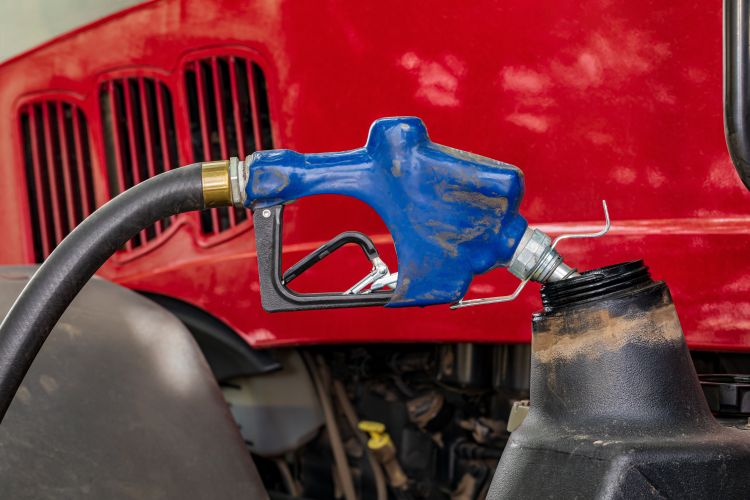
The recent conflict with Iran and restricted passage through the Strait of Hormuz have led to increases in diesel fuel costs. National prices of diesel fuel have steadily increased by almost 40% since the beginning of the conflict, with Michigan prices showing similar trends. Purchases of farm (off-road) diesel fuel have not been immune to these increases. With higher fuel costs, many farms are trying to determine how best to adjust their cost of production estimates. Michigan State University Extension recommends that budgeting start with farm-level planning.
Farm-level planning focuses on the typical field operations for each intended crop. Identifying the fuel usage for an intended crop offers several important considerations.
- Are the tractors being used older or in good repair?
- Are field operations the farm has typically used necessary this year?
- Are there opportunities to reduce or combine field operations?
The answer to these types of questions could help to significantly reduce fuel usage and overall cost. Especially as farms consider the types of soil in the fields they operate and their impact on fuel usage. The first step is to identify fuel usage by field operation, then adjust usage based on soil type.
Tractor condition and fuel usage
Fuel consumption often varies between tractors. Older tractors or those in poor mechanical repair may use 10% or more additional fuel. There are also differences in fuel efficiency between different-sized tractor engines and the fuel needed to move the tractor. However, tractor size is not often a significant consideration, according to Purdue University.
While smaller tractors use fewer gallons per hour than larger tractors, they have to run longer hours to cover the same acres. Often, the gallons per acre between small and larger tractors are similar enough to ignore when estimating fuel usage. Instead, the cost of fuel (gasoline or diesel) is correlated to the field operation, or production activities that each farm uses to grow a crop.
Fuel usage by field operation
Consider that each farm is different in its approach to production. A common example is often no-till versus tillage systems. Fuel costs are reduced in no-till systems due to the lack of tillage. Even no-till planters may offer fuel savings, as they can be easier to pull than conventional planters.
However, the differences in field operations extend beyond broad considerations of no-till versus tillage. Within tillage systems, how a farm approaches primary or secondary tillage is an important consideration. Does the farm use a chisel plow or moldboard plow for primary tillage? Does secondary tillage focus on a field cultivator, tandem disk, offset disk or some other implement? The answer to each question brings with it a difference in fuel usage on a per-acre basis (Figure 1).
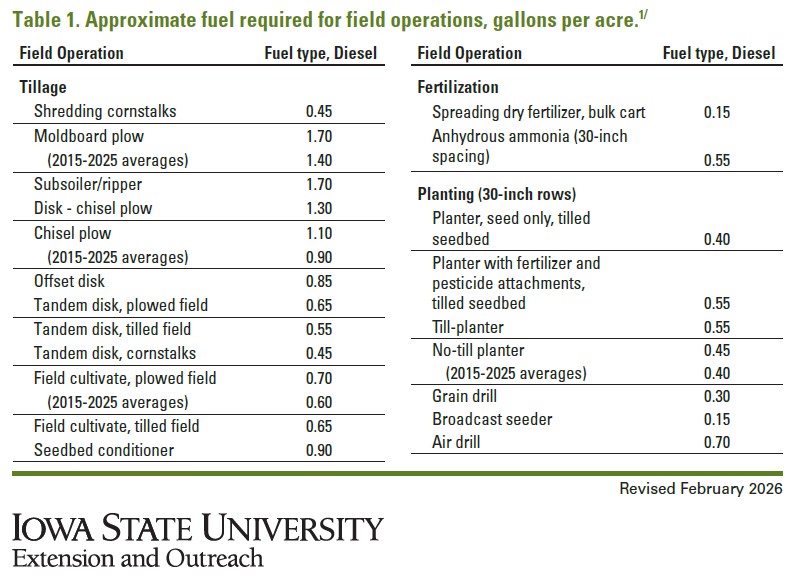
To help farms better identify fuel usage and cost per acre, Iowa State University recently updated their bulletin A3-27: Fuel Required for Field Operations. The report provides an estimate of the average amount of diesel fuel used based on different field operations.
Field operations are often different depending on the crops being raised (Tables 1 and 2). To calculate the impact of higher diesel prices, our next step will be to apply the fuel usage numbers to the operations needed for our specific crops.
|
Table 1. Example Corn Fuel Usage with Tillage Operations |
|
|
Field Operation (tillage system) |
Fuel type, Diesel (gallons/acre) |
|
Fertilization, Spreading dry fertilizer, bulk cart (pre-plant) |
0.15 |
|
Chisel Plow |
0.90 |
|
Field cultivate, plowed field |
0.60 |
|
Planter with fertilizer and pesticide attachments, tilled seed bed |
0.55 |
|
Sprayer, self-propelled (pre-emerge) |
0.08 |
|
Sprayer, self-propelled (post-emerge) |
0.08 |
|
Fertilization, Spreading dry fertilizer, bulk cart (side-dress) |
0.15 |
|
Hauling spray and fertilizer to field (10% of total grain hauling use) |
0.17 |
|
Combine corn |
1.25 |
|
Hauling, field plus 0.5 miles on gravel road |
0.18 |
|
Hauling, added ten miles at 0.15 gallon/acre (10 x 0.15) |
1.50 |
|
Total Season Fuel Needs (gallons/acre) |
5.61 |
|
Price/Gallon of Diesel Fuel (3/30/26)1 |
$4.89 |
|
Fuel Cost/Acre (season fuel needs x price/gallon of diesel fuel) |
$27.40 |
|
1National average price per U.S. Energy Information Administration minus state and federal taxes. |
|
|
Table 2. Example Soybean Fuel Usage with Tillage Operations |
|
|
Field Operation (tillage system) |
Fuel type, Diesel (gallons/acre) |
|
Fertilization, Spreading dry fertilizer, bulk cart (pre-plant) |
0.15 |
|
Field cultivate, plowed field |
0.60 |
|
Planter, grain drill |
0.30 |
|
Sprayer, self-propelled (pre-emerge) |
0.08 |
|
Sprayer, self-propelled (post-emerge) |
0.08 |
|
Hauling spray to field (10% of total grain hauling use) |
0.17 |
|
Combine soybeans |
1.00 |
|
Hauling, field plus 0.5 miles on gravel road |
0.18 |
|
Hauling, added ten miles at 0.15 gallon/acre (10 x 0.15) |
1.50 |
|
Total Season Fuel Needs (gals/acre) |
4.06 |
|
Price/Gallon of Diesel Fuel (3/30/26)1 |
$4.89 |
|
Fuel Cost/Acre (season fuel needs x price/gallon of diesel fuel) |
$19.83 |
|
1National average price per U.S. Energy Information Administration minus state and federal taxes. |
|
Table 1 outlines fuel usage for an example farm raising corn with tillage operations. It uses a chisel plow for its primary tillage and a field cultivator for secondary tillage. It also uses multiple passes of fertilizer spreading, spraying and harvest activities that require different fuel usage. Total gallons needed for the season are 5.61 gallons. The diesel price is $4.98 per gallon, based on the national average price minus state and federal taxes. Total fuel cost for the example corn crop is $27.40 per acre.
Table 2 outlines fuel usage for an example farm raising soybeans with tillage operations. The example farm does not use primary tillage or side-dress fertilizer application. It also uses a grain drill instead of a planter. Total gallons needed for the season are 4.04 gallons. The diesel price remains $4.98 per gallon, resulting in a total fuel cost of $19.74 per acre.
Adjusting fuel usage by soil type
Another important consideration for evaluating the impact of higher fuel prices is soil type. The soil type can impact fuel efficiency for both tillage and planting operations. This makes soil type important even for no-till operations.
Purdue University offers Bulletin AE-110: Estimating Fuel Requirements for Field Operations. It uses many of the same parameters as the bulletin from Iowa State University. It also suggests adjustments to make considering soil types. Soil type can affect fuel use and power requirements based on draft or the horizontal pulling force needed to move implements through the ground. Bulletin A3-27 highlights that Iowa State’s values are based on loam soils, which are considered `moderate-draft' soils (loams and silt loams). Purdue University suggests that, “for `low-draft' soils (sands and sandy loams), reduce the figures by 35-40% for primary tillage, 20% for planting, and 10-15% for secondary tillage and cultivation. For `high-draft' soils (clay loams and clays), increase the values by the same percentages for the different field operations.” These adjustments are illustrated in Figures 3 and 4.
Table 3. Corn Fuel Usage with Soil Factor |
|
Sandy Loam Factor |
Adjusted |
|
Field Operation (tillage system) |
Fuel type, Diesel (gallons/acre) |
Fuel type, Diesel (gallons/acre) |
|
|
Fertilization, Spreading dry fertilizer, bulk cart (pre-plant) |
0.15 |
|
0.15 |
|
Chisel Plow |
0.90 |
0.35 |
0.59 |
|
0.90 - (0.90 x 0.35) |
|||
|
Field cultivate, plowed field |
0.60 |
0.10 |
0.54 |
|
0.60 - (0.60 x 0.10) |
|||
|
Planter with fertilizer and pesticide attachments, tilled seed bed |
0.55 |
0.20 |
0.44 |
|
0.55 - (0.55 x 0.20) |
|||
|
Sprayer, self-propelled (pre-emerge) |
0.08 |
|
0.08 |
|
Sprayer, self-propelled (post-emerge) |
0.08 |
|
0.08 |
|
Fertilization, Spreading dry fertilizer, bulk cart (side-dress) |
0.15 |
|
0.15 |
|
Hauling spray and fertilizer to field (10% of total grain hauling use) |
0.17 |
|
0.17 |
|
Combine corn |
1.25 |
|
1.25 |
|
Hauling, field plus 0.5 miles on gravel road |
0.18 |
|
0.18 |
|
Hauling, added ten miles at 0.15 gallon/acre (10 x 0.15) |
1.50 |
|
1.50 |
|
Total Season Fuel Needs (gals/acre) |
5.61 |
|
5.12 |
|
Price/Gallon of Diesel Fuel (3/30/26)1 |
$4.89 |
|
$4.89 |
|
Fuel Cost/Acre (season fuel needs x price/gallon of diesel fuel) |
$27.40 |
|
$25.03 |
|
1National average price per U.S. Energy Information Administration minus state and federal taxes. |
|||
Table 4. Soybean Fuel Usage with Soil Factor |
|
Sandy Loam Factor |
Adjusted |
|
Field Operation (tillage system) |
Fuel type, Diesel (gallons/acre) |
Fuel type, Diesel (gallons/acre) |
|
|
Fertilization, Spreading dry fertilizer, bulk cart (pre-plant) |
0.15 |
|
0.15 |
|
Field cultivate, plowed field |
0.60 |
0.10 |
0.54 |
|
0.60 - (0.60 x 0.10) |
|||
|
Planter, grain drill |
0.30 |
0.20 |
0.24 |
|
0.55 - (0.55 x 0.20) |
|||
|
Sprayer, self-propelled (pre-emerge) |
0.08 |
|
0.08 |
|
Sprayer, self-propelled (post-emerge) |
0.08 |
|
0.08 |
|
Hauling spray to field (10% of total grain hauling use) |
0.17 |
|
0.17 |
|
Combine soybeans |
1.00 |
|
1.00 |
|
Hauling, field plus 0.5 miles on gravel road |
0.18 |
|
0.18 |
|
Hauling, added ten miles at 0.15 gallon/acre (10 x 0.15) |
1.50 |
|
1.50 |
|
Total Season Fuel Needs (gals/acre) |
4.06 |
|
3.94 |
|
Price/Gallon of Diesel Fuel (3/30/26)1 |
$4.89 |
|
$4.89 |
|
Fuel Cost/Acre (season fuel needs x price/gallon of diesel fuel) |
$19.83 |
|
$19.24 |
|
1National average price per U.S. Energy Information Administration minus state and federal taxes. |
|||
Tables 3 and 4 outline how Tables 1 and 2 would be adjusted for a sandy loam soil type. Table 3 shows a net change is 0.49 gallons per acre less (5.61 – 5.12 gallons/acre). The net result is $25.03 per acre or a net reduction of $2.37. Table 4 reveals a net change of 0.12 gallons per acre less (4.06 – 3.94 gallons/acre). The net result is $19.24 per acre or a net reduction of $0.59 per acre. The main difference between the examples is the lack of primary tillage for soybeans. This difference illustrates the importance of field operations and soil type to the value of farm-level planning.
Farm-level planning is an important step in navigating higher diesel fuel prices. The field operations per crop and the adjustments to soil type can identify how impactful prices are for individual farms. Understanding the level of impact is also important if a farm is still considering final planting intentions. How a farm approaches field operations for corn or soybeans could be a significant deciding factor if diesel fuel prices remain elevated.