USDA awards more than $16.2M for MSU greenhouse renovations
 Print
Print Email
EmailThe upgrade efforts, which will help researchers advance solutions to some of agriculture's toughest challenges, will also receive matching funds from MSU that create $32.5M in new support.
EAST LANSING, Mich. — Through the Research Facilities Act Program, the U.S. Department of Agriculture’s National Institute of Food and Agriculture (USDA NIFA) has awarded more than $16.2 million for Michigan State University’s ongoing Plant Science Research Greenhouse Complex renovations.
Per the program’s requirements, MSU is providing matching funds to create more than $32.5 million in new support for the project. MSU received the third-largest award from the total $121 million investment in research facilities across the country.
The Research Facilities Act Program provides financial assistance to institutions for the construction, alteration or modernization of research facilities that host basic, applied and developmental agricultural research.
The program places an emphasis on infrastructure that promotes research, teaching and extension activities that enable the training of future researchers and professionals in a wide range of agricultural industries. Program priorities focus on themes such as advancing agricultural productivity and profitability, supporting domestic agricultural markets, promoting sustainable resource use, and enhancing resilience against insects, diseases and environmental pressures.
“The USDA NIFA funding will allow our researchers, staff and students to benefit from high-quality greenhouse facilities, and we’re grateful to USDA for recognizing the importance of this project,” said Matt Daum, associate provost and dean of the College of Agriculture and Natural Resources (CANR). “We also appreciate the tremendous role our partners have played in securing funding, including legislators at the federal and state levels, as well as our agriculture commodity organizations, business leaders and Michigan’s farmers.”
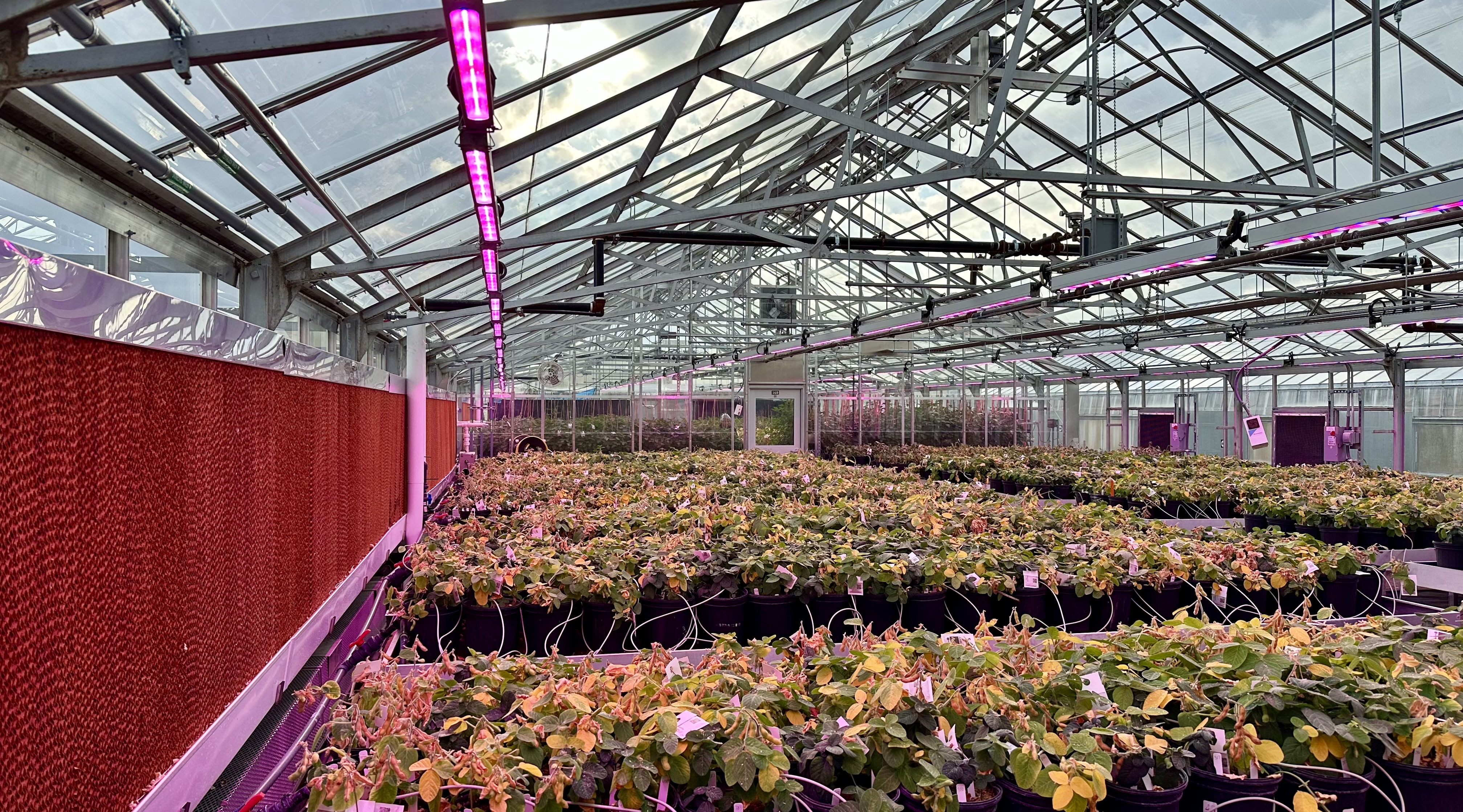
To date, roughly $40 million from the State of Michigan and MSU units has led to new construction and renovation of about 60% of the research greenhouses, including a new headhouse, environmental control systems, LED lighting, glazing panels and taller ceilings for larger crops. Upon completion of the latest project phase in April 2026, however, 40% of the greenhouses have received little to no updates.
When USDA NIFA announced a request for proposals through the Research Facilities Act Program in June, MSU leaders saw great opportunity to enhance the greenhouses for the more than 400 users in CANR and the College of Natural Science.
“In a state with an unpredictable growing season, our greenhouses are critical for plant research,” College of Natural Science Dean Eric L. Hegg said. “This funding will give our faculty quality spaces and controlled environments to do what they do best — the unseen but vital research that lays the foundation for farmers, plant breeders and agricultural innovators to better feed the world.”
In addition to addressing the unrenovated greenhouses by installing LED lighting, environmental controls and taller ceilings, other features will be added throughout the complex. This includes automated shade and energy curtains that give researchers the ability to manipulate environmental conditions such as light exposure, temperature and humidity — all while increasing energy efficiency.
“Funding from USDA NIFA and the university will greatly expand the research our scientists can perform in the greenhouses,” said Erik Runkle, a professor and MSU Extension specialist in the Department of Horticulture and co-chair of the MSU Plant Science Research Greenhouse User Committee. “The new facilities will give us much tighter and more reliable control of temperature and light, which are the main drivers of plant growth. They will also eliminate research barriers, such as height restrictions on tall crops and obstacles in drought studies and pest control research.
“Just as importantly, they will operate more sustainably than the greenhouses they replace. Once this project and the Plant and Environmental Sciences Building are complete, we will have one of the largest and most sophisticated plant growth facilities in the U.S. and beyond.”
Chad Cotti, MSU AgBioResearch interim director, said with USDA NIFA’s support, MSU scientists will have the necessary tools to meet the plant agriculture industry’s needs of today and tomorrow.
“MSU is one of the world’s leading plant science research institutions, and we need modern infrastructure to build on that foundation,” Cotti said. “This funding strengthens our mission of finding solutions to the major challenges facing plant agriculture in Michigan, across the U.S. and all over the world. The upgrades already made to the facility allow us to do many types of experiments that were not previously possible, but bringing the entire complex up to that level will spur innovation in even more areas for years to come.”
Working with Michigan plant agriculture partners
The greenhouses are vital to some of MSU’s preeminent research endeavors, including the Department of Energy-funded Plant Research Laboratory (PRL) and the Plant Resilience Institute (PRI).
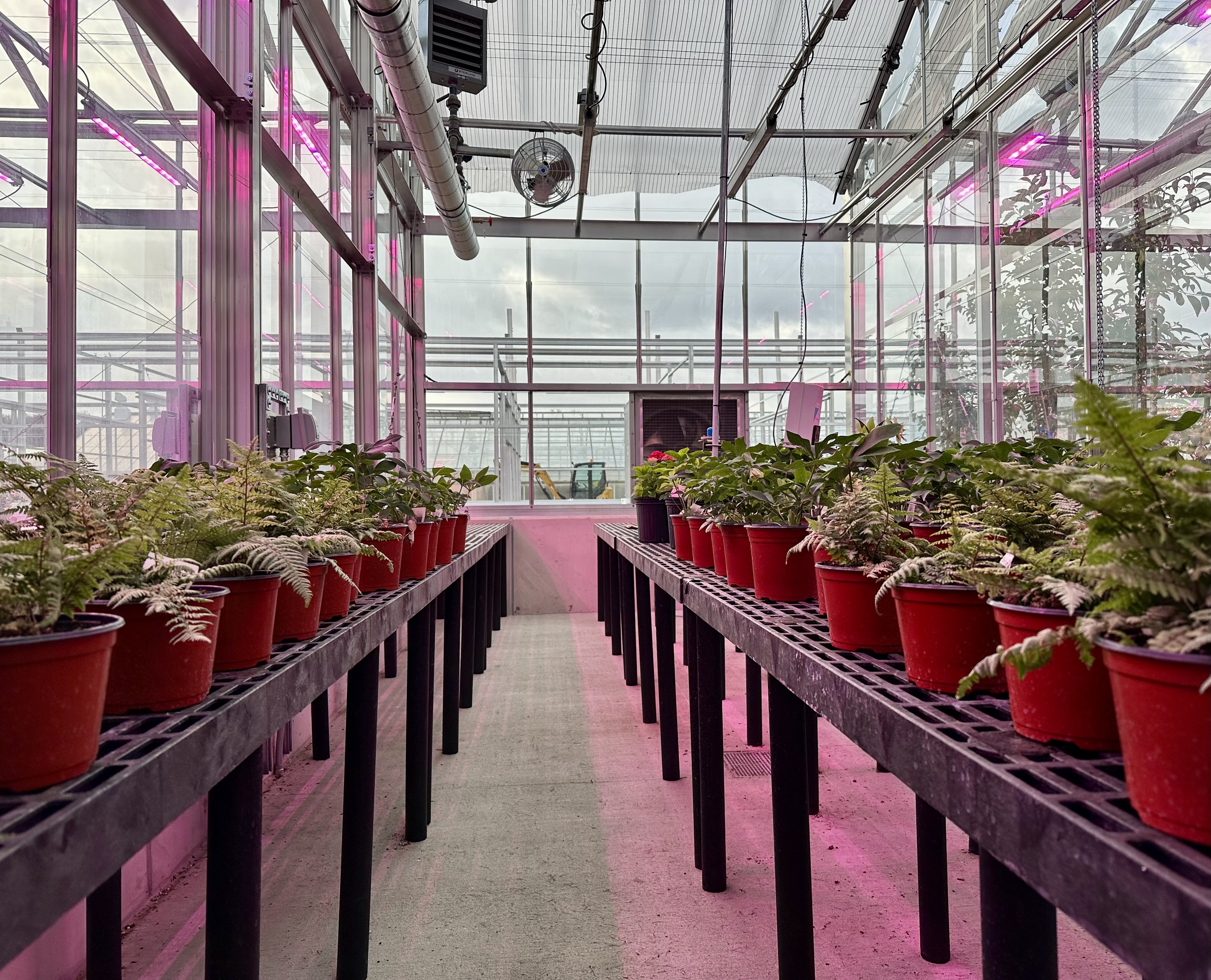
For more than 60 years, PRL faculty members have conducted basic research to uncover how photosynthetic organisms operate, ultimately seeking to develop technologies that improve life in myriad ways. Scientists in the PRI use basic and applied studies to advance plant resilience in the face of increasingly unstable environmental conditions.
On the applied research side, two State of Michigan-funded programs administered by MSU AgBioResearch and MSU Extension — Project GREEEN and the Agricultural Resiliency Program — support a variety of research in the greenhouses. Both are partnerships among MSU, the Michigan Plant Coalition, and the Michigan Department of Agriculture and Rural Development.
While Project GREEEN tackles emerging plant agriculture issues such as insect and disease control, the Agricultural Resiliency Program is aimed at long-term, cross-commodity challenges with extreme weather and water. Each program awards grants for research and outreach directed at industry-defined priorities, ensuring MSU is addressing the most pressing topics.
Michigan’s vibrant specialty crops sector relies heavily on these programs due to a lack of private industry research funding, and the MSU greenhouses are an essential element to the discovery process.
“Michigan's growers operate in one of the most diverse agricultural landscapes in the country, which also leaves us highly vulnerable to emerging pest pressures and unpredictable weather patterns,” said Nancy Nyquist, executive director of the Michigan Blueberry Commission and the Michigan Tree Fruit Commission. “Securing the Research Facilities Act Program funding is a vital step toward ensuring our growers have a modern, state-of-the-art defense system. Upgrading MSU’s controlled environment facilities allows researchers to simulate real-world threats in real-time, delivering the fast, actionable data that our fruit, vegetable and specialty crop industries need to remain competitive and resilient.”
MSU Extension Director Quentin Tyler said strong backing from Michigan’s agricultural industries was critical to receiving the award.
“Our partners helped demonstrate why this investment matters for Michigan agriculture,” Tyler said. “Their support speaks to the importance of having research capacity to address the challenges growers are facing today and prepare for what’s ahead.”
Along with Nyquist, Michigan Agri-Business Association President Chuck Lippstreu and several other partners submitted letters of support to USDA NIFA on behalf of MSU. Lippstreu touted the funding as a major victory for the university and all of Michigan agriculture.
"This award represents a historic investment in agricultural innovation for our state," Lippstreu said. "The world-class greenhouse modernization supported by this grant will continue MSU's strong agricultural research momentum. It will directly improve a wide range of key capabilities, from plant breeding and variety improvement to better disease and pest resilience, and beyond.
“Ultimately, this supports the full range of farmers and rural businesses across America's most-diverse agricultural state with abundant access to water. We thank USDA NIFA for recognizing the value of this project and MSU leaders for their vision and proactive leadership.”
The funding application effort was co-led by Kang Xia, CANR associate dean for research and associate director for AgBioResearch, and Michelle Mazei-Robison, associate dean for research and infrastructure for the College of Natural Science. Also providing support was a team of faculty and staff, as well as MSU leadership in the Office of Research and Innovation, Office of the Provost, Infrastructure Planning and Facilities, Institutional Space Planning and Management, Office of Financial Planning and Budget, and MSU Foundation.
Michigan State University AgBioResearch scientists discover dynamic solutions for food systems and the environment. More than 300 MSU faculty conduct leading-edge research on a variety of topics, from health and agriculture to natural resources. Originally formed in 1888 as the Michigan Agricultural Experiment Station, MSU AgBioResearch oversees numerous on-campus research facilities, as well as 15 outlying centers throughout Michigan. To learn more, visit agbioresearch.msu.edu.