West central Michigan tree fruit update – July 2, 2026
 Print
Print Email
EmailSweet cherries are being harvested across the region, and tart cherry harvest will start next week for some growers.
Weather update
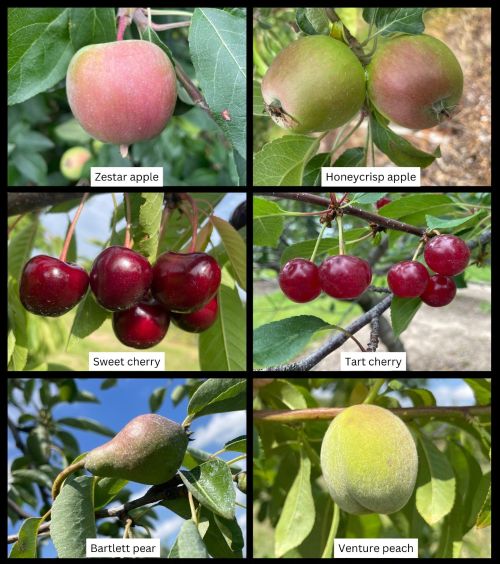
Weather this week has been extremely hot with scattered showers and pop-up storms due to high heat and high humidity for the west central and Grand Rapids, Michigan, regions. Fruitlets continue to grow rapidly for tree fruit crops such as cherry, peach and apple (Figure 1). As of July 2, degree-day (DD) accumulations are 1,537 DD42 and 920 DD50 at the Hart Enviroweather station and 1,727 DD42 and 1,068 DD50 at the Sparta Enviroweather station. Degree-day accumulation has been high over the past week.
One of the challenges of the current weather is that nighttime temperatures have also remained high. High temperatures have been in the 80s and 90s with lows in the upper 60s and 70s over the past few days. This trend will continue through the weekend and into next week. Humidity will also continue to be high, and storms are in the forecast for the next few days. Severe storms may develop, and pop-up storms can form quickly, so be sure to watch the weather and leave the orchard if there is lightning.
Listen to the weather update from Jeff Andresen, MSU climatologist, at the Fruit & Nuts Weather page from MSU Extension.
Weather data was gathered from MSU Enviroweather.
More information and reports on normal weather conditions and departures from normal can be found on the NOAA Climate Prediction Center website, NOAA U.S. Climate Normals website, NOAA Climate Normals Quick Access Page.
Crop update
With extreme heat, be sure to drink plenty of water, take breaks to cool off, and eat well. Growers and farm workers are at high risk of heat stress this week. Also, know the signs of heat stress to know how to help if someone develops a heat-related illness. Read more information about heat stress and heat stress prevention strategies.
Irrigation will also be important over the next week or so. This extreme heat will cause stress for tree fruit, and the evaporative demand is very high. Monitor soil moisture status and scout blocks to evaluate irrigation needs.
Apple varieties are being hand-thinned. It may also be time for another summer spray of NAA to enhance return bloom, especially for varieties that tend to be biennial. Summer NAA applications are recommended at five, seven and nine weeks after bloom for varieties with a heavy crop load or tend to have poor return bloom. At this timing, fruitlets are about 1 inch in diameter and no longer sensitive to NAA as a chemical thinner like they are when fruitlets are smaller. Flower bud initiation has already begun for most varieties such as Honeycrisp and Minneiska, but three applications of summer NAA treatments at 5 parts per million (ppm) during the next 30 days have been shown to enhance return bloom of varieties like Golden Delicious, Jonagold, Fuji and Empire. Read more information about return bloom sprays.
Managing summer diseases such as fly speck and sooty blotch is important going forward. A scheduled fungicide program from mid-June through August will be effective against these diseases.
Fruit are also susceptible to sunburn at this timing, particularly sunburn necrosis. Protectant strategies to help mitigate sunburn include protectant products, irrigation and protective netting. For more about sunburn in apple and mitigation strategies, see the following articles:
- Sunburn risk in PA orchards – Penn State University
- Sunburn in apple and strategies to mitigate it – Washington State University
Tart and sweet cherry fruitlets are ready for harvest. Sweet cherries are being harvested and flavor and size are excellent. Tart cherries will be ready for harvest shortly, and some growers will start harvesting tart cherry next week. Spotted wind drosophila are being trapped in Oceana County in low numbers, only one per trap. However, now that cherries are maturing, their risk of spotted wing drosophila infestation is very high. With fewer sweet and tart cherries in the west central region this year, fruit that is being harvested should be protected. The fruit that is present will be targeted by spotted wing drosophila more intensely than when there are more cherries on the trees.
The extreme high temperatures we’re experiencing may slow development and activity for some pests such as spotted wing drosophila. Focus on managing adults with excellent coverage, full covers, and tightening spray intervals if populations build. A minimum of seven-day spray intervals under dry conditions is recommended with tighter intervals following a rain or other wetting event if needed. Be sure to rotate chemistries to manage for resistance of spotted wing drosophila. Remember that trap counts are not necessarily an indicator of fruit infestation. It is important to sample fruit to monitor if larvae are present in fruit. Read more about managing spotted wing drosophila in Michigan cherry.
Cherry leaf spot symptoms have been observed across the county. Continue protecting trees from leaf spot infection to keep leaves healthy through mid-September. Copper products and Captan provide good protection during this time of year. With hot weather, use caution when spraying fungicides to avoid toxicity. Some bronzing can occur with applications of copper, but mild bronzing should not impact photosynthetic capacity for healthy leaves.
Brown rot management will also be needed as fruit mature, particularly for sweet cherries. As a reminder, Indar is no longer effective against American brown rot due to resistance development. Scout blocks for brown rot over the coming days. Fruit are highly susceptible as they ripen, especially in warm and humid conditions, and brown rot can spread rapidly. Extensive heat like we are experiencing is not optimal for fungal growth which could helpful, but protective fungicide programs should still be used to protect fruit, especially if there is already fruit damage from birds or cracking.
Peaches are being hand thinned across the region for fresh and processing varieties.
Additional pest and disease information
The second generation of oriental fruit moth is starting at some locations. Codling moth counts were low or at zero this week, depending on the site. Obliquebanded leafroller adults were trapped this week with 18 adults per trap in Oceana County.
American plum borer, lesser peachtree borer and greater peachtree borer had zero catches this week at the West Michigan Research and Extension Center. Dogwood borer was trapped at an average of 27 adults per trap.
Other pests to scout for this week include rose chafer, green peach aphid, European red mites and white apple leafhopper.
European red mite is active in warm and dry conditions, which are favorable for egg hatch and larvae activity. Scout for European red mites in apple and pear.
Green apple aphid nymphs and adults were observed feeding on the underside of leaves this week. Scout to determine if management is needed. Many aphid predicators such as lady beetles and lacewings can help keep aphid populations in check. In general, established orchards can sustain thresholds of an average of three to four infested leaves on terminals before fruit damage occurs.
Green peach aphid may be present in orchards this week. Adults and nymphs cause leaf curling and yellowing from feeding on the undersides of leaves. Monitor orchard blocks to determine if treatment is needed.
Scout for rose chafer adults on leaves and fruit where rose chafer typically feed. Damage can be more severe in sandy locations near the orchard edge and grassy areas.
Rosy apple aphid and woolly apple aphid are common pests in our region. Scout for colonies of rosy apple aphid nymphs in fruit clusters. Woolly apple aphids have been observed in orchards this week.
Twospotted spider mites are active in hot and dry weather like we have right now. Scout for twospotted spider mites in addition to European red mites. Check for necrosis or bronzing of leaves and webbing on the underside of the leaf. Twospotted spider mites can impact leaf health in combination with European red mite and plum rust mite if feeding is heavy. “Firing” in tart cherry has been associated with this mite complex and can cause branch die back in hot and dry conditions.
For more information about regional reports, please visit the Michigan State University Extension website.
This work is supported by the Crop Protection and Pest Management Program (grant no 2024-70006-43569) from the USDA National Institute of Food and Agriculture. Any opinions, findings, conclusions, or recommendations expressed in this publication are those of the author(s) and do not necessarily reflect the view of the U.S. Department of Agriculture.