Wildfire smoke: Concerned about your floriculture crops?
 Print
Print Email
EmailMichigan has been one of the most affected states, with thick smoke that decreased visibility to a mile or less.
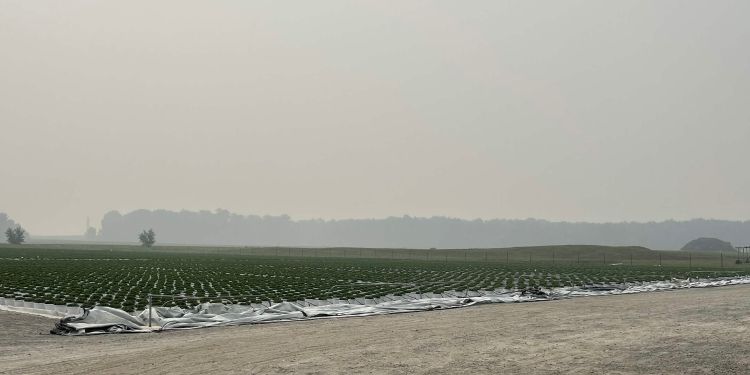
Smoke from the wildfires in the boreal forests of northern Minnesota and Ontario, Canada has been in the news almost every day for the last week. Michigan has been one of the most affected states, with thick smoke that has decreased visibility to a mile or less. Pollution from wildfire smoke also made the news in Michigan in 2023 and 2025, but the fires were farther away in British Columbia and Alberta. As a result of the smoke, the particulate matter (PM2.5) significantly reduced air quality in Michigan when the wind came from the northwest. Table 1 shows examples of the air quality index (AQI) at select Michigan locations from July 15 to July 17, 2026.
Table 1. Air Quality Index (AQI) values for July 15 to July 17 at various locations throughout Michigan.
|
|
Date |
||
|
Location |
7/15/26 |
7/16/26 |
7/17/26 |
|
Western Upper Peninsula |
532 |
619 |
241 |
|
Grand Rapids |
89 |
482 |
281 |
|
Kalamazoo |
56 |
287 |
254 |
|
Detroit |
224 |
490 |
282 |
*Data from Airnow.gov
**(0-50: Good, 51-100 Moderate, 101-150 Unhealthy for Sensitive Groups, 151-200 Unhealthy, 201-300 Very Unhealthy, 301+ Hazardous)
Not surprisingly, some of the greatest AQI values were at downwind locations of the fires in the western Upper Peninsula of Michigan, which were 532 on July 15 and 619 on July 16. While the air quality has clearly been dangerous at times for people and their pets, the potential impacts on plants in general, and floriculture crops specifically, are unclear.
At its worst, the smoke decreased sunlight by 20 to 80%, according to MSU Enviroweather stations across the state. A reduction of 20% is not cause for concern since it is comparable to a partly cloudy day. However, heavily affected regions, such as McMillian in the Upper Peninsula of Michigan, reported one of the lowest solar radiation values reaching the ground on 7/15 according to the MSU Enviroweather system (Figure 1). The only other weather event that could cause such an extreme reduction in solar radiation would be dense fog the entire day.
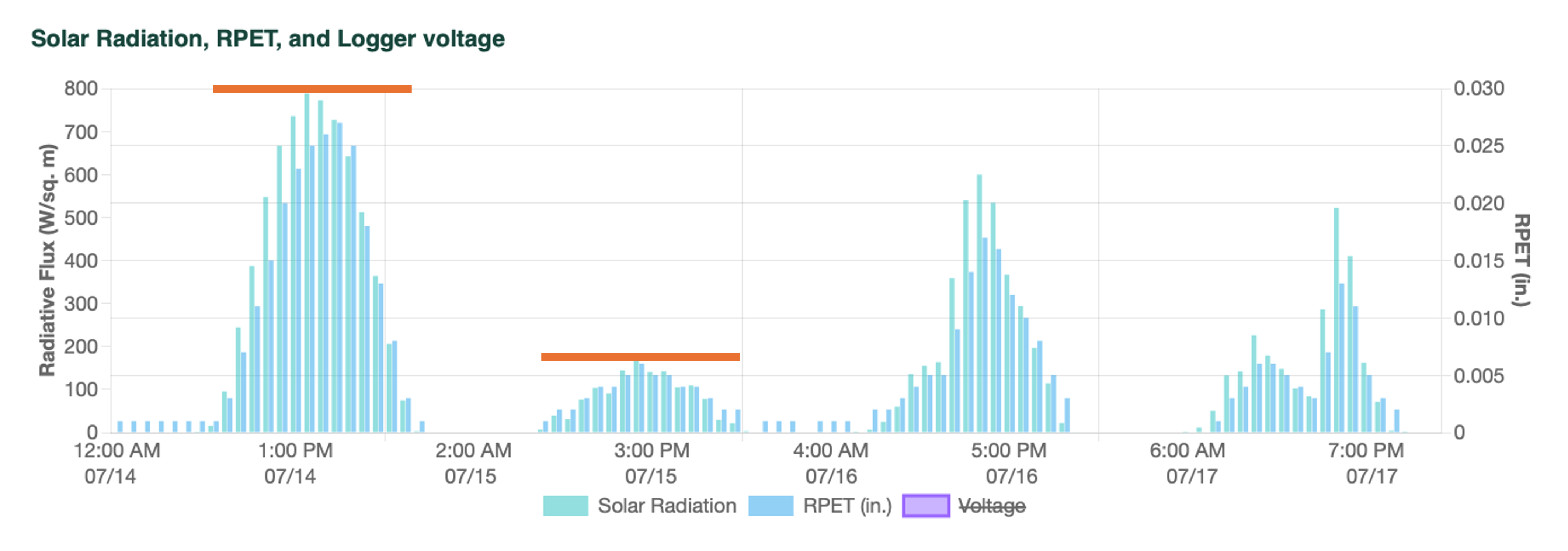
While this is significant, the events of reduced solar radiation have occurred during the longest and brightest days of the year, when the average daily light integral outside is typically greater than 40 mol∙m–2∙d–1. Thus, the DLI outside has been at least 15 to 25 mol∙m–2∙d–1. Even if half of the obstructed sunlight did not enter the greenhouse or outdoor production field, plants still received at least 10 mol∙m–2∙d–1 on the most polluted days. This meets the recommended minimum DLI for most floriculture crops. For DLI to reduce growth this time of year, there would have to be a long stretch of time with extremely heavy air pollution.
Another concern is the components of wildfire smoke. Smoke contains gases that can damage plant tissue and potentially decrease growth. Sulfur dioxide, nitrogen dioxide, and ethylene can cause severe effects on crops, including leaf burn, twisting of stems and flower abortion. These symptoms are often most apparent on new growth. However, these gases are only high enough to be troublesome close to a wildfire, for example within 10 or 20 miles.
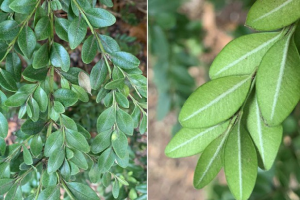
For many, the more concerning gases in wildfire smoke are nitrogen oxides and volatile organic compounds (VOCs) that can create surface ozone. These gases can travel hundreds, if not thousands of miles downwind. Ozone concentrations can exceed levels that, with prolonged exposure, can cause leaf chlorosis and speckling of leaves, decrease photosynthesis, and thus decrease crop growth (Photo 2). These effects are most likely to be subtle, but Michigan State University Extension recommends that growers should nevertheless be on the lookout for crops that show unexpected growth responses. Sensitivity can vary among species and cultivars.
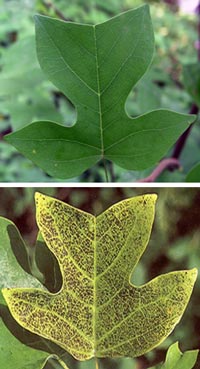
While the poor air quality has certainly been concerning, there may have been a few small positives. The decreased sunlight likely meant our days were a few degrees cooler than they would have otherwise been. High temperatures, especially above 85 degrees Fahrenheit, can limit chrysanthemum growth and lead to poor branching. It can also delay flowering when a crop is induced to flower under short days. In addition, the smoke diffused the sunlight, similar to the effects of clouds. Diffused light penetrates deep into a canopy, which can be helpful in dense canopies.
Thankfully, a couple of rain events and firefighting efforts have reduced the wildfires in the area, however, there are still hundreds of fires still burning and will likely burn until the fall. There is a possibility of more air quality issues in the Great Lakes region during this growing season due to the continuation of wildfires, but hopefully they will not be as extreme as seen during the week of July 13.
While wildfire smoke is unlikely to cause excessive shading or phytotoxic effects on floriculture crops, Michigan State University Extension recommends that growers in the most polluted areas should monitor their crops for subtle symptoms of surface ozone exposure.