2026 KBS LTAR Newsletter
DOWNLOADJanuary 1, 2026
 Print
Print Email
EmailFrom the Director
LTAR differs from many other agricultural research efforts in three important ways—it is stakeholder driven, systems-oriented, and intended to be long-term. But being long-term does not mean we have to wait a long time to draw conclusions and operationalize findings. Indeed, an early expectation voiced by stakeholders is that useful results will be reported, critiqued, and made usable far sooner than a typical scientific publication cycle.
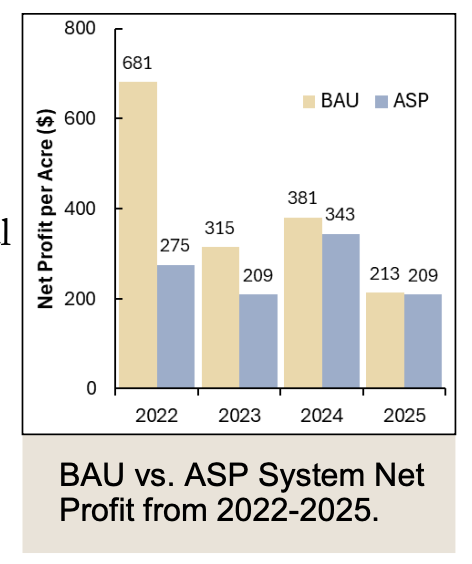
One area that lends itself to immediate feedback is economics. On page two of this newsletter we present yields and profits for the 2025 growing season of the Aspirational Cropping System Experiment. We show that the economic gap between the Aspirational (ASP) and Business-as-Usual (BAU) systems has closed substantially. But details matter. For example, starting with corn or soybeans rather than wheat, canola, or forage can avoid the economic gap altogether. Examining the costs and returns of individual practices can further reveal how to improve returns.
We are hopeful that these analyses will give farmers and advisors the insights needed to test practices on their own operations.
— Phil Robertson, KBS LTAR Director
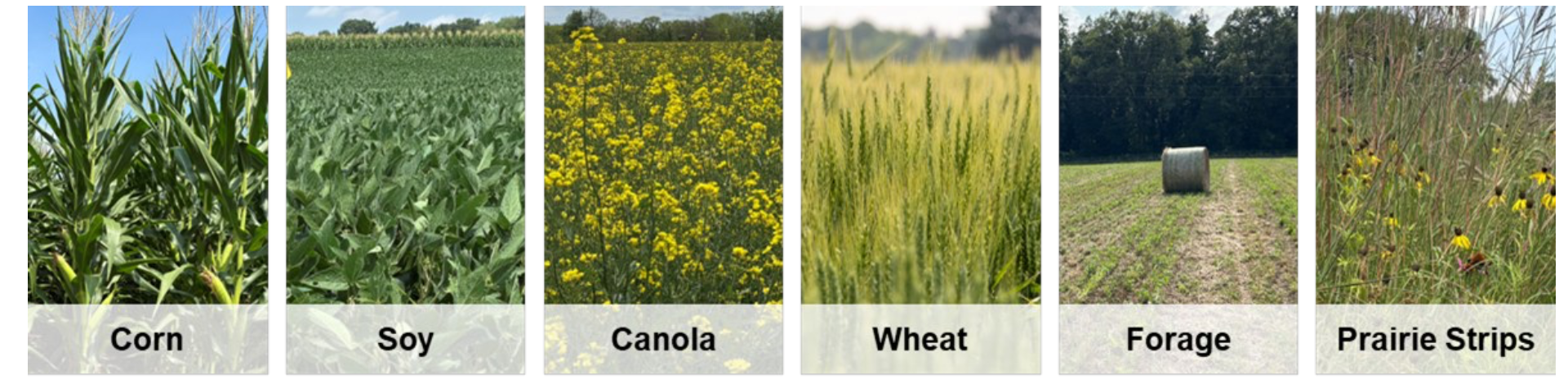
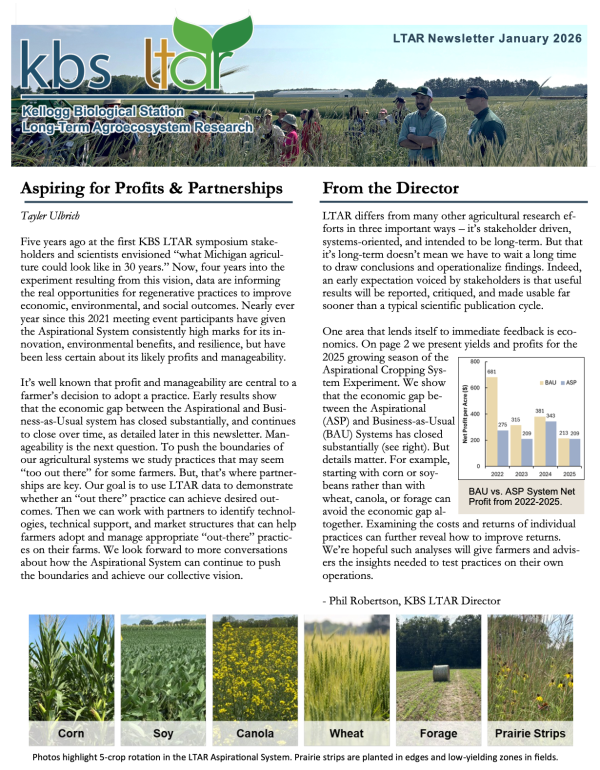
Photos highlight the 5-crop rotation in the LTAR Aspirational System. Prairie strips are planted in edges and low-yielding zones in fields.
Aspiring for Profits & Partnerships
Tayler Ulbrich
Five years ago at the first KBS LTAR symposium, stakeholders and scientists envisioned what Michigan agriculture could look like in 30 years. Now, four years into the experiment resulting from this vision, data are informing real opportunities for regenerative practices to improve economic, environmental, and social outcomes.
Nearly every year since the 2021 meeting, event participants have given the Aspirational System high marks for innovation, environmental benefits, and resilience, but have been less certain about its likely profits and manageability. Profit and manageability are central to a farmer’s decision to adopt a practice.
Early results show that the economic gap between the Aspirational and Business-as-Usual systems has closed substantially and continues to close over time. Manageability is the next question. To push the boundaries of agricultural systems, KBS LTAR studies practices that may seem “too out there” for some farmers. This is where partnerships are key. LTAR data help determine whether innovative practices can achieve desired outcomes, and partnerships help identify the technologies, technical support, and market structures that make adoption feasible.
Agronomy and Economics
Brook Wilke
Mild spring conditions in 2025 led to excellent wheat and canola development and good planting and emergence of corn and soybeans. Warm weather in June shortened grain fill periods and reduced yield potential of wheat and canola. August and September were dry, limiting soybean and corn yields.
- Cabbage seedpod weevils reduced canola yields by approximately 25%.
- Volunteer canola reduced yields of the first forage cutting.
- Slug populations were low, resulting in good stands of ASP soybeans.
- Fall drought led to premature senescence of corn and soybeans, particularly in BAU fields.
Overall, BAU and ASP returned similar system-level net profits at the plot scale, though market prices drove lower profits than in previous years. Prairie strips were harvested for the first time, providing $79 per acre (excluding establishment costs).
2025 System Summary
| Crop | BAU Yield | BAU Profit | ASP Yield | ASP Profit |
|---|---|---|---|---|
| Corn | 207 Bu/A | $251/A | 222 Bu/A | $448/A |
| Soybeans | 56 Bu/A | $175/A | 56 Bu/A | $200/A |
| Wheat Grain | 96 Bu/A | $158/A | ||
| Wheat Straw | 2 Tons/A | $157/A | ||
| ASP Prairie | 3 Tons/A | $79/A | ||
| Whole System | $213/A | $209/A | ||
Precision Fertilizer by Drone
Bruno Basso & Ruben Ulbrich
Nitrogen limits crop yield, and its uneven availability within fields challenges nitrogen management. Conventional uniform-rate applications can reduce profits and harm the environment by polluting water sources and increasing nitrous oxide emissions.
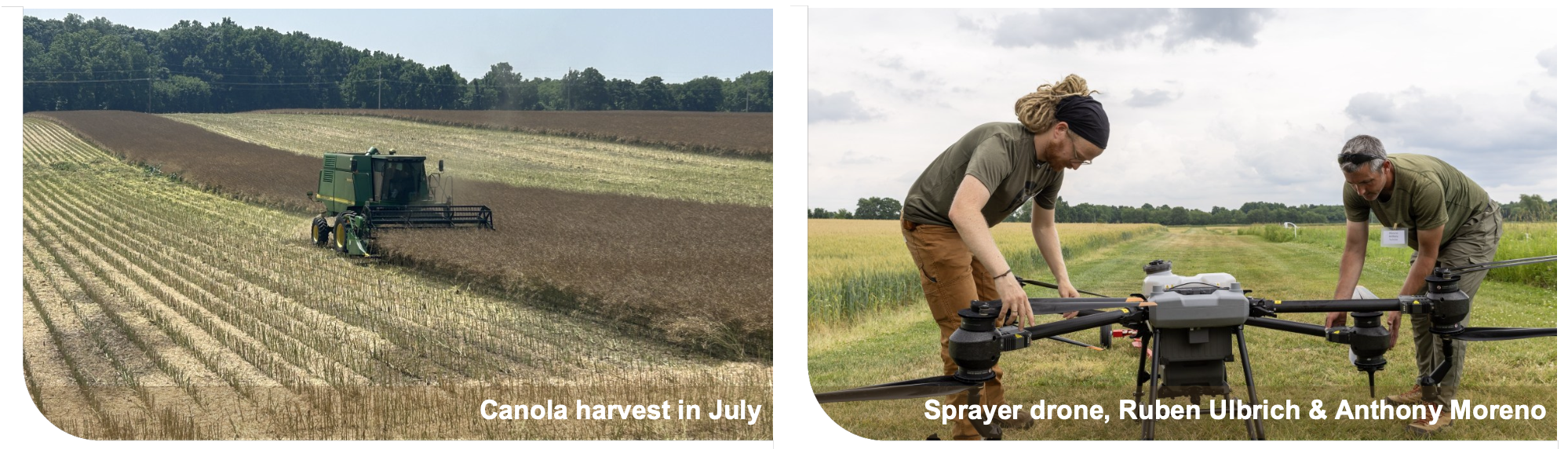
Graduate student Francesca Mignola is studying how drone-based fertilizer applications compare with traditional ground-based methods. Early results indicate that splitting nitrogen into multiple UAV applications can significantly reduce nitrous oxide emissions without reducing yields.
Environmental Impact Updates
Phil Robertson
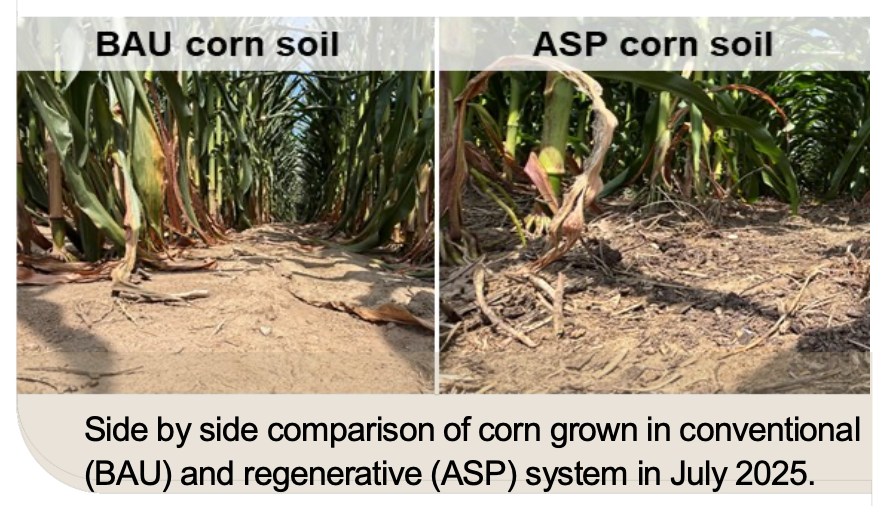
It can take years to fully understand how changes in agricultural management affect the environment, but early results are promising. ASP fields show greater resistance to erosion and sediment runoff compared to BAU fields, particularly following intense rainfall events.
Early nitrate leaching results also show very low nitrate loss to groundwater in some ASP treatments, helping identify combinations of practices that improve nitrogen retention and water quality.
Innovations on the Horizon for ASP
Brook Wilke
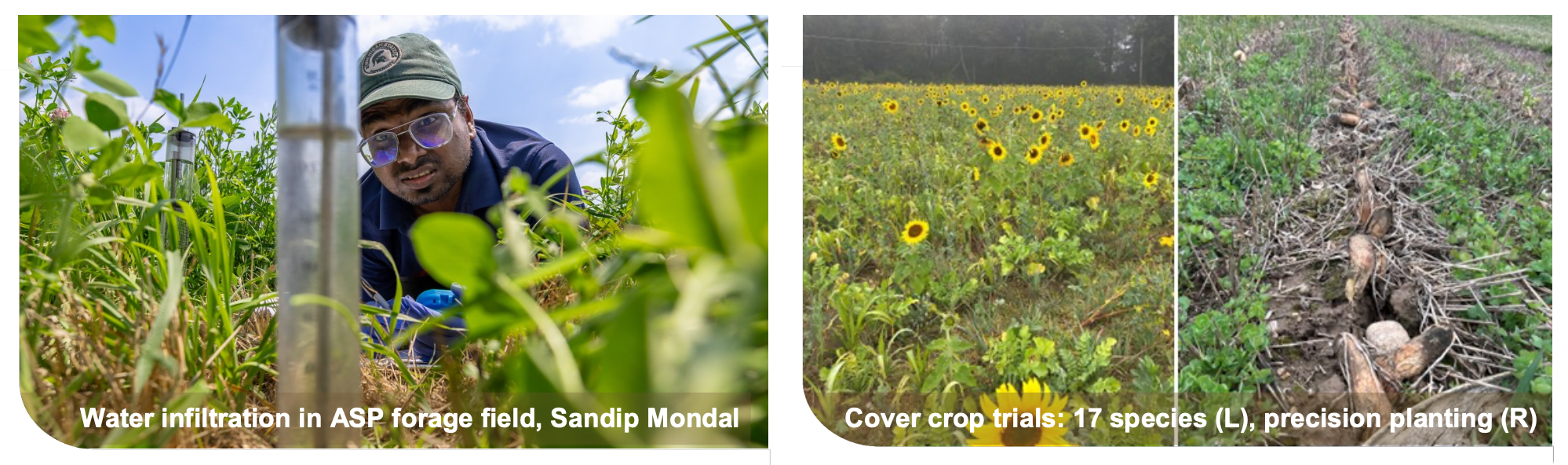
KBS LTAR scientists and farmers work together to test innovations that could improve outcomes of the Aspirational System. Trials include diverse cover crop mixtures, precision cover cropping, alternative crops, double cropping systems, and precision-planted winter wheat.
Local Partnerships for National Impact
Tayler Ulbrich
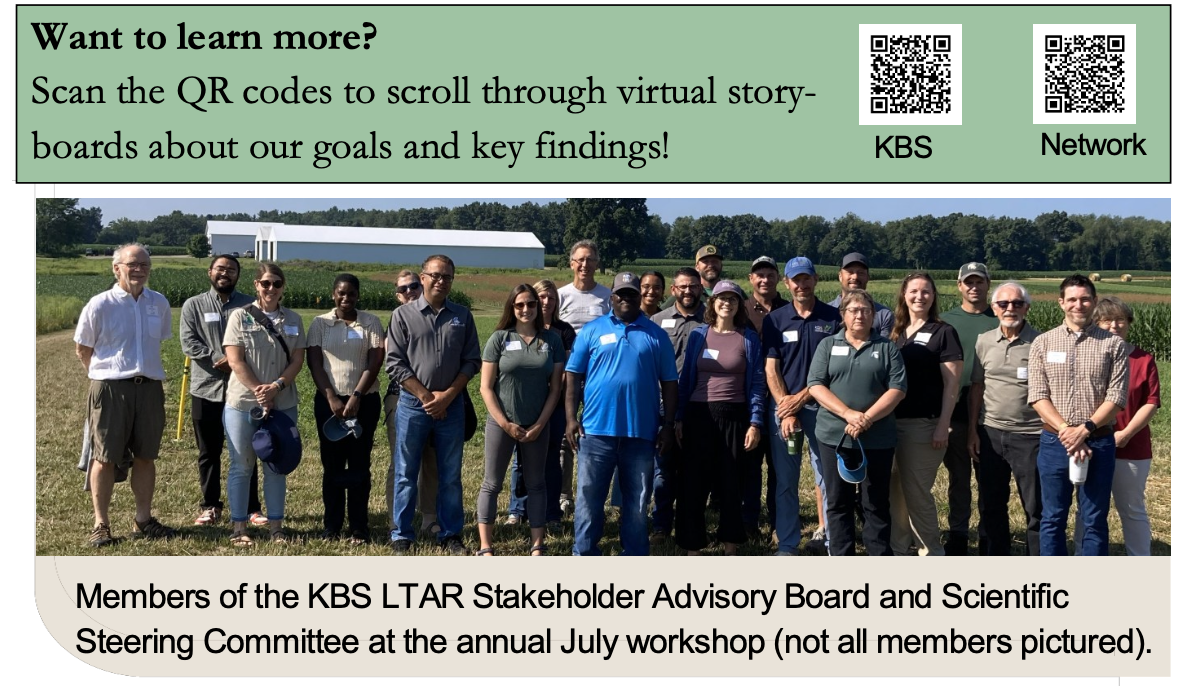
Sites across the LTAR Network collaborate with stakeholders to ensure innovations are meaningful and adoptable. The KBS LTAR Stakeholder Advisory Board received the 2025 LTAR Network Stakeholder Award for its impact on site and network science.
- Northern Plains: Soybean yields under drought were 29% greater with high residue and cover crops.
- Mississippi River Basin: Three-crop rotations with cover crops and no-till increased returns by $75 per acre.
- Florida: Patch-burn grazing and overseeded cover crops improved forage production and reduced nutrient runoff.
Our Team
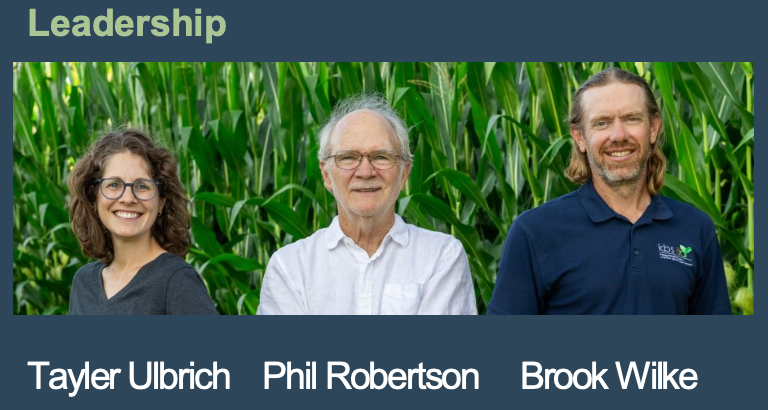
Leadership: Tayler Ulbrich, Phil Robertson, Brook Wilke
Scientific Steering Committee: Bruno Basso, Hannah Burrack, Laura Campbell, James DeDecker, Sarah Evans, Nick Haddad, Sasha Kravchenko, Sandy Marquart-Pyatt, Christine Sprunger
Systems Integration Team: Dean Baas, Jennifer Blesh, Tim Boring, Kim Cassida, Marc Hasenick, Manni Singh
Staff Appreciation: Many make the KBS LTAR what it is today, and this year we give special thanks to Stacey VanderWulp. Stacey has been with KBS for 24 years, wearing many hats as the LTER, GLBRC, and LTAR Field Lab Coordinator and Manager. She supervises field sampling and lab analyses, ensures timely and safe data collection, and makes sure scientists have quality, reliable data for their analyses. People like Stacey make long-term science possible!
Upcoming Events
- June 17: Food-Grade Grains Field Day (MiAA & MSU Extension)
- September 3: LTAR Field Day (MSU Extension)
Contact Us
Email: kbs.ltar@msu.edu
Website: https://ltar.kbs.msu.edu
Newsletter photo credits: Aerin Braunohler, Gavin Hutchings, YJ Su, Ruben Ulbrich, Brook Wilke.