4-H Science Blast Activities: Biofuel Blast
DOWNLOADOctober 30, 2026 - Michigan State University Extension
 Print
 Email
Educational Elements
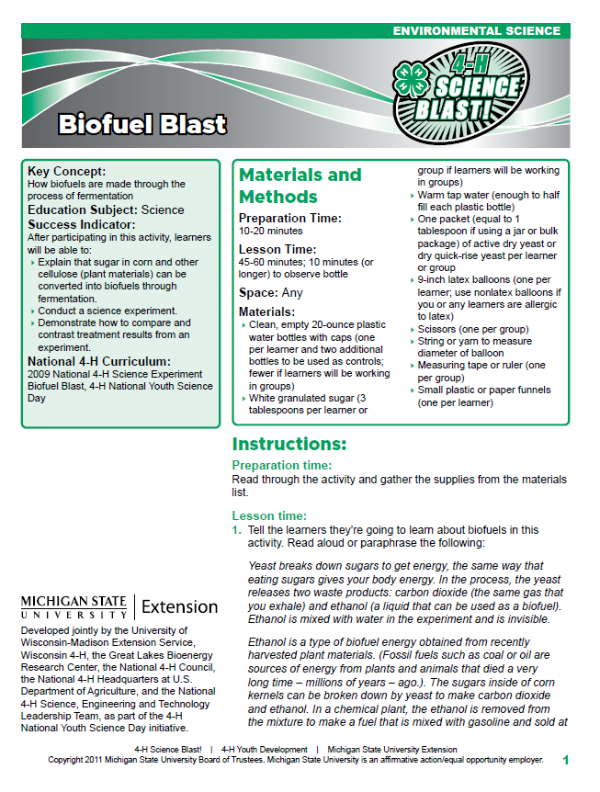
Key Concept:
How biofuels are made through the process of fermentation
Education Subject:
Science
Success Indicator:
After participating in this activity, learners will be able to:
- Explain that sugar in corn and other cellulose (plant materials) can be converted into biofuels through fermentation.
- Conduct a science experiment.
- Demonstrate how to compare and contrast treatment results from an experiment.
National 4-H Curriculum:
2009 National 4-H Science Experiment Biofuel Blast, 4-H National Youth Science Day
Materials and Methods:
Preparation Time: 10-20 minutes
Lesson Time: 45-60 minutes; 10 minutes (or longer) to observe bottle
Space: Any
Materials:
- Clean, empty 20-ounce plastic water bottles with caps (one per learner and two additional bottles to be used as controls; fewer if learners will be working in groups)
- White granulated sugar (3 tablespoons per learner or group if learners will be working in groups)
- Warm tap water (enough to half fill each plastic bottle
- One packet (equal to 1 tablespoon if using a jar or bulk package) of active dry yeast or dry quick-rise yeast per learner or group
- 9-inch latex balloons (one per learner; use nonlatex balloons if you or any learners are allergic to latex)
- Scissors (one per group)
- String or yarn to measure diameter of balloon
- Measuring tape or ruler (one per group)
- Small plastic or paper funnels (one per learner)
Instructions:
Preparation time: Read through the activity and gather the supplies from the materials list.
Lesson Time:
- Tell the learners they’re going to learn about biofuels in this activity. Read aloud or paraphrase the following:
Yeast breaks down sugars to get energy, the same way that eating sugars gives your body energy. In the process, the yeast releases two waste products: carbon dioxide (the same gas that you exhale) and ethanol (a liquid that can be used as a biofuel). Ethanol is mixed with water in the experiment and is invisible.
Ethanol is a type of biofuel energy obtained from recently harvested plant materials. (Fossil fuels such as coal or oil are sources of energy from plants and animals that died a very long time – millions of years – ago.). The sugars inside of corn kernels can be broken down by yeast to make carbon dioxide and ethanol. In a chemical plant, the ethanol is removed from the mixture to make a fuel that is mixed with gasoline and sold at some gas stations. You may have noticed this at the gas pump, where signs may read “E10,” which means the fuel mixture is 10 percent ethanol and 90 percent gasoline.
In the United States, most ethanol is made from corn. In this experiment, we’re going to observe how yeast can break down processed sugars (such as granulated sugar and sugars found in corn syrup) through fermentation. We’ll also see if yeast can use other plant products to make biofuels. - (Note: Depending on your space, time and equipment constraints, you may want to have the learners work in small groups. For simplicity, these instructions are written as if the learners will be working individually.) Have the learners collect the supplies they’ll need for the experiment.
- Tell them to use a funnel to add 1 tablespoon of yeast and 3 tablespoons of sugar to their empty bottles, then fill each bottle half full with warm tap water. (The water should be very warm to the touch but not so hot that it is painful or scalding.) Tell them to replace the cap on the bottle tightly, then shake it to mix the yeast and sugar in the water.
Prepare your two controls: use a funnel to add 1 tablespoon of yeast to each of the two additional bottles and fill each bottle half full with warm tap water. Do not add any sugar. - After the contents are thoroughly mixed, have the learners remove the bottle caps again and place a balloon over the open top of each bottle, then observe what happens. Do the same with the two bottles used as controls. It will take a few minutes for the yeast to start eating the sugar, but soon learners will see their balloons starting to inflate, but they will see no change in the two control bottles. Explain that carbon dioxide gas is filling the balloons. Carbon dioxide is the same gas that humans and other animals exhale when breathing. As the yeast organisms eat the sugar in the bottle, they release waste products, one of which is carbon dioxide. However in the two controls there is no sugar available for the yeast to eat and the yeast can not release any carbon dioxide, which would make the balloon inflate.
- When the balloons seem to have reached a stable state, have the learners measure their balloons to find out which one contains the most carbon dioxide. Show them how to cut a long piece of string, wrap it around the largest part of the balloon and mark where the string begins and ends while it is wrapped around the balloon. Then have them measure the length of the string from mark to mark with a measuring tape. This is called measuring the circumference. Have them compare the circumferences of the balloons by placing all of the measurements side by side or hanging them on the wall.
Check for Understanding:
After the learners have compared the circumferences of all the balloons, return their attention to the group and ask them the following questions:
- What happened during the activity — what did you observe?
- How large was the circumference of your balloon after 10 minutes (in inches)?
- How large was it after one hour?
- What changes did you observe in the two controls?
- Can you convert that size between inches and centimeters? Why do most scientists use metric measurements?
- For older students: Can you calculate the approximate volume of the carbon dioxide inside the balloon and share it with everyone? (Note: You may have to remind them of the formula for figuring the volume of a sphere.)
- Were there any differences in the sizes of the balloons? Why do you think this might be?
- Do you think the yeast might eat other types of food to make carbon dioxide?
- When you make bread, you add yeast to make the bread rise. Now that you have seen what happens when yeast eats sugar, how do you think the yeast makes the bread rise?
- What do you think would happen if you added very hot water to the yeast? (Note: Do not attempt this without adult supervision. Hot water may cause injury.)
Ways to Extend:
In small-group experiments, see how yeast can break down processed corn sugars (such as those found in corn syrup) and other plant products (such as dried ground-up leaves or wheat bran from the grocery store) to make biofuels. Have learners experiment with other variables (water temperature, amount of sugar, yeast, cellulose source, etc.). Your possibilities are limitless!
Find more information at the archived 2009 4-H Biofuel Blast site at: https://site.4-h.org/nysd/archive.php.
The youth work sheets are at:
https://site.4-h.org/nysd/misc/pdfs/experiment_guides/4-H_NYSD_Youth_Worksheets.pdf.
The facilitator guide is at:
https://site.4-h.org/nysd/misc/pdfs/experiment_guides/4-H_NYSD_Facilitator_Guide.pdf.