4-H Science Blast Activities: Walk in a Bag
DOWNLOADOctober 30, 2026 - Michigan State University Extension
 Print
 Email
Educational Elements
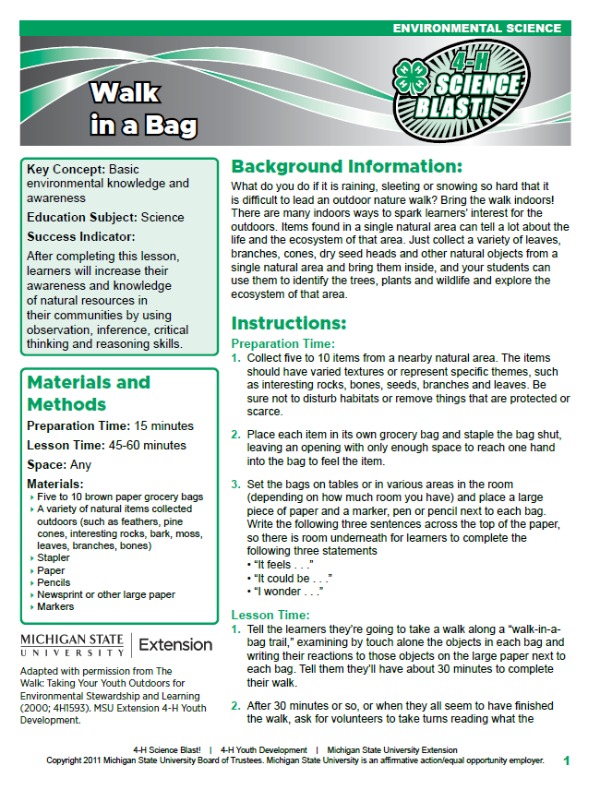
Key Concept:
Basic environmental knowledge and awareness
Background Information:
What do you do if it is raining, sleeting or snowing so hard that it is difficult to lead an outdoor nature walk? Bring the walk indoors! There are many indoors ways to spark learners’ interest for the outdoors. Items found in a single natural area can tell a lot about the life and the ecosystem of that area. Just collect a variety of leaves, branches, cones, dry seed heads and other natural objects from a single natural area and bring them inside, and your students can use them to identify the trees, plants and wildlife and explore the ecosystem of that area.
Education Subject:
Science
Success Indicator:
After completing this lesson, learners will increase their awareness and knowledge of natural resources in
their communities by using observation, inference, critical thinking and reasoning skills.
Materials and Methods:
Preparation Time: 15 minutes
Lesson Time: 46-60 minutes
Space: Any
Materials:
- Five to 10 brown paper grocery bags
- A variety of natural items collected outdoors (such as feathers, pine cones, interesting rocks, bark, moss, leaves, branches, bones)
- Stapler
- Paper
- Pencils
- Newsprint or other large paper
- Markers
Instructions:
Preparation Time:
- Collect five to 10 items from a nearby natural area. The items should have varied textures or represent specific themes, such as interesting rocks, bones, seeds, branches and leaves. Be sure not to disturb habitats or remove things that are protected or scarce.
- Place each item in its own grocery bag and staple the bag shut, leaving an opening with only enough space to reach one hand into the bag to feel the item.
- Set the bags on tables or in various areas in the room
(depending on how much room you have) and place a large piece of paper and a marker, pen or pencil next to each bag. Write the following three sentences across the top of the paper, so there is room underneath for learners to complete the following three statements- "It feels..."
- "It could be..."
- "I wonder..."
Lesson Time:
- Tell the learners they’re going to take a walk along a “walk-in-a-bag trail,” examining by touch alone the objects in each bag and writing their reactions to those objects on the large paper next to each bag. Tell them they’ll have about 30 minutes to complete their walk.
- After 30 minutes or so, or when they all seem to have finished the walk, ask for volunteers to take turns reading what the learners wrote about each of the objects. Lead a discussion of the learners’ reactions.
- Finally, reveal what was in each bag and discuss the items with the students. Talk about where each item might have come from, what plant or animal it belonged to, what sort of habitat it was part of and how the learners could have figured those things out.
Check for Understanding:
When the discussion has died down, explain that the items in the bags represent the natural environment of your local area. Ask the group the following questions:
- If you were in another part of Michigan, what kinds of things might you find in a “walk in a bag”?
- What might you find if you were in a natural area in Alaska? Arizona? Florida?
- What kinds of natural things might you find in New York City?
- Have you ever been surprised to see or hear a plant or animal in a city setting? What was it?
Learn More:
This activity can branch out in many ways. It can be the starting point for exploring our natural resources:
- Landscapes: geology, soils.
- Plants: grasslands, forests and trees, wildflowers.
- Water: rivers, streams and lakes; wetlands; groundwater.
- Animals: fish, birds, mammals, reptiles, amphibians, insects.
- Energy: renewable resources, energy fundamenta
Ways to Extend:
- Use the following activities from The Walk: Taking Your Youth Outdoors for Environmental Stewardship and Learning to extend this lesson into the outdoors.
- • Discovery Walk: For Seeing the Land and Watershed.
- Woods – N – Water Walk: An Investigation Walk for Knowing the Land.
- Lead your group in an outdoor scavenger hunt or a nature bingo hike.
Vocabulary:
Environment – The surroundings or conditions in which a person, animal or plant lives or operates.
Natural resources – Components in nature, such as trees, water, wildlife, mineral deposits, etc., that are necessary and useful to humans.
Stewardship – The careful and responsible management of something entrusted to one’s care. Stewards are caretakers.
Nature – The physical world and everything in it (such as plants, animals, mountains, oceans, stars, etc.) that is not manufactured by people.
Habitat – The place where an animal finds the food, water, shelter and space necessary to sustain a population; the environment where a plant or animal naturally or normally lives and grows.
Life cycle – A series of stages through which something passes during its lifetime; for example, the insect — egg, larva, pupa and adult.
Ecosystem – A community of living and non-living things that all work together and make a balanced system. Ecosystems have no particular size; they can be as large as a forest or as small as some decomposing leaves on the ground.