A Moving Green Laser Reduces Bird Damage to Grapes in a Michigan Vineyard
DOWNLOADSeptember 8, 2026 - Esmaeil Nasrollahiazar, Michigan State University Extension; Sarah E. Grimes and Bryan C. Pijanowski, Purdue University College of Agriculture
 Print
Print Email
EmailBirds Cause Extensive Damage to Crops
Bird damage often becomes most noticeable as grapes ripen. Around veraison and harvest, birds may remove berries, puncture or tear fruit, and reduce both yield and quality. Damaged berries can also become more vulnerable to insects and rot. Bird losses in grapes can be substantial. A five-state grower survey estimated more than$70 million in annual wine-grape losses. Michigan growers reported average losses of about 9.2% of the crop, while severe unprotected vineyards have experienced much greater damage (Anderson et al., 2013; Nasrollahiazar et al., 2020; USDA APHIS, 2026).Growers use several bird-management tools, but each has limitations. Netting is effective but costly and labor-intensive. Propane cannons and other sound devices may disturb workers and neighbors, and birds can become accustomed to them. Reflective tape and stationary visual deterrents may also lose effectiveness over time. Automated lasers offer a quiet,non-lethal alternative. These systems move a green laser beam across the vineyard, creating a visual threat that encourages birds to leave the area. MSU Extension and Purdue University evaluated an automated robotic laser to determine whether it reduced cluster damage and bird activity in wine grapes.
Key Messages
Automated green lasers reduced bird damage. Damage incidence was about 37% lower and damage severity about 9% lower in the laser-protected area. Bird pressure varied by year and cultivar, so deterrents may be most useful in high-risk seasons and vineyard blocks. Laser-protected areas had less overall bird sound activity, supportingthe fruit-damage results. Bird species responded differently to the laser; some were deterred more than others. Lasers are best used as part of an integrated bird-management strategy, and more multi-site research is needed.
Laser Implementation and Damage Assessment
- 2022-2024 three field seasons
- 2 acres experimental vineyard
- 6 wine-grape cultivars
- 5,400 clusters assessed
- 2024 acoustic monitoring
Vineyard Details
Field trials were conducted from 2022 through 2024 in a 2-acre, spur-pruned Vitis vinifera research vineyard at the Northwest Michigan Horticulture Research Center in Traverse City, Michigan. The vineyard contained 14 north-south rows. Rows 1-7 were the laser protected-zones, and rows 8-14 were the unprotected comparison zone. The six cultivars - Pinot Gris, Riesling, Cabernet Franc, Chardonnay, Pinot Noir and Pinot Blanc - had been randomly distributed throughout the vineyard at planting, and all six were represented in both zones (Figure 1).
Laser System and Operation
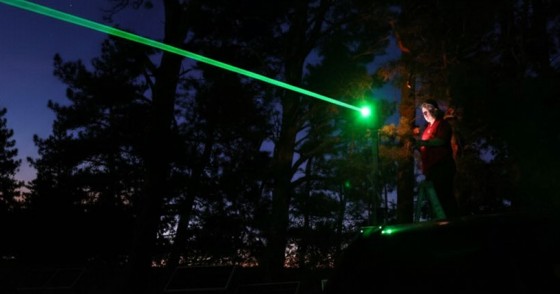
The protected zone used a commercial AVIX Autonomic automated bird-deterrent laser. The system projected a high-powered green beam over the vineyard canopy and followed changing, unpredictable routes intended to reduce habituation (Figure 2). It was programmed to operate during peak bird-activity periods, especially early morning and evening, throughout the fruit-ripening period.
Bird damage was assessed once per season near harvest. Over the three year study, 5,400 grape clusters were evaluated. Damage was counted as bird-associated when the visual evidence matched pecking, tearing, puncturing, crushing, plucking, or berry removal (Figure 3). Two complementary outcomes were recorded: damage incidence and damage severity.
Damage incidence asks: Did this cluster show any bird damage? It describes how widely damage was distributed across the vineyard.
Damage severity asks: What proportion of berries in this cluster was injured or removed? It describes how much damage occurred within a cluster.
Why use both? A deterrent may reduce the number of clusters birds visit without greatly changing feeding intensity after a cluster is found.
Bird Activity Assessment
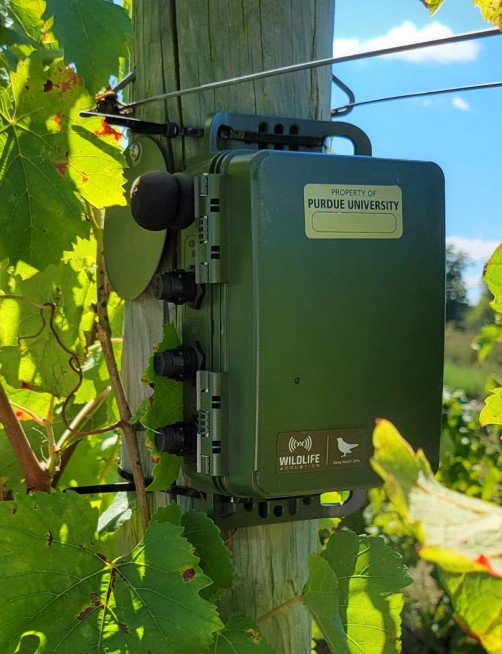
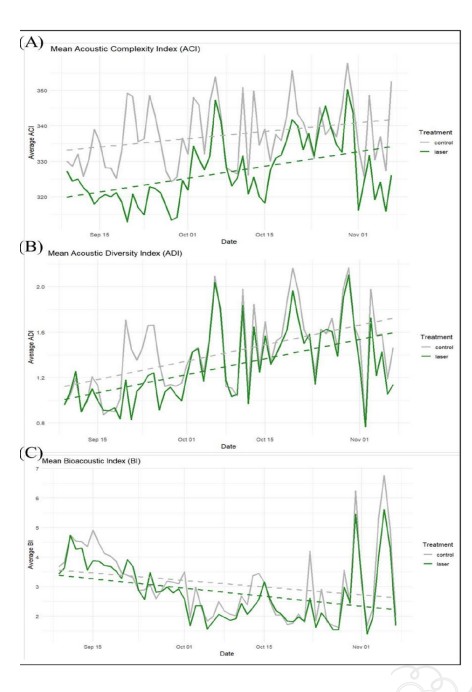
The researchers also used soundscape recordings to determine the amount of bird activity in each vineyard section. During 2024, researchers placed one Wildlife Acoustics SM4 automated recorder in the center of each vineyard zone (Figure 4) to record bird sounds. The recordings were analyzed in two ways. First, three acoustic indices - the Acoustic Complexity Index (ACI), Acoustic Diversity Index (ADI) and Bioacoustic Index (BI) - were calculated as broad indicators of biological sound activity as a proxy for bird activity. Second, BirdNET was used to classify bird vocalizations to determine the species of bird detected in the vineyard.
Project Result
Grape damage was lower in the laser-protected area
Both damage severity and damage incidence were lower in the laser-protected rows (Figure 5). Although reductions were modest, damage severity was reduced by about 9% in the laser- protected rows.
The incidence response was larger. The probability that a cluster would show any bird damage was about 37% lower in the laser- protected area compared to the control with no bird deterrent. One interpretation is that the laser reduced how often birds discovered or revisited clusters more strongly than it reduced feeding intensity after a cluster was selected.
Bird pressure changed substantially among years
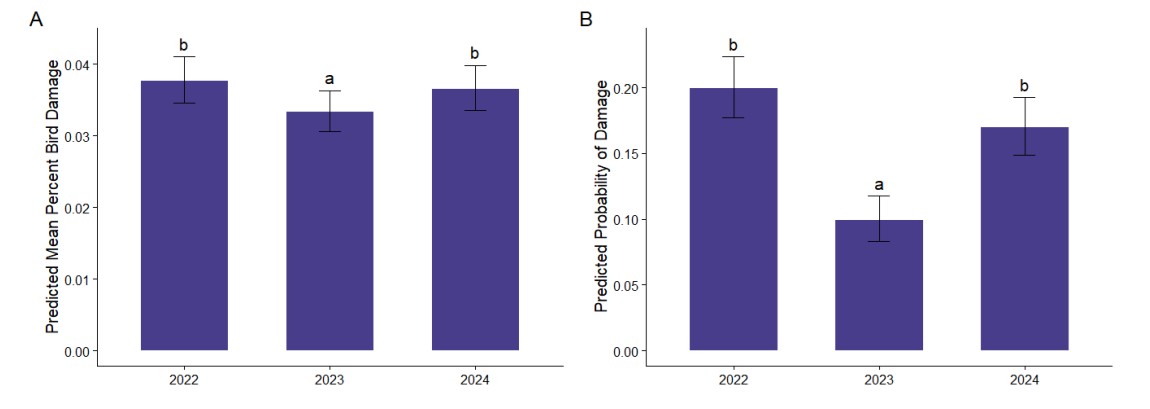
Bird damage was lowest in 2023 (Figure 6). Grape damage incidence was about 10% that year, compared with roughly 20% in 2022 and 17% in 2024. Severity also reached its lowest level in 2023, while 2022 and 2024 were broadly similar. Possible influences include regional bird abundance, migration timing, and availability of alternative foods.
The year effect has an important management implication. The value of a deterrent is unlikely to be constant from season to season. Previous Michigan work has similarly shown that proportional bird damage can rise in low-fruit or high-pressure contexts (Lindell et al., 2018). Growers may gain the most from targeted protection in years, blocks, and cultivars where risk is highest.
Cultivar influenced where damage occurred, but now how severe it became
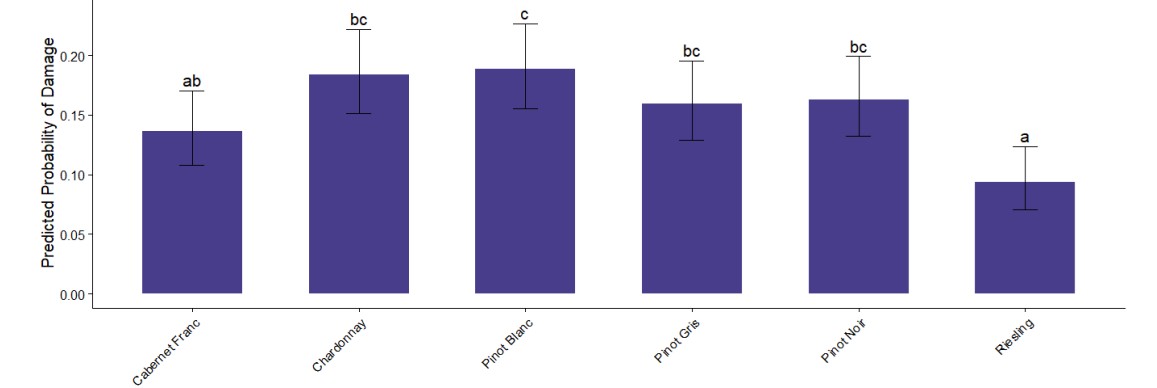
Cultivar affected damage incidence but did not significantly affect average damage severity once a cluster was injured. Pinot Blanc had the highest risk of damage, while Riesling had the lowest (Figure 7). Chardonnay, Pinot Gris, and Pinot Noir were intermediate and relatively similar; Cabernet Franc was lower than those cultivars but higher than Riesling. This result cautions against using berry color as the only risk indicator, as Pinot Blanc and Riesling are both white cultivars.
The laser-protected soundscape had less overall bird sound activity
Higher acoustic index values tend to represent more bird/biological activity. All three acoustic indices were lower in the laser-protected zone than in the comparison zone (Figure 8). The acoustic result complements the fruit assessment: the area with lower grape cluster damage also produced less biological sound activity.
Bird species did not uniformly respondto laser deterrent
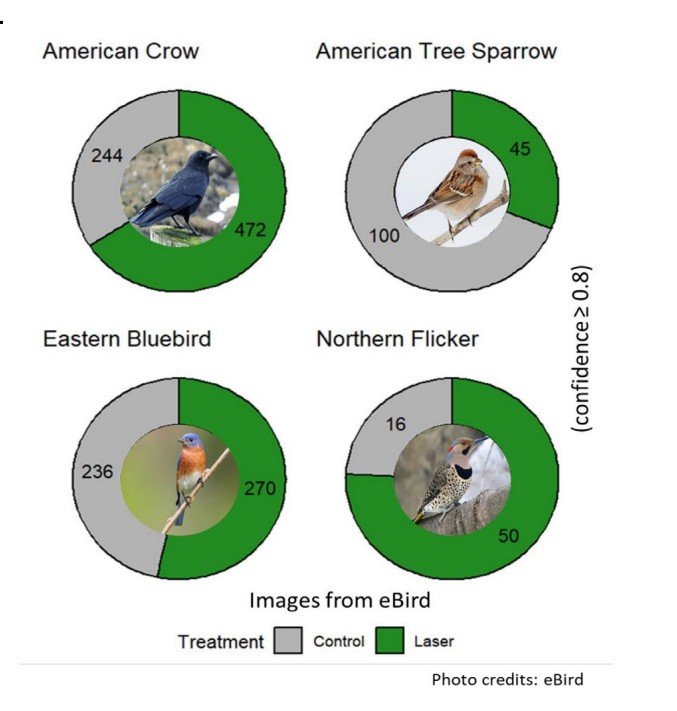
BirdNET identified 60 species in the laser-protected zone and 54 in the control. More species in the laser zone does not necessarily mean greater overall bird activity, since individual species may have been detected less frequently.
Responses varied by species (Figure 9). American tree sparrow was detected more often in the control, while American crow, eastern bluebird, and northern flicker were detected more often in the laser zone. The continued presence of insect-eating bluebirds and flickers is encouraging, while reduced tree sparrow activity suggests the laser may help deter a fruit-feeding species.
Project Conclusion
Across three seasons in this Northwest Michigan vineyard, laser protection was associated with lower grape-damage severity, lower damage incidence, and lower bird acoustic activity. The laser system appears to be an effective bird deterrent, but multi-site replicated research is still needed to confirm performance across vineyard settings and bird-pressure conditions.
Management and Grower Takeaway
- Laser use appears to reduce bird damage to grapes. Growers could consider implementing laser use with existing bird deterrent methods like acoustic scare techniques or netting.
- The laser can be used as a preventative strategy to deter birds before repeated feeding patterns have been established.
- Prioritize laser use in years of high bird activity or high risk, such as when few alternative food sources for birds exist.
- Do not rely on just berry color as a risk guide, as both the highest and lowest incidence cultivars in this study were white fruits. Growers could consider observing areas of high bird activity and prioritizing laser use in those blocks.
Acknowledgements
The Migratory Bird Management organization donated the robotic laser system and provided technical support. The team also thanks Dr. Nikki Roswell and the Northwest Michigan Horticulture Research Center.
Contact: Esmaeil Nasrollahiazar, nasroll2@msu.edu
Selected References
- Anderson, A., C.A. Lindell, K.M. Moxcey, W.F. Siemer, G.M. Linz, P.D. Curtis, J.E. Carroll, C.L. Burrows, J.R. Boulanger, K.M.M. Steensma and S.A. Shwiff. 2013. Bird damage to
select fruit crops: The cost of damage and the benefits of control in five states. Crop Protection 52:103-109. doi:10.1016/j.cropro.2013.05.019 - Lindell, C.A., M.B. Hannay and B.C. Hawes. 2018. Bird management in blueberries and grapes. Agronomy 8:295. doi:10.3390/agronomy8120295
- Nasrollahiazar, E., P. Sabbatini and T. Miles. 2020. Bird damage reduction strategies utilizing viticultural practices. Michigan State University Extension. MSU Extension article
- U.S. Department of Agriculture, Animal and Plant Health Inspection Service. 2026. National Wildlife Research Center research areas: Bird damage. USDA APHIS resource