California Chamber of Commerce v. Bonta (contribution to FDLI's top food and drug cases, 2025)
July 10, 2026 - Neal D. Fortin
 Print
Print Email
Email
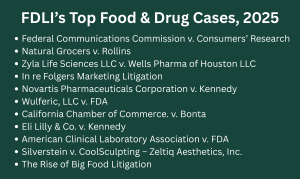
The Food & Drug Law Institute (FDLI) publishes an annual list of top food and drug cases.
Neal Fortin, Director of MSU's IFLR, contributed to the 2025 edition with a chapter on California Chamber of Commerce v. Bonta.
Read the chapter online at the FDLI website.
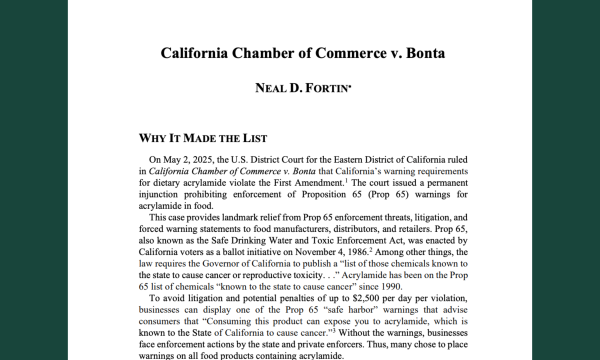
Why It Made the List
On May 2, 2025, the U.S. District Court for the Eastern District of California ruled in California Chamber of Commerce v. Bonta that California’s warning requirements for dietary acrylamide violate the First Amendment. The court issued a permanent injunction prohibiting enforcement of Proposition 65 (Prop 65) warnings for acrylamide in food.
This case provides landmark relief from Prop 65 enforcement threats, litigation, and forced warning statements to food manufacturers, distributors, and retailers. Prop 65, also known as the Safe Drinking Water and Toxic Enforcement Act, was enacted by California voters as a ballot initiative on November 4, 1986. Among other things, the law requires the Governor of California to publish a “list of those chemicals known to the state to cause cancer or reproductive toxicity. . .” Acrylamide has been on the Prop 65 list of chemicals “known to the state to cause cancer” since 1990.
To avoid litigation and potential penalties of up to $2,500 per day per violation, businesses can display one of the Prop 65 “safe harbor” warnings that advise consumers that “Consuming this product can expose you to acrylamide, which is known to the State of California to cause cancer.” Without the warnings, businesses face enforcement actions by the state and private enforcers. Thus, many chose to place warnings on all food products containing acrylamide.
Acrylamide forms naturally during high-temperature baking, roasting, and frying of plant-based foods. Thousands of manufacturers, distributors, and sellers of these foods are now relieved from posting Prop 65 warnings for acrylamide. Likely tens of thousands of food products sold in the United States contain some acrylamide because it forms in all carbohydrate-rich foods cooked at high temperatures, such as French fries, cookies, cereals, bread, potato chips, and crackers.