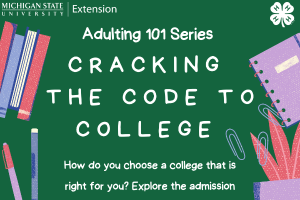
Adulting 101: Cracking the Code to College
 Print
Print Email
EmailDecember 4, 2024
How to choose the right college for youAre you ready to leave for college or be out on your own? Are you prepared to do the adult tasks of managing your finances, home, health, or finding a career? Watch the video to learn real life skills to help you successfully transition to living independently.
Cracking the Code to College -Video from Tuesday, November 19, 2024 at 5 p.m.
MSU admissions provides advice on getting admitted to the college of your choice and what to expect in the application process. Plus, get tips on writing your essay.
Resources:
How to choose the right college for you
How to Choose a College Comparison Chart from Best College
Michigan State University Admissions
Video Transcript
Welcome. Welcome, everyone. To our November 19, Adulting 101. Today, we are going to talk about Cracking the Code to College, and I'm super happy that we have two individuals from MSU College Admissions. We have Riley Van Pelt, and we also have Tania from MSU admissions. In addition, we have Madeleine and she is going to be our ASL interpreter today. And if you have any tech problems, we have Alan Pilkinton here to help out. I am going to turn it over to Riley to get it started. All right. Thank you so much, Kathy. How's everybody doing? Happy. What day of the week is it Tuesday? Happy Tuesday . It's so nice to meet all of you. I see that you're coming from all over Michigan. I think I saw North Carolina, Massachusetts, trying to go through all of these areas, but no matter where you're tuning in from, Thanks so much for taking about an hour out of your evening to talk about college readiness. So me and my colleague, Tania, will give quick introductions to ourselves, and we'll get started and kind of set what we're going to talk about today. But my name is Riley Van Pelt. I use He/Him pronouns. I'm a senior admissions counselor at Michigan State. So basically what that means is that it's my job to review applications for Michigan State. I'm currently in the process of making a lot of decisions on applications right now. And I also get to do a lot of fun recruitment events, whether it's for Michigan State specifically or just college readiness in general, because I'm a big advocate of access for everybody to higher education. So I think that's why this event is so important tonight. I'm also going to give Tania a quick opportunity to introduce herself as well. Thanks Riley, my name is Tania Kurzawa. I too am a senior admissions counselor. My role is a bit different than Riley. A lot of similarities, but a bit different that I live in the Upper Peninsula. So shout out to Mennay from Marquette County. I to am in Marquette County. So glad to see somebody from the UP represented in our audience here tonight. But Riley and I are looking forward to just chatting with you all about cracking the code to college. So looking forward to it. Yeah. Thanks so much, Tania. So and to also mention, I technically we have kind of recruitment territories. So technically, I recruit for like the southwestern Michigan area, like Kalamazoo, Battle Creek, Grand Rapids well, not Grand Rapids, but a little south of Grand Rapids, et cetera. But I'm a representative for not just all of admissions at Michigan State, but we're going to be talking about college readiness just in general because obviously, yeah, we would love for you to come to Michigan State. By the end of the day, We want you to be ready to go to where the best fit is for you today. So I'm going to first start off by talking about the five Cs for choosing a college. I got to give my colleague Kathy some credit for coming up with that. I thought it was I think she showed me that curriculum, like, maybe two or three years ago, and I thought it was great. I've used it ever since. So we're going to talk about how to find your fit for a college with the five Cs. Tania will talk a little bit more about applying to colleges in general and what to expect. And then I'll wrap it up with talking about the college essays. I'm sure a lot of you are anxious about what do I do for the college essays? We'll talk about that. We're going to be using Zoom poll throughout this. So we want this to be interactive. We want you guys to engage as much as possible. I see there's 50 of you now, which is awesome. So we want you guys to engage with the poll. And then if you guys have any questions throughout, just feel free to throw it. In the Q&A or chat, Kathy, I don't know if you have a preference for the Q&A or the chat. So no preference, cool. Yeah, if you guys have questions, we're going to have we're going to try to have at least 10 minutes or more for questions at the very end. So I post them throughout and we'll be ready to answer some of them. If we end up getting a lot of questions, Tania will answer those in the chat, well I'm speaking and vice versa. With all that being said, let's let me get my screen shared. Get this roll in. Yeah, let's just jump right into it. As I alluded to, before I go into this, C ever see my screen? I see head nods. That's good. That's good. Yes, the five Cs for choosing a college. We're going to break down all five of them with curriculum, campus, community, career, and cost, and we're going to have several poll questions. Be ready to answer some poll questions and let's have a good time. Yeah, let's first start with the first C, which is curriculum and academic choice. The way that I really like to break this down is, what exactly is your goal for attending this specific college? For some people, that might be studying a specific area of study. Some people might want to increase skills if you're looking at trade schools and you want to get into welding, or you want to go into AgTech, or maybe you want to learn about marketing and see what you can do with a marketing degree. That's why I used it as an example, or it could be engineering or teaching, or nursing, or heck, could be preparing for problems that we have not quite even got to yet, because obviously, you know, everything is changing constantly in the world and You're going to be studying for jobs that might not even be out there yet. I know you guys are kind of a wide range. I know there's some people who might be in middle school, some in high school, you might have adults looking to get into college. The first thing you want to break down is, what is your goal because college is all about studying what your goal is. And obviously, that can be as simple as what you learn in a lecture writing notes, but a lot of schools emphasize hands on learning opportunities. You have to figure out how do you like to learn and what exactly do you want to learn and what's your goal of that? Is your goal to get a high paying job in a certain field. So, I read a lot of college essays, and some people always tell me, I just want to help people, which is a very common thing. I think that's awesome. But you want to then get to the next question is, you want to help people, but how do you want to help people? When we're thinking of colleges, at least in the curriculum lens, we want to look at what majors the school offers. We want to see ranking. You might hear that like, this school is number one in the nation for I'll use MSU as an example, because I work for Michigan State. We're number one in the nation for teacher education. And supply chain management. But what exactly does that mean? If I'm breaking down the teaching curriculum, we provide opportunities to do student teachings as early as your second year of college. You're getting exposure to the classroom, you're learning to become a master of your various subjects. You're learning how to manage a curriculum, manage a classroom, and then we have an entirely paid student teaching year at the very end. On the flip side of things, maybe you want to go into a more very specific program like Fire sciences. I know Lake Superior State, which is up in the UP. It's over in Sioux St. Marie. They have one of the only top ranked fire science programs in the state of Michigan. Michigan State, for example, doesn't have a fire science program. You want to see where are these specific programs offered and how are they ranked, right? You know, you want to go to when you're thinking of highly ranked, that usually means higher job placement rates, which we kind of talk about later or very hands on learning. So you're getting to learn what you like and don't like in certain areas. That's kind of what we mean in regards to quality and reputation. Of course, you want to be careful of going to an accredited university. I see, Matty, you have your hand raised. If you want to throw your question in the chat, feel free, and then I'll check the chat in just a minute. But when we're talking about accreditation, we want to consider factors of, there's some colleges. A lot of them can be labeled as for profit colleges. I'm not going to say all for profit colleges are bad. But some colleges have different motives, some want to provide you opportunities to, you know, get a job and figure out what you want to do, and there's some that are just out to get your money. There are unfortunately colleges that do exist like that, and they're usually non accredited colleges and they are called for profit, which means most higher education institutions are nonprofit, so they're not designed to want to just bring in money. I mean, they do, but they're more so designed to we want to provide access for education and teach you guys things. That's something you want to keep in mind as well when we're looking at the curriculum and academic choices. Of course, you want to go to a college that also helps you figure out what you want to study as well. Because you might not know right away. Some of you guys are like maybe as early as 12 or 13-years-old. Maybe some of you guys are closer to my age, close to your 30s or maybe even a little older than that. It's okay to also go to a place that gives you the opportunity to figure things out. A lot of two year community colleges are fantastic for that because there's more scholarships available where you're having an opportunity to get free community college. You get a free opportunity to take classes and figure out what you want to do, and then you can always transfer to a different place later on and get more specified with your major. That's also okay, and we'll talk about that process as well. I'm going to get this poll going, give me a second to get this going. But it's asking what major are you interested in? We just simply want to get to know The general area of study that you want to go into. I'll leave this up for about I think 40 seconds is good, 30 to 40 seconds. If you're choosing other as an option, please post in the chat, and I'll open the chat once the poll is over, and I want to see some of the other things you guys want to study. I'll reveal the results in a second. It's like we have about 40% of people who have answered. But we're seeing a lot for natural science, pre med, engineering, business, education, psychology, others at 22% as well. So I'm going to ask a few of you all to elaborate on that. I'm very curious. All right. I think that's about 40 seconds, about 50% of people answered. I'll give it five more seconds, five, four, three, two, 2.5 1.5. Okay. We'll land it there. All right. So sharing the results, can everybody see the results on the screen? Can people see it? Okay. Yeah, it looks like a lot of you guys want to go into natural science, pre med, engineering, business, education, that's great because a lot of those careers can lead you to very high paying jobs or very meaningful jobs. Especially with becoming a doctor, you're saving lives, or if you're doing natural science, you're doing research for a living, you're also making really cool discoveries that could lead to life saving innovations. If you're doing engineering, I mean, I mean, engineering is essentially the future, right? We need to continue to have engineers to evolve with our very changing things within the climate or infrastructure or the way cars are even run. And we need people to also be in charge of those businesses too. There's a lot of other things. I'm going to quickly open up the chat. I want to see what you guys put for others. I see fashion design, culinary and cosmetology. That's awesome. Yeah, there's specific culinary schools, cosmetology schools. Somebody wants to be a welder, Yeah, a lot of programs specifically for welding. Public administration. That's awesome. Amanda, I'd be curious to hear why you want to go into public administration. PT, astrophysicist, prosecuting attorney. We're getting specific. I like that. Criminal justice, computer science, art, music, poetry, creation. Somebody just said other. I respect that. You don't know yet. That's totally fine. Religion and astrophysics. That's an awesome combination, graphic design. A lot of you guys have some really cool ideas, and we can talk more about those majors too at the end if you guys would like to. The next C is campus. We want to break down. What type of campus are you looking for? There's a lot of things to consider with the campus. The first thing that comes to my mind is the size of the school. Because, I represent a school that we're the biggest school in the state of Michigan. 50,000 students go to Michigan State. And for some of you guys, you would thrive in a huge school like that. But others, you might want to look for a smaller school, and that is totally fine or mid size school. To give you guys a little background information about myself, I'm from a super small town in Southwestern Michigan. I had like 55 people in my graduating class. And I would bet based on seeing that some of you guys are from the thumb area up north, even a little bit outside Midland, Saganaw and I'm sure a lot of you guys are in schools that are that size. And one of the reasons I chose to go to a big school was because I just I was around all the same people who kind of looked and acted like me, and I wanted a chance to meet people who were coming from different backgrounds in different places. So one of the reasons I went to a big school is because Michigan State specifically or as much I hate to do this, you could put U of M in the same boat, you could put Purdue in the same boat, you could put I U, any of the Ivy leagues, you know, you know, the Stanfords or the Harvards of the world. A lot of them are very diverse campuses with students coming from all over the place. And it was cool because during when I went to my big school, I got to make friends from countries like Angola, Uganda, Brazil, the UK, Thailand, France, Australia. It's cool you have a chance to meet a lot of people. But also, it can be I'm not going to lie. My first few weeks in a big school, were kind of scary. Like, my first time in a big lecture of like 3 or 400 people, like, I was like, Oh, this is intimidating. And eventually, you know, I learned about all the academic resources that Michigan State offered and kind of how to navigate that. But with that being said, that environment's still not for everybody, because there are some great schools. You know, for example, my fiancee went to Calvin University, which is over in Grand Rapids. Much smaller school and the class sizes are usually about, like 15 to 20 students on average. Same with Hope or Aquinas, or we can look at more mid sized schools like Ferris, Grand Valley, Central, Eastern, et cetera. Those are all size is something you want to consider, and the best way to figure that out is to go on a tour of those schools. Is the location convenient, right? Because, for Michigan State, it's a really big campus. Some people like that. Some people don't. And what's the transportation look like? We have a free bus system and a lot of other schools have that same thing as well. Some schools are more made so where you don't live on the campus and it's more of a commuter school. But with that being said, that can be really convenient because you don't have to pay for housing in that case, you could live with your parents or live in your apartment or whatever your housing situation looks like, and that's something to also consider as well. Do you like to look of the campus. That's always something. Some campuses are small and everything is just in one building or kind of a few buildings. I'm thinking like Kettering, which is over in Flint, which is a really big engineering or not a big engineering school, but they're very well known for engineering, or MSU has like a million buildings with, like I mean not a million. That's an exaggeration, but a lot of buildings, essentially, and there's an old part of campus and a newer part of campus. And you want to consider amenities as well, like, gym facilities. You want to consider dining halls. Food is important. When you're going to a campus for anywhere 2-4 years, and if you guys going to get your masters or PhDs eventually, which I think you all can do if you want to, you got to make sure the food's good, right? So that's also important with the campus, and of course, safety, right? Because there's some schools that are more safe than others, and you can always look up safety statistics for any school online. Usually, for most public institutions anyway, that stuff should be out there. I know, like I said, I can always talk for Michigan State examples, but we have a lot of safety implementations. We have something called the safe walk, which if you're coming back from the library at night, two students will walk you home back to residence hall, or we have MSU safe ride, which is like a free Uber that takes you anywhere on campus at night. But with that said, Michigan State does experience crime. There are things that happen. It's a big campus with 50,000 students. Sometimes things are unfortunately inevitable. And even being a big campus, we have our own police system, but our own police-like system on campus. But with that said, would I say some smaller schools can be safer than Michigan State? Absolutely. And you can look at all those information online. So that's a little bit about the campus and what you want to look for there. I'm curious to see what kind of school you guys would want to go to. So let's get another poll going. Give me 1 second. Get my technology skills really fired up. So campus size. I'll give you guys about 30 seconds to answer what size of school would you want to go to? And while you're doing that, while they're answering Riley, I did want to just make a comment that some of you might be thinking about maybe just online only programs. There are a lot of them out there that exist, especially since COVID and kind of flipped our world around. So lots of opportunities for online only colleges. Some of you might be working full time and have to take online classes in the evenings or you might have families, things like that. So absolutely available to you in the state of Michigan, and I'm sure there are other states as well that can do that for you. So and maybe you don't want to go to college. Maybe you just need a certificate or you want to get a welding certificate or do some sort of certificate program that doesn't involve going to a campus itself. So lots of choices for your future, for sure. Yeah, that's a great point, Tania. I'm also I'm going to end the poll, but I'm actually for my master's program, my program is completely online. So if you guys have questions about that, too, let me know, because I'm doing the full online school thing. I graduate in the spring, so we're getting there, one class at a time. All right, I'll share the results. And most of us are kind of looking for something in the middle. Kind of a medium option. So, you know, just a few of you guys said very small and yes, there are schools is less than 1,000. I bet like Madonna, which is in Livonia, would probably be one of those schools or maybe Cornerstone right in Grand Rapids. Then we got the really small schools, 1,000 to 10,000. You can think of Hope, Aquinas, Calvin. Some of those small private schools, a lot of times will be that size, Kettering, I think is in that ballpark too. Then you've got your mid size, so that your CMU, your Ferris's, I bet Northern would probably be there, right Tania in mid size. Then the very large ones, Michigan State and UM, certainly in the state of Michigan or if you're looking at, I think one of the bigger ones like University of Arizona, if you're looking at out of state. Yeah, there's a lot of you guys are looking at a lot of different options, and if you guys, like I said, have questions even about basics of certain colleges, just let us know. I'll quickly check the chat before I move on. I do see somebody has a question. It just says I have a question of the chat. So repost your question on the chat, and I'll get that when I open it back up, or I'll have Tania look at that. So thank you so much. All right Moving on, just to keep things moving. I'm a bit of a yapper, so don't want to go too long. Next thing you want to look at is community. So this is one of my favorite things to talk about. Because obviously, what you study is important, but also how you find your people, I'd say, can really be the thing that makes your college experience enjoyable. You know, for me, like I said, I went to a really big school and I was really intimidated by that at first. How I made friends at my school was I got involved with clubs. And most most colleges have clubs that you guys can join. And what do I mean by a club or you can also the more proper term is registered student organization. Basically, a group of people who have a common interest, who do that common interest together. So in Michigan State, we have this giant event called Participation, where all 1,300 of our clubs come to one spot on campus, and you get to see what we have to offer. So I got to join the MSU running club. I got to compete in cross country and track for all four years. I also just had people to run and work out with every day, and we did a bunch of social events outside of the running club. We would tailgate together every year, before football games, we would do a corn maze in the fall, we'd have banquets before and after meets. It's where I made all my closest friends because even just having people to go to the dining halls with at a big school, or just like a community of people to just do things with is can really make the college experience so much much better. I just also, like I said, with getting to meet people who may be in your hometown, you would never get to meet. It's a really cool opportunity. In fact, I'm getting married next year, and most of my friends who are in my wedding party, I met all of the Running club. I'm not saying you guys got to join the running club, but whether it's a different intramural sport or you join a Pottery club, or, you know, I'm the advisor for the Taylor Swift Club on campus at Michigan State. I've heard most schools now have a Taylor Swift Club, if that's your kind of thing. I don't know if she's in or not, let me know in the chat. But even beyond clubs, right at smaller schools, you might have more of an opportunity to interact with professors and at larger schools. Support services. I like to think of those as like, does the school offer tutoring and free academic support? In Michigan State, there's a math learning center where you can get math help anytime during the week or weekend. I'd say most schools probably offer an equivalent of that. But you want to make sure or if you're at an online school, you want to make sure that there's at least tutoring options and professor office hours, even if it's on Zoom that you can jump in that are accessible. Yeah, thinking about the friends side of thing, obviously, you want to go to college, to get a degree, get a good return on investment. But at the end of the day, you also your chance to make friends and make those lifelong connections. College is also about becoming an adult. This is Adulting 101 for example, you learn other life skills and and how to live independently, how to live with other people and how to just navigate life in general, which is why this program is so awesome too. Career outcome. This goes hand in hand with curriculum. I alluded to this a little bit, But will this college help me get a job? That's important. Be if you're paying some colleges can be really expensive, if you're not on scholarship or if you don't have financial aid that can help, is it worth it to go through all four of those years? When you're looking at programs, you really want to look at job placement rate. Love to use Michigan State in an example. I'll go back to our teaching program. Our teaching and our nursing program have a 99% job placement rate, which means within six months of graduation, you have a 99% chance of getting a teaching or nursing job, which 99%, I like those odds to be honest. You can usually find this information at most colleges. I know Lake Superior State. As I mentioned earlier, their fire science program. I don't know the exact job placement rate off top of my head, but I know it's in the 90 percentiles and very high. I was at Kalamazoo Valley Community College not that long ago, and they have a really strong welding program. And I know their job placement rate was also very high. If you finish their program, they almost guarantee that you're set up to have a welding, I think, what do they call it? It's not an internship, but there's another word that's escaping me. But essentially, it's kind of like a development program where you kind of move out in rankings. You have an apprenticeship is the word I'm looking for. So yeah, that's something you want to consider and what the return on investment. So basically what that means is for the money that you're putting forward, are you going to be making that money in the long term? So especially a lot of you guys want to be doctors. Doctors make a lot of money. It's a lot more schooling, right? And a lot of doctors are hundreds of thousands of dollars in debt, but that kind of makes up for it when you're making 2 to $400,000 a year. Same with engineering. A lot of maybe you get a four year engineering degree and your 30 to $40,000 in debt. But if you're making over $100,000, I, you can make that up in the future. If you're on scholarship, even better. Always look for the places that give you scholarship so that return on investment is stronger. Of course, looking at schools that offer opportunities to do full time jobs before you actually do the full time job, which that's basically called an internship or a co-op. And you want schools that offer high internship rates that can place you to do an internship or at least prepare you for job interviews and different kind of skills like that. So some things to keep in mind of what you want to look for. If you guys don't know what an internship is, again, it's like getting to do the job before actually doing the job. You're usually usually still have to interview for them, but schools have partnerships with companies, and it's like a free trial before you make a full commitment. I used to work two internships when I was at Michigan State, so you want to make sure schools have those opportunities and connections. Then, with cost, cost is another C. The things that you consider with cost, I'll keep this pretty brief. Tuition is always going to be the biggest cost, that's the money that you're paying for your classes, and usually it's going to be based on how many credit hours you're taking and whether you're a full time student or a part time student. Obviously, being a full time student can be really expensive. Then you consider Room and Board. If it's a college where you're required to live on campus, like Michigan State, you are required to live on campus, but if you look at a college like Eastern, you're not, and then if you live within a commutable distance, I mean, that's going to save you so much money a room and board. You got to think of those small things too. So schools, you might be able to get free books, others you're not going to, and the books can be expensive. I remember when I was taking my first college algebra class and I paid $300 for a book and with the digital homework thing, I was like, Oh, man, this is pretty rough. It's pretty rough. So some things to keep in mind. But then you'll see that, all those things add up. But I think it's very important for you guys to also consider filling out the FASFA. The FASFA, if any of you guys are seniors this year, opens up on December 1, and usually you get a package anytime from January to April depending on the school and depending on how fast the federal government is moving. But financial aid includes, it basically gives you an individualized package based on your family income, and it can include loans, which we don't love loans, but it can help make college affordable up front. There are financial aid and need based scholarships, and there's grants as well too. There's two types of scholarships. There's need based scholarships based on your family income, and then there's merit based scholarships based on how you do in school. If you're a really high achieving student, you might be able to get some some of those merit based scholarships. And MSU doesn't work like this, but there's some schools that work like if you have a 3.7 or 3.8 GPA, you get this amount of scholarship. I'm pretty sure like Central Michigan works like that, or GVSU, I think also works like that as well, Grand Valley. So when you consider all the cost value, that's kind of how you get the ultimate number of the return on investment, and how much you're going to be paying out of pocket. So you want to go to a school that offers you a lot of scholarship or financial aid opportunity. Then finally, before I handed off to Tania, these are the steps that you want to consider with the five Cs for choosing a college. So first, I'm going to recommend you make your college list, right? Maybe it's MSU, U of M or maybe it's a trade school at KVCC or a trade school that's not associated with the community college. It could be a lot of different things. Make your list. Rate what your needs and wants are and you can think of that in regards to maybe doing it as cheaply as possible is the most important thing for you. That's something to consider for a need. Maybe the second thing is, I want to be a doctor and I want the best pre med program to set me up to get to med school. That's something to consider. I want an opportunity to have a great social environment. That might be for some of you a thing as well. I'd say one of the most important things to see if a college is a good fit, you got to visit those colleges, and it's never too early. I love seeing kids as early as eighth or ninth grade come to admissions presentations and tours. I think it's great. The best way to always figure out if you could really picture yourself there and if you get that sparkly feeling is to go visit those schools. Eventually, when you're deciding between colleges, you got to look at your financial aid offers and what scholarships are available. Then finally, just weighing the pros and cons between the schools you've chosen. I think that if you go on a tour and you're like, yes, this feels right, and it's not too expensive. Maybe you're on scholarship or financial aid helps. It has what you want to study or helps you figure out what you want to study, and it also gives you an opportunity for a great social environment. That's the school that you ultimately want to go to. I'm going to hand it off to Tania, but I'm going to quickly check in the chat. Quick questions. We will get to more questions at the end. I see one person asked, what about online colleges or online versions of in person colleges. Yeah. There are fully online programs. One of them is trying to think of one of the main ones that I know. University of Arizona I'm pretty sure it's University of Arizona has a really strong online presence for school. Then there's also, for example, there are in person programs that either have online class options or fully online programs. Like I said, I'm in a online program. It's specifically for a master's in higher education. Yes, those do exist. Someone said one problem with being a doctor is that a lot of people chase that degree, so there's extreme competition. Yeah. That's a fantastic point. Med school can be really difficult to get into. You really want to make sure that you're in a good pre med program. You want to make sure to do really well in those math and science classes, but I'll say if you do well in them and you get, I agree, same with lawyers, same with pre law as well. But if you're given the right opportunities, Intern a law firm or Intern a hospital, do research because med schools love to see that or just get as much like hospital experience before you apply to med school. A. you can see whether you like it, and B. also just to get as much, like I said, as much experience as possible. All those things are things you want to consider, because, I've seen people they finish their pre med undergraduate degree and then they don't get into med school and you have to always have a backup plan. I'll say having a backup plan can be really important as well. That's a great point. To keep on track of time because I don't want us to go over. I'm going to hand things off to Tania, and she's going to talk about applying to colleges. Thanks Riley. I love the conversation in the chat. Thanks, everybody for weighing in and sharing some of your opinions and things that you've experienced, so we appreciate the engaging conversation because we would love to be in person, but we all know that we can't. So I'm going to move along and talk about some more traditional ways to apply to college. And really, the first thing that you would need to do is decide, Okay, what do I think I want to do for my future? There are some excellent resources, as you're well aware in the state of Michigan and in other states. MSU Extension is a great place to start. People like Kathy. Have wonderful resources in many of your communities. So even if you're not close to East Lansing, there are Extension offices all over the state of Michigan. And now with virtual resources, we can help you even if you're in Massachusetts. So that would be a great place to start if you're a little bit unsure, you know, think, I don't know if I want to go to college. I don't know if I want a four year degree. I don't know if I want to go to a campus, if I want to do online learning. All of those are great exploration questions for you to think about. And there are people like Riley and Kathy out there to help you with those decisions. So absolutely decide where you want to apply. And I work with a lot of rural students from very small communities in Michigan, some of whom are the first ever students to think about going to college for their families. So they're not super well aware of the whole process. But don't assume that college is not for you because there are a lot of great resources in the state of Michigan, free community college tuition, some free tuitions at four year schools. Don't ever sell yourself short. Think big. Think about what it takes to get into certain colleges, how much it might cost, deadlines that you have to meet at what point in your life do you apply to these colleges? What kind of materials do I have to send? Will I be able to go to that city and check that campus out and see if it feels right? We'll start with the first slide after this would be deciding where to apply. You might have a dream school that you've always thought you wanted to go to and you check it out. Are you thinking Yale down the road? Are you thinking Harvard? I know kids from Marquette. I'm a fairly small town that have gone on to Yale and Harvard and done great things. So that might be your dream school. Maybe Michigan State or Michigan are your dream schools. You also want to look at some target schools. What is a target school? That's a school that you're pretty darn certain that you can get in. So with the Internet these days, you can go on Google and check out What are the admissions criteria for Western Michigan University? and it will all pop up there for you. And you can compare that to what your experience has been in high school or at another college if you want to transfer. So have some target schools in mind. Then you might have a safety school that you absolutely know you can get in because they really don't have any admission criteria other than maybe a college degree, maybe your GED, something like that. So those would be considered safety schools. So once you decide where to apply, you'll want to look at their admissions criteria. Most colleges and universities will look at your high school GPA. If you're applying to college as a high school senior, we'll look at ninth, tenth and eleventh grade work. You'll send your transcript and we'll look at those three years. We would also look at maybe an SAT or an ACT score, if you're coming right out of high school as a high school senior applying to college. Some colleges are test optional. Again, another silver lining of the COVID in the pandemic, but most colleges are starting to require SAT or ACT again. Academic rigor can be very important, so it's important for you high school students to continue to take a good solid college core of classes through your senior year, don't think you can take it easy as a high school senior because we will continue to look for math, science, English, social studies, or foreign language type classes. If you feel like you've mastered everything at your high school and what they offer, please consider dual enrollment. You can do dual enrollment classes online, which means you take a college class as a high school junior or a senior. We see a lot of students come in with credit because they took advantage of dual enrollment as high school students. Academic rigor can be very important. An essay or a personal statement, Most colleges will require that, and it gives people like Riley and I an idea of what makes you,You what makes you unique? What things have you accomplished? What are your goals? We'll talk a little bit about essays in a minute. But that can be a requirement sometimes. Activities, list everything you've ever done. Have you had a summer job at Subway? Have you been a camp counselor? Have you been involved in your church? Have you worked with the wonderful 4-H programs in your communities? Do you have animals that you raise? Do you babysit for the neighbors? All of that is very important. Of course, any activities that you've done in your school, maybe sports or volunteer work, things like that. We want to know it all. We have scholarships that we sometimes give out based on your activities as well. Very important to give colleges a very thorough look at who you are and what you do. Some colleges will require a letter of recommendation, not all, but some tends to be the more competitive dream schools that require letters of recommendation, but always good to have a person in your space like a teacher, a counselor, maybe a neighbor, or a coach, somebody that you feel could write a good letter of recommendation for you. After we look at those criteria, before we move on, I want to see if you were listening and agreeing with what we had to say, we'll do another poll. We want to know what you think are the criteria that colleges use to make to determine if you're admissible to a college or university. Thank you, everybody who's jumping in and answering these questions. A trickier one. We're not asking for a. There's right answer here. Right. We want to know we put high school GPA, ACT or SAT, activities outside of the classroom, family income, height and weight of applicant, or AB and C. It sounds like one of the dreaded multiple choice questions I had in freshman psychology. Those were all those AB and C or AB and D or whatever. So, the majority of you got you answered correctly with F, being A,B and C. So we have a smart group with us here today. Awesome. And I don't know if you want to share those results, Riley, or just move along. Sorry. I though they were being shared? No. I think's All right. The next thing you want to kind of consider is, do I want to spend money to apply to these colleges? Do I have the money to spend? You know, am I going to ask for help from a family member or can I apply for free? A lot of rural communities specifically might be part of some programs that allow you to apply for colleges for free. So why not apply to several colleges and see what's out there. If you can't apply for free, then you want to have a serious conversation with how much can I afford to spend? It's crazy to me. Riley, I don't know if you see this in your visits to high schools, but high school students are telling me they're applying to 10 to 20 colleges that seems like a lot, but it's very much a common thing amongst our younger generation these days. I personally would say maybe narrow it down to a few A few less, but if that's your thing, go ahead. Apply to as many colleges as you feel like you want to. Again, there are some fee waivers that are available out there for certain people, depending on maybe family income or what community you're in, where your high school is located. The state of Michigan has a free application week typically in October for high school seniors, and there are some colleges that participate with that program for transfer students throughout the year. So always a good question to ask when you're thinking about applying. Is there a free application week? And jump in and get on that, if possible. I'm curious to know from you all here, how much do you think it costs to apply to one college? What would you think a college application fee would be $25 $50, $75 or $100. There is no one right answer here, but we're just trying to gauge what you guys think it costs to apply to some colleges. Yeah, very interesting I don't know if you can say the results coming through Tania, but I can. Yeah. Interesting results so far. Yeah. So some of you guessed 25, about 17%, A 14%, $50. Half of you guessed correct. I said there's no correct answer, but the more correct answer would be around $75. Normally, it's $50-100 to apply. So 75 is a good guess. Those of you who guess 75. Some of them can cost up to $100. So can get quite costly. That's why we're asking you to think about it before you just randomly throw out 20 applications there. Yeah. As Tania was saying with typically, Michigan, if you're looking at Michigan school specifically, Michigan schools do have a free application month. Were not every school, but most of the public Michigan schools are free for the month of October. I know for us, Michigan State usually only participates for a week or two, but, like, Central, Grand Valley, Western, Lake Superior State, Northern, you can apply for free during that time for the entire month of October. So always apply for free if you can. Of the privates (colleges) too are free. There's a big question in the chat. She asked considering college rates are low why charge for applications. I agree with that. I have three young adults in my household, and I always I'm like, Why do they charge? But honestly, there's like a school like Michigan State, we get 65,000 applications, and the majority of those application fees go to support our processing team. The people that make these decisions at these colleges. So some colleges and universities takes a lot of people to get through those applications and make decisions. So some of that goes to processing fees and just administrative fees as well. But I agree, Jolene, why do we charge these students to apply to college? We want everyone to think about college and do something with that down the road. So but some of them are free certain times a year, so I think that's a good compromise. Three typical ways to apply to, like, a traditional four year college or university that some of you may be familiar with these terms. There's something called the Common App. And that common app is used by about 75, 80% of the students who apply to colleges these days, use the common app because you can use it, you fill out your name and your address and your high school, things like that one time, and then you can submit that information to multiple colleges. So it's supposed to be a little bit easier way for students who are looking at applying to multiple schools to apply. My kids actually thought it was harder because there's an awful lot of questions. That they ask for in the common app. So some of you might just decide that's not for you, and that's okay because a lot of colleges have their own homegrown application that are a little shorter and a little easier to apply to. So if you only have a couple of colleges you want to apply to, super easy to do so on their own. And there's something called the coalition application. That is something that a lot of rural students can use, and that involves a fee waiver. So you don't have to pay to apply if you qualify to use the coalition application. So that's something you might want to ask school principal or your school counselor or teacher. Do I qualify for this coalition application? That is Michigan Specific. There may be other programs in other states that are available as well. All right. Those are your three typical ways to apply. Once you apply to a traditional college, I have a great friend who works for Bay College in the UP. That's the Community College up here, and she has so much fun harassing me because they get their decisions out really fast. Once a student applies to Bay College, they get an answer very quickly saying, congratulations, you're admitted. Um, some colleges, it may take us a little longer to get through and make those admit decisions, but some colleges are very fast at telling you you're admitted. A second type of decision a student might see would be that you're really close to being admissible, but not quite there yet. Your GPA might not be quite high enough. Might want to see what you're doing in your fall semester of senior year of high school, or maybe we need another semester of college work from you if you're transferring. So if you're not quite at that school's admission standards, they might request additional information. So the good news is that's not a no. It's just not a yes yet. They're saying we need a little bit of additional information. So that would be a second type of decision. A third common decision would of course be, we're sorry. You're not admissible at this time. It's never a no forever. It's just sometimes it's a no. You don't quite meet our admission standards. We feel like you might be a little bit over your head. We'd like to see you get some experience under your belt at another college, like a community college or another school, and then we'll reconsider down the road. So never hurts to apply to a school you might not think you're admissible to, and then we can work with those students down the road. So those are the three common decisions you might find. Be aware of deadlines. This is something as a mother that I was very concerned with with my students. There are often application deadlines for school, so it's good to know a year out, six months out what you think you're planning to do so that you can meet those admissions deadlines. A traditional for year university, normally will have a an early decision or early action deadline, meaning you should apply by November 1 of your senior year of high school. Regular decision deadline, which is what a lot of students use. That means they're just not quite ready by November 1, so they might apply over the holidays because they finally have time or they apply in January. A regular decision deadline would usually be February 1. And that just means you'll get a later decision. Sometimes there might not be room for you at that school. So there is a little bit of a a risk that you take if you don't apply early action. So those are just some of the deadlines you might see out there. More important deadlines would be scholarship deadlines. In my experience, traveling the state of Michigan, I see a lot of schools in the UP that have scholarship deadlines usually around mid October. MSU has a November 1 scholarship deadline. I'm sure other four year schools in the state also have deadlines, CMU, Central, Ferris. They have some great full scholarship scholarships that they offer, and those deadlines are typically in October. Or at the latest November 1. Watch out for those deadlines, maybe get yourself a planner or some way to organize it all so that you don't miss any of the deadlines. We also, when you apply to colleges or you start getting involved with different programs like community colleges or training programs. They're going to want to email you a lot because we don't use the traditional postal service anymore. Most schools will email you. So probably a good idea to set up an email that you use with colleges specifically like your own gmail account or whatever works in your community. Don't use a school email address, especially if you're in a high school because a lot of times colleges will try and email you and they'll meet with a firewall, or it gets kind of jumbled up with your important school email. So we recommend that you select your own email address, choose your email address wisely. It might not be the one that you set up when you were in fifth grade because that might have a silly name that you thought was good at the time. Some of the emails we see are quite creative. But you might want to send up a good college email. Set up a good college email that can use. Check your spam and junk email just in case because a lot of important college emails will go to junk email for some reason. I sit on the scholarship team at Michigan State, and oftentimes we will send scholarship emails out. And unfortunately, the students don't see them, they don't read them, and they might miss important deadlines because it went to their junk email. So I always make it a regular habit to check those just in case there's something important there. And then Riley is going to jump in and talk with you. We're almost finished here, gang, so thanks for hanging with us. We went a lot longer than we thought we might. But Riley's going to share some quick tips with you for writing a good college essay, and I will jump into the Q&A and chat and try and answer some of these questions that are coming in. Yeah, perfect. Thank you so much, Tania. You made a lot of awesome points. I'm going to keep this section. I can talk about this in about 2 to 3 minutes. So we'll talk about essays and then leave the last 5 minutes for any Q&A that you have. So if there's anything on your mind, I know we've given you a lot of information, get typing in the chat or Q&A, and we'll have a full Q&A session in about 3 minutes. But we can't do that without talking about the college essay, which for many of you is the most intimidating part. I think I mentioned in the chat, and I think Tania might have mentioned it, too. Not all colleges require the essay. For example, I was on a panel of about 15 schools at an event for the Kalamazoo Promise, and You know, I found out that like, Southwestern Michigan University, Kalamazoo Valley Community College, a lot of community colleges don't require the essay and some 4 year institutions don't require an essay. But with that being said, Let's talk about the dos and don'ts. I would say if I had to bring it down to three most important things of the college essay, it's to highlight yourself. We want to get to know you. You should humble brag about yourself, not be too brag-adocious, but humble bragging is good. We want to learn about you. We want you to tell us what your GPA and your test scores can't tell us. I know a few of you guys want to be teachers or doctors. If you guys have a good story of maybe an event that inspired you to want to go into those fields, or on the other end, what you would want to do if you were a teacher or doctor. Those are great essay topics to write about. Another thing is keep the essays short. To give you some context for myself, and Tania as well. Between the two of us, I would say we review maybe well over 1,000 essays per year, more than that, maybe thousands depending on the year. Every sorry, if you can hear my cat in the background, it's dinner time for him. But if you when we're looking at essays, you want to keep it brief because we review so many essays per year. I got one essay that was sent to me. I think it was about two years ago, but they sent me a seven page essay on the War of 1812, just giving me the entire line by line of what happened during that time, and that's great, but I didn't tell me anything about them, and it was seven pages. It's too long. You guys don't want to write a seven page essay. We don't want to read it necessarily. I mean, we love to read long essays, but keep it with an appropriate length of course, have someone check for grammar and spelling as well. I think that's important. You have a parent, a teacher, a counselor. Look into that stuff. I'd say those are the three most important points, but, yeah, just a few other dos and don'ts. Something important to you. I think it's important that you write it about you and kind of that's what makes you unique because when you write about your story, you know, have people review it. If you need to rewrite it, great, write a few different types of essays and see what the best one is and always share with people and get feedback. Especially, somebody in the chat brought up a great point of like, applying early. Yeah, the earlier you're looking to apply, the more you can have time to get feedback and have people check over your essay. So that's important. A few of the don'ts. A few things I want to highlight is the personal trauma. Personal trauma, you can write about that, if it's important to you. One thing to know is a lot of admissions counselors like Tania and I, we are mandatory reporters, so that is just something that you should keep in mind when writing about personal trauma, especially just that's not a bad thing, right? It's just usually someone will send you resources to help out for your specific situation. But with that being said, if the personal trauma does really relate to your story and you feel like that's essential to really the uniqueness of you, then great, but just some things to keep in mind when you're writing about it, right? You know, Just be careful what you do write about, keep it appropriate too. Yes, sending the right essay to the right school. As a Michigan State counselor, I'll be reading the best essay of my life, and then it'll be like, and this is why I want to apply to Western Michigan University. And I love Western. I think Western's a great school. But especially if using the common app, sometimes you forget to change the name of the school because you got to change it for every school on the common app. So do that because as an admissions counselor I'm like, Oh, you almost got me. Almost got me. And then yeah, don't leave it last minute, right, because that will make it very intimidating if you write your essay, for us, our early action deadline is November 1. So if you're writing it on October 31, we're going to make your Halloween pretty spooky, am I right? Pretty bad joke. And then the final thing is, yeah, don't let it overwhelm you. The earlier you start, and the more people you have to help you, the better. So if you guys have more questions about that, let us know, but I do want to spend this next 4 to 5 minutes answering some of the questions. We do have another poll. I'd say let's ignore the poll and just go to questions because see a lot of people popping up in the chat. Let's see what we got. Okay. Sorry. It's scrolling pretty quickly. Is it okay if we leave a bit early, that is up to Mrs. Jamieson. How long are the essays typically? That's a great question. Typically, I think the limit they usually say is 600 to 650 words. Now, I'll say as an admissions counselor, I don't have time to do a full word count. Are you saying no, Tania? I think 600 is way too many. I think 250 to 400 is very common. Oh, I always say 600 hundred. Some of them can be 600, but I think that's too long. I mean, the admissions person at the end gang, like, there's a human reading your essay, and you should be able to get to the point by 400 words. Unless you're applying for a scholarship, and they allow you up to 600 words or they allow you unlimited. I do know some people who've written very, very long scholarship essays, but as someone who's reviewed a lot of applications and scholarship essays, I would say, keep it to 400. 400-500 max, if you can. That's fair. I always put my cap around 600, but I'd say take Tania's advice. She has been in the admissions game a little longer than me. So I'll agree with that. 250 feels a little short. I'll say about 4 to 500. I think is nice. It is short. 250 is definitely short, but I think the important thing for all of you is make sure you read the prompt and that if there is a prompt that you're supposed to be answering, stick to that and answer what they're asking you to answer or write about. And secondly, if they give you a 250 word limit, do not send an essay that's 400 words because there's easy ways for them to count. So that might knock you out or make it a little harder for you. So pay attention if there is a word count. And if they ask you a specific question, be sure to address that. Don't just send your English paper from junior year of high school. Don't do it. We want something a little more original. Yeah. Another good question I see here from AJ. Is it okay? So two good questions. Is it okay to use the same essays to different colleges? Technically, if it's the same prompt, then yes. But make sure that, for example, with my thing earlier, make sure you are if you're ending it with, and this is why I want to apply to like Michigan State or U of M or Washtenaw Community College. Make sure that you adjust those kind of things, right? But if it's the same like common at prompt, Yeah, that's fine. But make sure to pay attention to the prompt. Some have U of M, for example, has two essays, and one of the prompts is very specific to University of Michigan, which you couldn't really use anywhere else. Then the what catches the attention of most college essays. That's a really a question. I would say finding ways just to highlight yourself. Some of the best essays I've read are I read one essay, I think it was on Friday of a student, and I'm not saying it always has to be the situation, but their mother had a heart attack and they unfortunately had to experience that and do CPR in their mom because they had taken a CPR class and that event inspired them to want to be a nurse. I hope none of you guys have to go through that kind of thing. I'm not saying that a tragedy will always catch the attention, but even something as simple as like, oh, I got to job shadow my teacher once and it really showed me while I want to be a teacher. I think anytime you can really show your passion and what you want to use college to do, I'd say that catches my attention. I don't know if you want to add anything there, Tania. Say I've read some really good essays this year. So I think it's great that your generation is really just writing some really neat things for a couple of years. It was very dark and a lot of trauma. And I think a lot of college essays feel like they need to talk about hardships. But honestly, one of the best essays I read this year was about a twin. She has a twin brother, and she's a dancer, and he was a soccer player. And it was just super interesting to hear about how their lives intertwined and what it was like for her growing up as a twin. So Um, it doesn't have to be trauma. It doesn't have to be a hardship that you've endured. It can absolutely be about your love of gardening or a hobby, or your rock collection that you started along one of the Great Lakes, you know, when you were seven. Like, all of that is interesting and will make you stand out. Yeah. I see AJ has another question. AJ, you're killing it with the questions. I know we're going over time, so I'll answer this question and hand it back to Kathy, but how many of your talents should you include while telling how much you know, but not bragging. So there's also a section in most applications where we can put your involvement for things as well. So that's where you can talk about, like, hey, I do this amount of things. I'm in band. I do two sports. I'm in honors society. I have a job. I would say focus your essay because you only have so many words, focus it more on one or two things. I'd say one is always better. And then use the involvement section to say, like all the other things you do. I know there's a few more questions, but I know we're kind of out of time. So Kathy, do you want to take it away or do you want me to add a few more minutes to answer these last questions? Well, we could. I mean, if people want to stay on and hear your answers, that's fine. I mean, if you have to go, you have to go. The only thing I do want to mention, and I know a lot of you have been attending these Adulting 101's for this whole year. We will be continuing this program next year. We hope to have the new class list out probably by Mid-December. And we will be doing classes every month again. You will have to register again to then get the emails and the new Zoom information. Everybody who has registered will get an email from myself or somebody from my team to let you know how to register and what we're going to be offering because we have a great lineup again of brand new classes. We hope you'll join. I want to sincerely thank Riley and Tania for presenting today because they have done an amazing job and answered a ton of questions. Their emails are on the slide right now. You might want to jot them down in case you have some additional questions. That's what they do. They're here to help you. If you want to stay on, there's a few additional questions that will keep them on to answer. That's fine. But in the meantime, I'm going to stop the recording and to get more information, there is a bar you can scan. Where is that going to take them to the admissions? Does it take the admissions website, Tania? Yes, it does. Sorry. I was reading the chat. Yep. It'll take us right to the admissions. So if they want more information, it's a great way to get in the system, and we'll start corresponding with them. Okay. Perfect. So thank you all for attending, but I'm going to stop the recording, but we're going to stay on to answer any additional questions. So thank you. Yeah. So I think