Dairy farm labor shortages, adaptation strategies and preferences for workforce policy options
 Print
Print Email
EmailDairy farms face unique challenges around labor shortages.
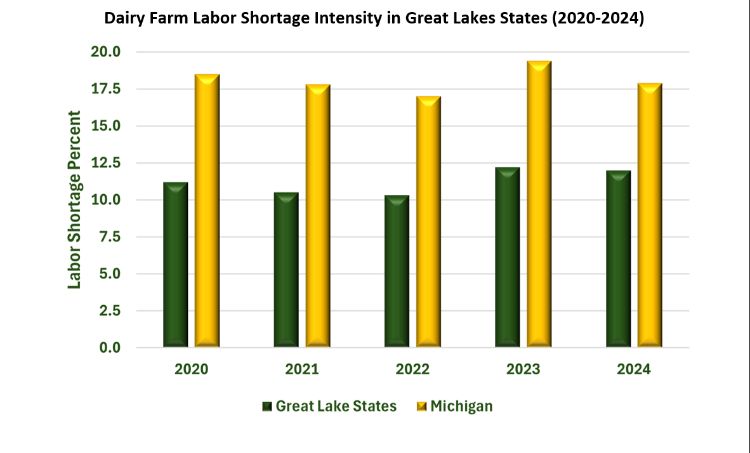
How do labor shortages affect dairy operations? Which policy solutions do producers believe will most effectively solve the problem?
A team of researchers at Michigan State University conducted a survey about dairy labor shortages, adaptation strategies, and support for various labor policies. They were interested in learning how farm labor shortages affected the adoption of key production and labor management practices. This article describes their findings and includes an interview with Anna Hooks, a graduate student who worked on this project. All quotes are hers.
Why are there labor shortages?
Labor shortages are increasingly prevalent in the agricultural sector. Dairy farms face a unique challenge because production requires a year-round workforce, yet most current American visa programs are primarily designed for producers with seasonal employment needs.
“There is an ongoing agricultural labor shortage across all sectors, including crops and other livestock industries. Something that livestock industries struggle with that doesn’t affect crop or seasonal industries as much is the consistent need for year-round labor. Solutions like the H-2A visa program are typically only for seasonal or temporary work,” Hooks said.
Factors linked to a declining American farm labor supply include:
- Demographic changes in rural Mexico
- Increased educational attainment among rural Mexicans
- Rising non-farm job opportunities
- Limited legal immigration pathways
What programs are currently available?
The H-2A Temporary Agricultural Workers program, better known as H-2A, is the largest source of temporary or seasonal farm workers. Workers may come from many countries, but most are Mexican.
In practice, the average H-2A contract is only about six months. Workers can receive extensions to stay in the United States and work for longer, but the legal and regulatory issues can be challenging for both the workers and their employers.
While employers of all sizes use the H-2A program, over two thirds of H-2A requests are for fewer than ten workers, according to 2023 data from the American Farm Bureau. Twenty-nine percent of requests are for contracts between ten and 99 workers. Only about 4% of contracts are for over 100 workers.
Employers are financially responsible for program application fees and visas, and must provide a standardized wage, housing, and transportation. Due to the complex rules and record keeping requirements, some smaller employers use farm labor contractors who manage the administrative burden of the program for an additional cost.
“Cows don’t turn off for the winter,” Hooks said. “While the H-2A program fills a real need in the agricultural workforce, the current program is less effective for dairy farms.”
How do dairy farms respond?
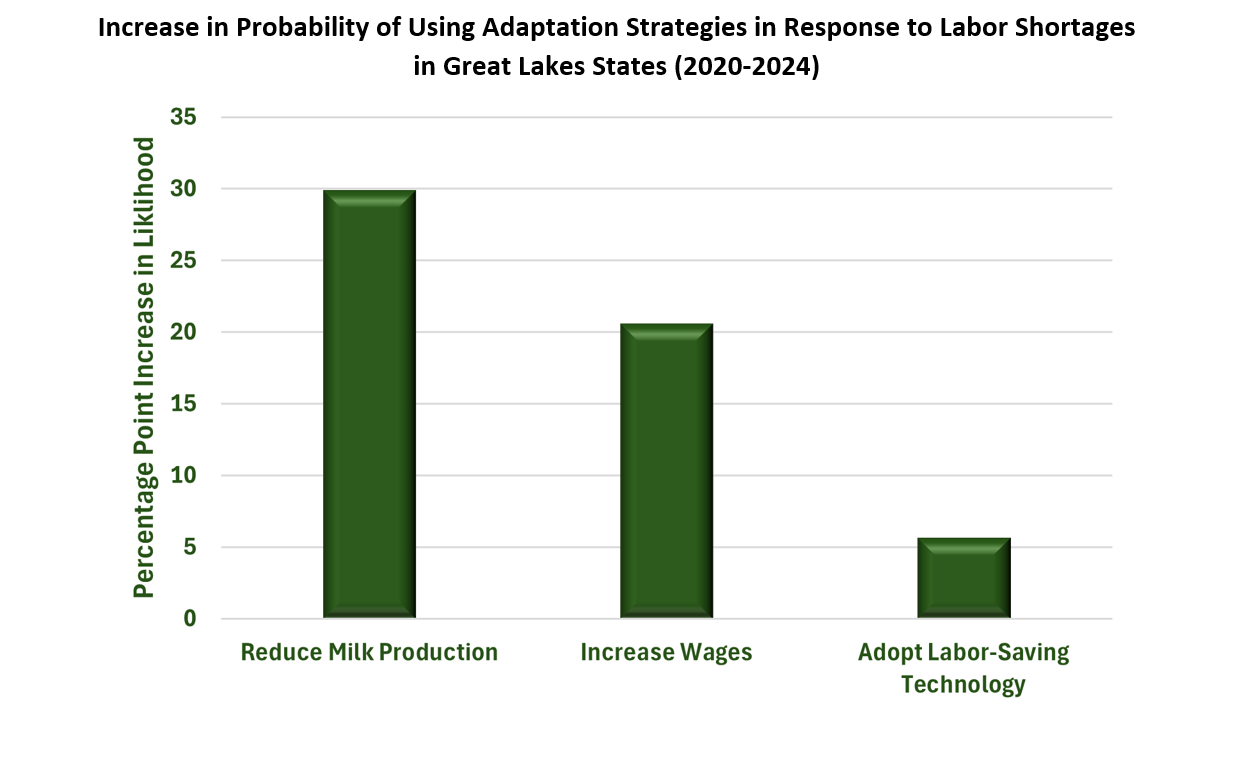
Our survey data reveal that dairy farms experiencing a labor shortage adjust their operations in several ways, with some adaptation strategies focusing on attracting workers while others involve reducing the need for labor.
An adaptation strategy is a deliberate adjustment within an economic system, such as a farm business, to reduce losses or take advantage of opportunities.
The research shows that dairy farms facing a labor shortage are 30% more likely to reduce milk production and 21% more likely to increase wages. Labor shortages are also associated with a 6% increase in the adoption of labor‑saving technologies, although the high cost of automation may limit technology adoption for smaller farms.
Response 1. Attracting workers
“For the average Michigan dairy producer, farm labor represents both a large expense and a source of stress,” Hooks said. “We found that some farmers increased wages to retain current workers and attract new ones.”
“In this study, we did not measure the effectiveness of the adaptation strategy, just whether a farm used it. However, national trends show that increasing agricultural wages does not automatically correlate with an increased supply of labor.”
“The issue here is that the wages farmers must pay to attract a domestic workforce are much higher than farmers can afford while remaining profitable.” While dairy farming has certainly benefited from technological advances in the past few decades, many tasks on a dairy farm are physically demanding, repetitive and must be performed at set intervals even during inclement weather.
Response 2. Reducing the need for labor
“Some farmers reported adopting new technology to reduce their reliance on labor. This could be smaller changes such as automatic equipment washers or automatic manure scraper systems. Or it could be larger systems such as an automatic milking system (AMS). In general, the technological adaptions in the dairy industry that meaningfully reduce labor needs are very expensive.”
For example, an automated milking system reduces labor associated with milking by up to 75%, according to some estimates. It also requires a large initial investment which is typically more feasible for larger farms. The cost of larger-scale automations includes more than just the cost of the technology.
“It often requires major infrastructure changes on the farm. Farms may need to construct a new building with modern electrical and plumbing systems before new technology can be added.”
Finally, return on economic investment often takes several years to realize. Depending on farm size, milk yield, and labor costs, it can take between four and seven years to see positive cash flow after AMS implementation.
Response 3. Reducing milk production
“In the dairy industry, we see a trend towards consolidation. Smaller farms have shut down or consolidated. So, while the average number of cows in Michigan has stayed about the same, they are owned by fewer, larger farms.”
“During our study, we had several farms report a herd size of zero cows. This means that around the time we administered the survey, a farm sold their cows and was no longer producing milk.”
Policy priorities for dairy farmers
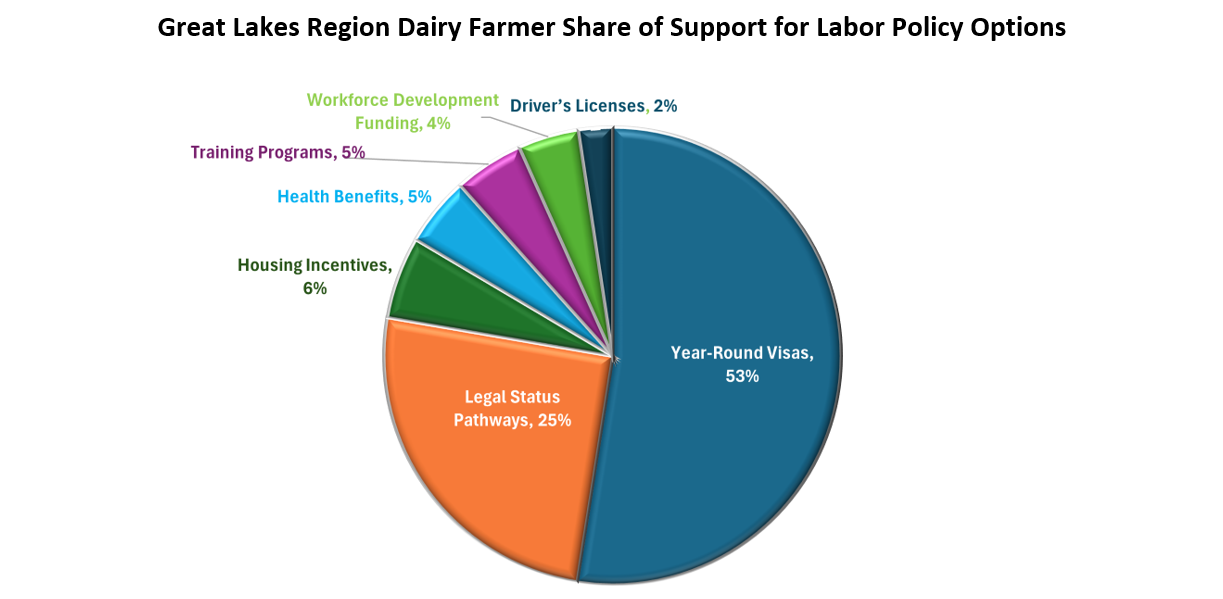
When asked to rank potential policy reforms, dairy farmers clearly prioritized policies that expand access to legally authorized workers. Expanding the H‑2A visa program to allow for year‑round employment needs was the most preferred option among farmers, followed by policies that create legal status pathways for currently undocumented farm workers. Policies such as funding to provide housing for workers, training new employees and promoting workforce development received substantially less support.
Implications for the dairy industry
The findings suggest that labor shortages are already shaping farm management decisions across the dairy sector. Some farms are investing in automation or raising wages, while others are reducing production. Over time, persistent labor constraints could influence farm structure and milk supply.
While farms are adapting, producers consistently report that farm labor policy reforms providing access to legally authorized employees remain the most important long‑term solution for stabilizing the dairy workforce.
Labor shortages continue to create uncertainty for dairy producers. Evidence from our Great Lakes region survey shows that producers strongly support policies that expand access to legally authorized workers, particularly reforms that would allow year-round use of agricultural visas like the H-2A. Addressing these workforce challenges will be critical for maintaining the productivity and competitiveness of the U.S. dairy industry.
This project was funded by the Michigan Alliance for Animal Agriculture. M-AAA project ID number AA-23-002.