


Kindergarteners' spider discovery leads to rare identification by MSU entomologist
 Print
 Email
A rare folding-door spider discovered by a Michigan kindergarten class was identified by an MSU entomology doctoral student.
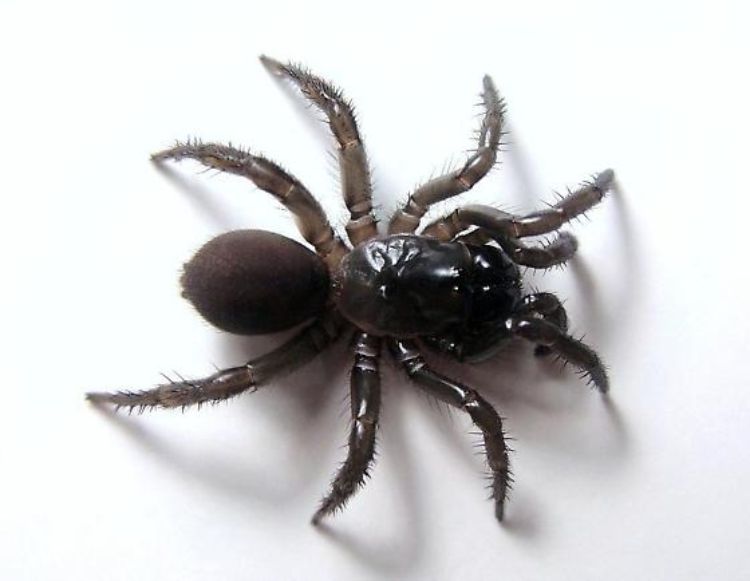
A chance discovery during a kindergarten outdoor lesson at Cranbrook Schools led to the identification of one of Michigan's most elusive spiders, thanks to assistance from a Michigan State University entomology Ph.D. student.
During a weekly "Outdoor Adventure Day" at Cranbrook Schools in Bloomfield Hills, students found a large, dark brown spider beneath a rock and immediately became fascinated by the unusual creature.
Among those helping with outdoor activities that day was Dr. Petra Huck, the inaugural Jennifer Caldwell and John Fisher Cranbrook Climate Science Fellow. The position, the first of its kind in Michigan schools, focuses on hands-on climate science education for K-12 students.
Recognizing an opportunity for scientific discovery, Huck photographed the spider and shared the image with colleagues at the Cranbrook Institute of Science. When they could not confidently identify the specimen, kindergarten teacher Kate Schallhorn reached out to MSU Entomology for help.
"The students were fascinated by the spider from the moment they found it. They're incredibly curious, and we love building our learning around their interests,” Schallhorn said in her email. “We might have some future entomologists on our hands!"
The mystery was solved by Junkai Wang, an MSU Entomology doctoral student and, coincidentally, a Cranbrook alumnus. Wang identified the spider as Antrodiaetus unicolor, commonly known as the folding-door spider.
The identification was noteworthy because folding-door spiders are rarely observed in the wild. According to Wang, only three sightings of the species were documented on iNaturalist in Michigan at the time of this discovery.
"These spiders are extremely difficult to find because they spend most of their lives underground," Wang explained.
Folding-door spiders create burrows in exposed soil, often along wooded hillsides and near rocks or tree roots. At the entrance, they construct a flexible door made from silk and camouflage it with soil and surrounding debris. When closed, the door blends so well into its surroundings that it is nearly impossible to detect.
Because the spiders remain hidden underground during the day and normally emerge only around dusk, established populations can exist for years without being noticed.
Wang said the species has been reported only a handful of times since it was first documented on the University of Michigan campus in 2009. However, he observed the spider himself while attending Cranbrook and believes additional folding-door spider burrows may be found on the Kingswood Campus hillside.
"It's really cool to hear from the school system I grew up with about a spider I used to find on campus," Wang said. "I would love to see more entomologists come from Cranbrook. The campus has beautiful nature full of really cool insects and spiders."
Students can continue exploring the world of arachnids at ArachnoBROADia on October 25, an annual collaboration between the MSU Broad Art Museum and the MSU Bug House. Inspired by artwork from the museum’s collection, this family-friendly event features a spooky afternoon of eight-legged fun just in time for Halloween. Create creepy crafts, meet fascinating arachnids and other crawly creatures from the MSU Bug House, and enjoy activities for all ages.


