M-AAA collaboration, MSU research fuel Michigan’s high oleic soybean momentum
 Print
Print Email
EmailResearch-backed insights from MSU and cross-sector partnerships are positioning Michigan as a leader in high oleic soybean production.
*This story is part of a series highlighting the impact of MSU AgBioResearch’s work with Michigan agriculture and natural resources told through our stakeholders' perspectives. Through partnerships with the State of Michigan and industries, MSU AgBioResearch is finding solutions to some of the timeliest problems facing our state. To view the entire series, visit agbioresearch.msu.edu.
EAST LANSING, Mich. — 2026 is shaping up to be a big year for high oleic soybean production in Michigan, with research from Michigan State University helping to identify the ways in which these buzzworthy beans can grow in the ag market.
Over the past couple years, much attention has been given to high oleic soybeans and how they can support the dairy industry.
Originally touted for their prospects of producing a healthy, human-grade oil comparable to olive oil, these beans have also shown through research from MSU Professor Dr. Adam Lock to boost milk production and, in some cases, lower feed costs for dairy farms feeding them to their cows — a finding farmers have described as being a “once-in-a-generation” change for Michigan dairy.

“This research is about more than just milk production and feed efficiency — it’s about empowering producers with science-based tools that improve profitability and sustainability,” said Lock, a professor in the MSU Department of Animal Science and interim chair of the MSU Department of Large Animal Clinical Sciences.
“Our goal is to empower producers with tools that are both economically viable and nutritionally sound. Research like this shows how science can directly improve farm sustainability and profitability.”
As news of this bean boon has spread throughout Michigan, the demand for them has skyrocketed. In March, Michigan Farm News reported that Pioneer’s Plenish high oleic Enlist E3 soybeans represented 4% of the company’s total seed sales when first introduced in 2025. Leaders at Pioneer said that number is up to 45% this year and is expected to be 83% next year.
In addition to nutritional research done by the Lock Lipid Lab on the benefits of dairy cows being fed these beans, research from MSU Professor Dr. Vincenzina Caputo and her Food Choice and Policy Lab has given greater insight into what the opportunities are for them to be adopted by soybean and dairy farmers, and what increased adoption could mean for Michigan agriculture overall.
This project was funded by the Michigan Alliance for Animal Agriculture (M-AAA), a partnership among Michigan’s animal agriculture and allied industries, MSU and the Michigan Department of Agriculture and Rural Development (MDARD) aimed at addressing needs for key sectors of the state’s $125.8 billion agriculture industry.
Caputo, Lock and their team, including former and current graduate students Sam Rickman and Hattie Polson, found that prior to 2026 interest was high among farmers for high oleic soybeans, but adoption was low. Their analysis points to several reasons for why this was:
- Economic uncertainty around yield performance, price stability, and upfront roasting costs.
- Limited processing and market access, with few Michigan processors offering high oleic soybean contracts and minimal local roasting or storage capacity.
- Contracting and licensing constraints that restrict flexible local partnerships and experimentation.
They concluded, however, that despite these difficulties, farmers who moved forward with growing and incorporating these beans have shown how local partnerships between dairy and soybean professionals can create “closed-loop” systems that bolster supply chains, foster shared value and build resilience within agriculture.
The team believes that Michigan — where dairy and soybeans are integral drivers of Michigan agriculture, with dairy generating about $15.7 billion to the state’s economy and soybeans generating more than $1.5 billion according to MDARD — can position itself to be a national leader in supporting the dynamics of high oleic soybeans and strengthen several of its major ag sectors by doing so.
“This work builds upon my earlier research on high oleic soybeans conducted for the United Soybean Board in 2023,” said Caputo, a professor and Homer Nowlin Chair in Consumer and Food Economics in the MSU Department of Agricultural, Food and Resource Economics.

“M-AAA has been instrumental in allowing me to expand the scope of this work to include the dairy sector and deepen the analysis of adoption dynamics. It’s provided an opportunity to generate novel, evidence-based insights on what the entries and barriers are for adoption, while also allowing students from my Food Choice and Policy Lab to take part in industry-related activities and interact with farmers from across Michigan. We’re grateful to M-AAA and hope to continue working on this topic in the future.”
Strong collaborations between MSU and ag industries are also helping open doors for farmers to incorporate high oleic soybeans. To advance the closed-loop systems discussed in the M-AAA study, the Michigan Soybean Committee (MSC) has funded Caputo and Lock’s research to strategize ways of further connecting dairy and soybean farmers and continue learning how high oleic soybeans can positively impact dairies.
This research is a win-win for all, said MSC CEO Ben Steyer.
“MSC has long partnered with MSU to conduct research that benefits soybean farmers in our state,” Steyer said. “Collaboration with partner organizations like M-AAA not only helps research dollars go further but also helps push for research that can identify and address common challenges. High oleic soybean research is a perfect example of how collaborative research helps move both the crop and livestock industries forward.”
Building local partnerships and embracing closed-loop systems
There are multiple ways high oleic soybeans can find their way onto dairy farms.
For some dairy farmers, they’re able to grow soybeans themselves while simultaneously running their dairy operations. Eliminating the need to import the expensive fats and oils found in high oleic soybeans from outside the country, coupled with the increase in milk production by feeding cows these beans, has led to tremendous gains for farmers.
Brian Preston of Preston Dairy in Quincy, Michigan spoke with MSU AgBioResearch in 2025 about what he and his farm have experienced growing and feeding high oleic soybeans.
“Our inputs went down substantially at the same time our income was going up,” Preston said. “We were able to hold the same pounds of milk produced while we increased our butterfat percentage. It wound up being a well over $1-per-head-per-day change. And on a dairy farm, we’ll try something to get maybe 5-6 cents more per cow per day.
“We operate on tight margins like every other business, and when you can do $1-$1.20 more per cow per day, that’s an unheard-of change. That’s a once-in-a-generation change.”
With the scale at which some dairy farms operate at or a lack of resources available to them, growing soybeans may be unfeasible, but getting access to them is not.
Caputo and Lock’s M-AAA research spotlights how closed-loop systems, where dairy and soybean farmers partner regionally with each other in the state, can support the adoption and growth of high oleic soybeans in Michigan.
MSC Market Development Director Hanna Campbell said high oleic soybeans offer an immense opportunity to strengthen Michigan agriculture from both animal ag and row crop perspectives.
“As I speak today, there are currently high oleic beans coming onto Michigan dairies from out of state, so seeing Michigan soybean farmers hop on board to take advantage of this market and partner with their neighbor farmers is so cool,” Campbell said. “Seeing this circular economy within Michigan where truly all farmers benefit is exciting. Soybean farmers can take advantage of a premium, and dairy farmers can take advantage on their milk checks and feed bills.”
Research from Caputo and Lock’s team indicates that even though some soybean farmers have felt uncertain about the input costs and yield performance associated with these beans, a premium ranging from $0.50-$1.50 at which they can be sold in Michigan is helping fuel the decision to invest in them — a decision PJ Feldpausch and David Williams recently made.
Feldpausch, a third-generation farmer of Pat Feldpausch Farms in Fowler, Michigan, and Williams, a fifth-generation farmer of W Farms LLC in Elsie, Michigan, have grown high oleic soybeans in the past, but this will be the first year they’ve grown them to be used as dairy feed. They said the premiums they’ll get for selling and storing them, as well as the cost savings from partnering with local dairies to reduce transportation costs, is a big reason why they’ve bought in.
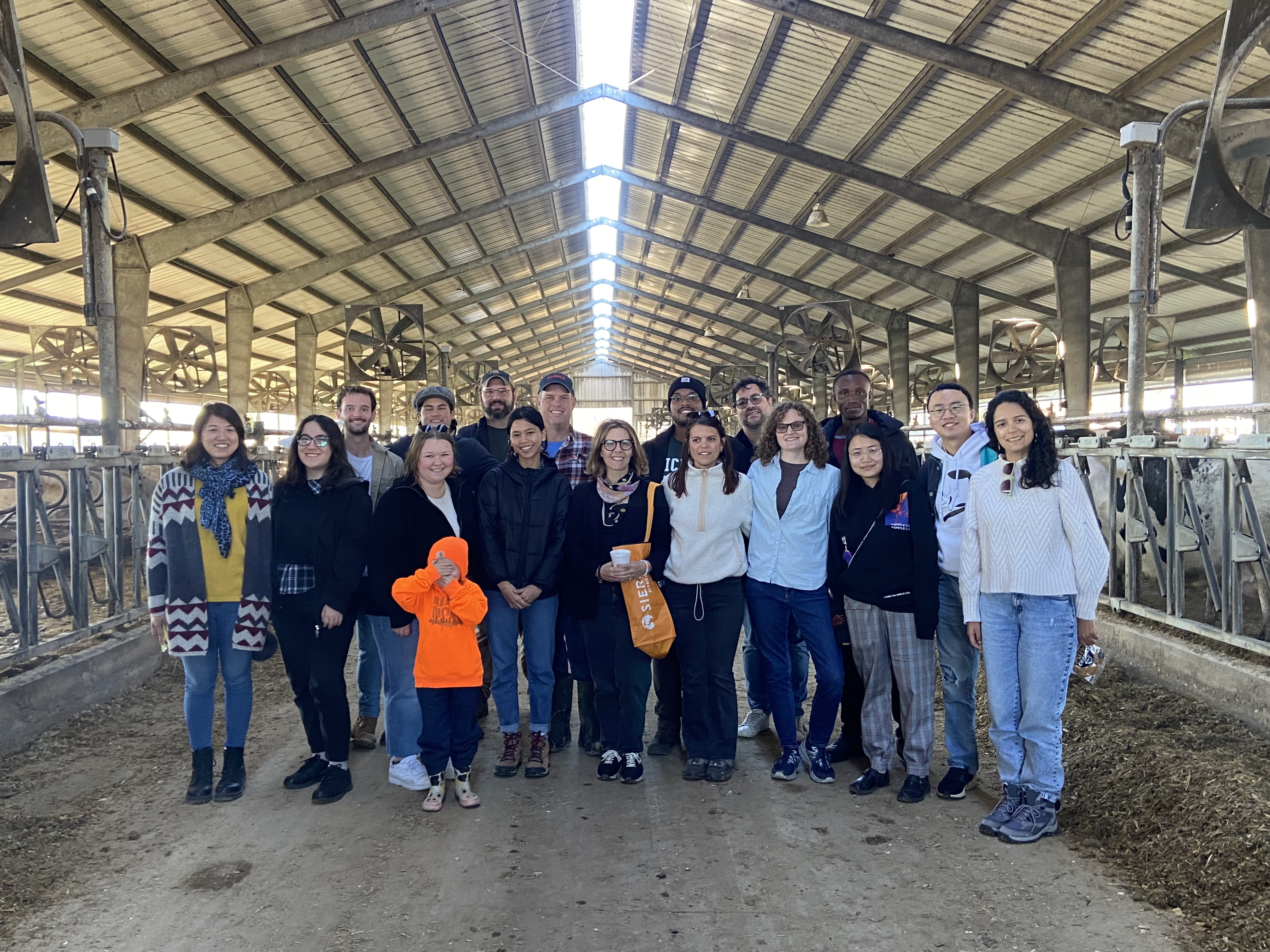
“Right now, it’s a $1 premium for fall delivery, and then most of the places you’re taking them to have a storage premium on top of that dollar. So, $1 per bushel plus about 5 cents a month after January for storing them is roughly the going rate,” Feldpausch said. “If we’re going to use our storage to our advantage, to be able to sell these beans, not have to transport them far distances and still get paid to store them is a good way for us to make the system work all the way around.”
Williams said, “The premiums vary. Different buyers pay different amounts. We decided on a midway point to sell our beans at, and that will boost our income.”
The potential high oleic soybeans represent for the soybean industry in Michigan is grand, Williams said. As someone who previously grew them for their quality food-grade oil, Williams noted the demand for them from dairies has added to their value and could make them a vital product of Michigan’s soybean industry moving forward.
“It’s a chicken-and-egg situation,” Williams said. “We need to increase production on the same token that we need to have enough demand so we don’t end up with something we can’t market. The dairy usage gives our farm a way to further utilize these beans, which will be another source of revenue for our operation.”
For Feldpausch, growing high oleic soybeans for the dairy industry has been a learning journey, one he said couldn’t be done without MSU research.
“If research like this wasn’t available, it would be a step back for us,” Feldpausch said. “There are some farms capable of doing this research, but getting it published and having it be trusted is a much more difficult thing to do. When it’s seen in a university’s eyes, we know the study was done with the utmost care to take out certain variabilities, test the correct metrics, and try to find all the answers — not just one.”
Processing and roasting: Necessary steps to unlock high oleic benefits
Along with soybean and dairy farmers, soybean processors play a critical role in the success of high oleic soybeans. Research from the Lock Lipid Lab underscores that roasting these beans is essential for dairy farmers to unlock their full benefits.
Caputo and Lock’s research shows, though, that limited adoption of high oleic soybeans among farmers in the past can be partly attributed to the continued need for more processors offering high oleic soybean contracts and more infrastructure supporting roasting and storage.
This finding reinforces how vital agribusinesses such as Quality Roasting are to the strength of Michigan’s agricultural supply chain.
Quality Roasting began operating in Valders, Wisconsin in 1991 but expanded into Northern Michigan in 2018 with a facility in Reese, Michigan, focusing specifically on animal feed production. Co-founder Dr. Lynn Davis, who with his daughter Erin (CEO of Quality Roasting) has worked closely with the Lock Lipid Lab, reiterated that the return on investment of high oleic soybeans can be experienced across the supply chain — starting with dairy farmers and shared with soybean producers and processors.
With over 300 different commodities produced in Michigan, Erin said the appeal of expanding into Michigan’s high oleic soybean market was farmers’ openness and willingness to diversify their crop portfolio.

As high oleic soybeans began growing in popularity originally for their oil, and as a company with a particular focus in animal feed production, Erin said there were questions for how Quality Roasting would make these beans work. The Lock Lipid Lab helped answer them.
“The big push for high oleic soybeans three or four years ago was on the oil side into the food industry,” Erin said. “I think that gave us a little more hesitation because of the premium we were paying for these beans and being told to put all that premium into the oil when our process leaves a lot of oil in the meal — we had to find value in that. That’s where Dr. Lock’s research really helped drive our process into high oleic soybeans because he was showing the value of oleic acid in the fat of an animal diet.”
Lynn noted the merit of the closed-loop systems described by Caputo and Lock, saying the Quality Roasting site in Reese is there to support farmers in the region growing these beans so that they don’t have to process or roast them themselves.
“Dairy farmers tend to put a lot on their plate,” Lynn said. “They need to be agronomists because they're growing feedstuffs for their cattle. They need to have good animal husbandry skills. They need to be sharp businesspeople. And then all a sudden, we’re talking about them needing to do an on-farm roasting process that requires a lot of oversight. Is that investment justified?
“Having MSU research to weigh in on the economics of all these questions is key to making this work for the ag industry. It’s not just the dairy producers — it’s a multifaceted industry where a lot of different players can be involved in this high oleic space.”
With the support of MSU and other institutional research to help further answer questions about the agronomy, transport and processing of high oleic soybeans, Lynn said he thinks high oleic soybeans could one day make up 100% of all the soybeans being grown the U.S.
Michigan State University AgBioResearch scientists discover dynamic solutions for food systems and the environment. More than 300 MSU faculty conduct leading-edge research on a variety of topics, from health and agriculture to natural resources. Originally formed in 1888 as the Michigan Agricultural Experiment Station, MSU AgBioResearch oversees numerous on-campus research facilities, as well as 15 outlying centers throughout Michigan. To learn more, visit agbioresearch.msu.edu.