


AI Citation
MSU Extension Guidance for Citation of Artificial Intelligence (AI)
AI: Citation & Avoiding Plagiarism
According to the U.S. Copyright Office, machines or software cannot hold a copyright; it must be the product of human creativity. Generative Artificial Intelligence (AI) currently cannot be an author.
However, you should not present Generative Artificial Intelligence writing as your own. AI should be used as a tool to support human creativity and not replace critical thinking and expertise. Additionally, tools to detect AI output exist and are evolving and to become more accurate, making detection of AI writing possible.
General Guidance: When AI Citation is Necessary
Cite AI when materials or assets were produced by or significantly derived from AI-generated outputs, exceeding prewriting, basic editing, or proofreading. The exception to this rule would be using AI for internal-use communications such as emails. Also cite when AI use is part of a study’s research methodology or analysis.
Citation Guidance: Academic Guidance
Check with the publishing policies of the style guide you are using (APA, CMOS, MLA, etc.) as well as with the publishing source, such as the journal in which you seek to publish. Generally, common themes across publication styles include always specifying which AI software you used, describing its purpose, including prompts used, and disclosing any AI-generated text.
Citation Guidance: Extension Articles
Extension articles are written using Associated Press (AP) Style, which does not yet have official guidance on citing AI-generated content. However, AP has advised journalists to treat AI-generated content with caution and disclose its use when relevant. Since AP encourages transparency, here’s a suggested way to reference ChatGPT in an article:
- Within the text: "According to ChatGPT, OpenAI’s artificial intelligence chatbot, …"
- For attribution (if applicable): "The information was generated using ChatGPT, an AI model developed by OpenAI."
Citation Guidance: Nonacademic Use Guidance
Use the following guiding questions to determine if it is appropriate to cite AI:
- Was something original created?
- Were you merely modifying something you have already created?
|
When citation is generally not needed |
When citation is recommended |
|
· Summarizing your own work · Brainstorming to generate ideas that you curate and develop · Brainstorming specific examples · Generating drafts of multi-choice questions based on your own material · Rewriting your own text in a different style · Editing writing for style, grammar or spelling · Writing or rewriting an email or email response · Reorganizing information such as reformatting references into a specific format, alphabetize, group · Generating title ideas for a paper you wrote
|
· Using AI-generated writing · Including AI-generated images · Analyzing data with AI · Demonstrating an AI tool
|
Citation Guidance: AI Generated Images
Different image generators have different use policies. Be sure to read, understand and comply with these policies.
Even if the tool allows you to use images generated for personal, commercial, or educational purposes, keep in mind that AI is creating a new image from images that it was trained on, and those could include copyrighted works.
ChatGPT and DALL-E, for example, allow you to use images generated for personal, commercial, or educational purposes. However, keep in mind that AI is creating a new image from images that it was trained on, and those could include copyrighted works.
Determining if an AI-generated image is too similar to a copyright-protected work can be challenging, so it is recommended to conduct an online image search to check for potential matches.
You also want to avoid trademarked logos or characters. For example, asking AI to generate an image of a Disney character may generate a unique image, but should not be used as it risks copyright infringement.
In general, when citing the creation of an image by AI, include the name of the AI tool, date, and the company used to generate the image and save the prompt used. While some guidelines may not explicitly require this information, it is recommended for transparency. Refer to the example below to see an AI image should be cited.
Example citation text for AI generated image:
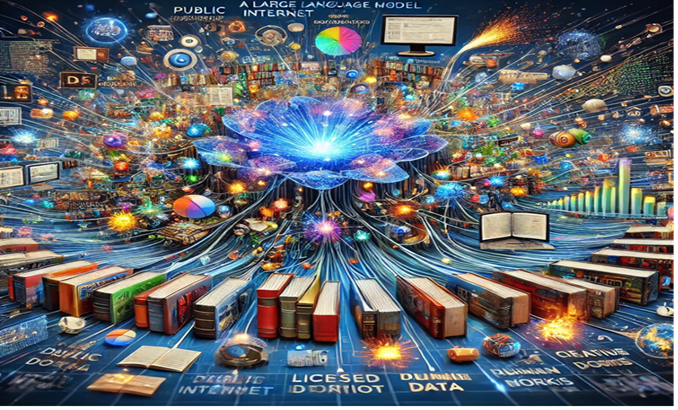
Additionally, the following MSU Extension resources and guidelines help educators understand the process of properly using citations, creating references, and finding quality resources.
- Keeping it Legit: Properly Citing & Sourcing MSU Extension Materials
- Text Citations & References Checklist
- Author Checklist for MSU Extension Educational Materials
 Print
Print Email
Email