Goat Showmanship Guide
DOWNLOADApril 30, 2026 - Autumn Converse Williams, Michigan State University Extension, and Dawn Reha, Ann Dasen and Leslie Warner
 Print
Print Email
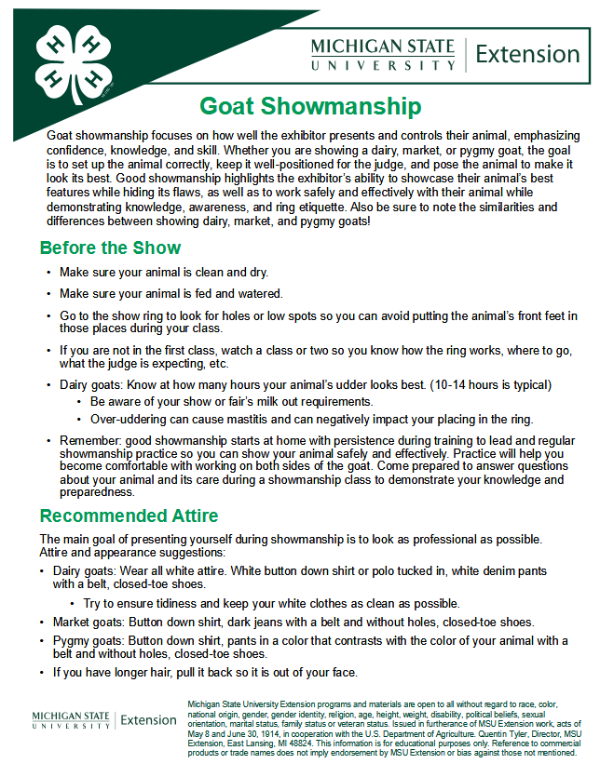
EmailGoat showmanship focuses on how well the exhibitor presents and controls their animal, emphasizing confidence, knowledge, and skill. Whether you are showing a dairy, market, or pygmy goat, the goal is to set up the animal correctly, keep it well-positioned for the judge, and pose the animal to make it look its best. Good showmanship highlights the exhibitor’s ability to showcase their animal’s best features while hiding its flaws, as well as to work safely and effectively with their animal while demonstrating knowledge, awareness, and ring etiquette. Also be sure to note the similarities and differences between showing dairy, market, and pygmy goats!
Before the Show
- Make sure your animal is clean and dry.
- Make sure your animal is fed and watered.
- Go to the show ring to look for holes or low spots so you can avoid putting the animal’s front feet in those places during your class.
- If you are not in the first class, watch a class or two so you know how the ring works, where to go, what the judge is expecting, etc.
- Dairy goats: Know at how many hours your animal’s udder looks best. (10-14 hours is typical)
- Be aware of your show or fair’s milk out requirements.
- Over-uddering can cause mastitis and can negatively impact your placing in the ring.
- Remember: good showmanship starts at home with persistence during training to lead and regular showmanship practice so you can show your animal safely and effectively. Practice will help you become comfortable with working on both sides of the goat. Come prepared to answer questions about your animal and its care during a showmanship class to demonstrate your knowledge and preparedness.
Recommended Attire
The main goal of presenting yourself during showmanship is to look as professional as possible. Attire and appearance suggestions:
- Dairy goats: Wear all white attire. White button down shirt or polo tucked in, white denim pants with a belt, closed-toe shoes.
- Try to ensure tidiness and keep your white clothes as clean as possible.
- Market goats: Button down shirt, dark jeans with a belt and without holes, closed-toe shoes.
- Pygmy goats: Button down shirt, pants in a color that contrasts with the color of your animal with a belt and without holes, closed-toe shoes.
- If you have longer hair, pull it back so it is out of your face.
Goat Showmanship Rules of Thumb
- Always keep your goat positioned between you and the judge; smoothly switch to the opposite side of the goat as necessary. When switching sides, never walk behind or step over the goat; always make your move in front.
- When you switch sides, switch the hand that the collar or lead is in.
- When lined up side-by-side, leave approximately an animal’s width between you and the exhibitors next to you.
- Throughout the class, maintain eye contact with the judge and be ready to respond to any further directions.
- Reach over the goat to position the legs. If you cannot reach over, you may reach under. Do not use your feet to set legs.
- Be natural. Do not overshow. Avoid fussing with leg placement and do not circle too often.
Leading Goats
- To properly lead your goat, you’ll use a collar, halter, or lead strap.
- Dairy: Collar; lead straps are permissible for Nigerian Dwarfs
- Market: Collar or show halter
- Pygmy: Collar and lead strap
- Keep the animal’s head held high and tall using the collar so it can move smoothly and at a slow pace.
- As you move around the show ring, you’ll walk on the animal’s left side. Enter the ring and walk in a clockwise direction, following the person in front of you.
- If the animal in front of you stops, wait patiently if possible. In cases when the animal completely refuses to move or falls to the ground, you can pass them.
- When the judge or ring steward prompts exhibitors to stop walking, stop immediately and set your animal up correctly as outlined in the next section.
Setting Up Dairy Goats
- Set up your animal with the front feet squarely beneath and its hind feet slightly spread. When possible, pose the animal with front feet on a slight incline.
- When the judge gives or changes placings, lead the animal to where you are directed, making a U-turn to get your animal into the correct position.
- Be mindful of the judge’s position during this maneuver, as you must switch sides as needed to keep the animal between you and the judge.
- To move your animal forward in line, use a slight pull on the collar or lead. If your animal moves far out of position, lead her forward and make a circle back through your position in line.
- For full showmanship requirements, refer to the American Dairy Goat Association Showmanship Scorecard.
- For visuals of completing maneuvers in the ring, refer to this Showmanship Packet from American Dairy Goat Association.
Setting Up Market Goats
- When the judge or ring steward prompts exhibitors to stop walking, stop immediately and set your animal up correctly.
- When instructed to line up side-by-side, walk your goat promptly into the lineup and set it with its nose even with the first goat in line.
- When instructed to line up on a profile, line your goat up single file head to tail.
- If the judge pulls a goat out of line from in front of you while on a profile view, move forward to fill in the empty space.
- During evaluation, make sure your animal’s head is held high and the animal is set squarely on all four legs.
- Market goats should be trained to brace. A light brace is often used during side-by-side and profile evaluation, while a full brace is used only when the goat is being handled by the judge.
- All four of the animal’s feet should remain on the ground while bracing.
- Some shows, by rule, may not allow bracing.
- When switching sides, make sure to do so only after the judge has moved on to look at the next animal in line. Do not cross between the goat and the judge and block the judge’s view.
- For more on market goat showmanship, refer to this in-depth guide from Kansas State University.
Setting Up and Showing Pygmy Goats
- Place the front legs squarely beneath the animal. Place the back legs slightly spread so that the hocks are in line with the tailhead.
- Stand or squat where you can see the judge and watch to ensure your animal remains set up properly.
- Pay close attention to the judge so you can make maneuvers when asked.
- For full pygmy goat requirements, refer to the National Pygmy Goat Association Showmanship Scorecard.
- The NPGA Showmanship Manual is only available for purchase. More info can be found here: https://npga-pygmy.com/npga-publications/.
For more goat showmanship tips, check out the 4-H Livestock Showmanship Guide from North Dakota State University Extension.
Goat Showmanship Sample Questions and Answers
Many judges will ask questions about your project and animal during showmanship.
To set yourself apart, be prepared to answer questions regarding the following topics:
- What breed your goat is
- Have knowledge of other breeds and their characteristics, as well, in case the judge asks you to identify the breed of another exhibitor’s goat
- Have knowledge of goat terminology such as color patterns, ear types, etc.
- Parts of the dairy market goat
- How much your goat eats daily (in pounds)
- Goat nutrition
- What type of digestive system a goat has
- What does your goat eat
- Percent protein
- Percent fat
- Avoid naming show feed brands in your answer
- Meat science
- Understand quality and yield grades
- Expected dressing percentage
- Most valuable cut on the animal
- What is the current average market price for chevon?
- Goat reproduction information and gestation length
-
Dairy and Pygmy goats: Number of points assigned to each category on the respective Confirmation and Showmanship Score Cards
-
What types of phenotypic or genetic characteristics you like about your animal, what you might want to change about it, how you highlight the best pieces and hide the least desirable features.