


Mali
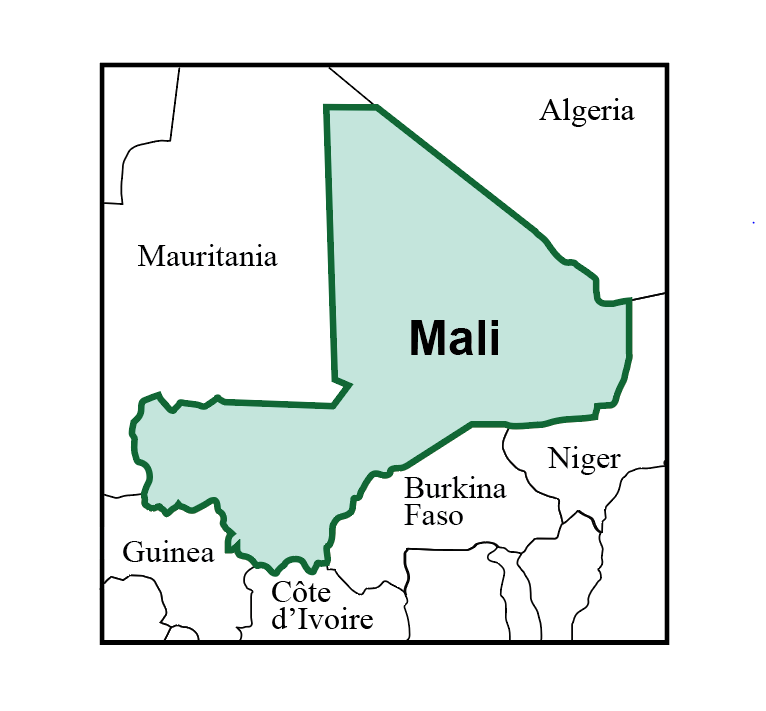 The capital and main city is Bamako.
- The official language is French
- Area: 478,841 sq mi (approx. 4x the size of the State of Michigan)
- Population approx. 15 million in 2009
- Climate: Northern Sahara zone in Mali experiences hot and dry climate whereas the climate of Mali in the subtropical southern part is hot and humid
Fun Fact: The prime meridian marker is located in Gao, Mali, where one can literally stand on the edge of two hemispheres.
MSU and Partners achievements in Mali
Brochure in English
Les réalisations de MSU et ses partenaires au Mali
Pamphlet en français
Main Research Themes
- Agrifood System Transformation
- Gender
- Input Use and Market Development
- Policy Research and Capacity Building
- Sustainable Agricultural Intensification
- Training and Capacity Building
- Value Chain Analysis
News
-
Tough Questions
Published on January 16, 2025
A webinar series by MSU’s Food Security Group exploring critical issues in international development research, featuring leading experts tackling ethics, policy pipelines, A.I. impacts, and more. -
MSU Research Team Leaves Lasting Impact on Malian Food Security Outlook
Published on June 25, 2021
The Mali Food Security Policy Research Program has come to an end but leaves behind a lasting legacy of agricultural policy research and capacity development. -
Malian Farmers’ Access to Fertilizer Is Challenged by COVID-19
Published on October 1, 2020
Malian Farmers face greater difficulty accessing fertilizer during COVID-19 -
MSU professor emeritus recognized
Published on May 9, 2014
John Staatz was named "Officier de L'ordre National du Mali," or Officer of the National Order of Mali, by Malian President Ibrahim Boubacar Keita.

Publications and Presentations
-
Beyond grain: the potential of cowpea in local markets of Mali
Published on September 5, 2022
Sissoko, M., Theriault, V., & Smale, M. (2022). Beyond grain: the potential of cowpea in local markets of Mali. Journal of Agribusiness in Developing and Emerging Economies. -
Input subsidies and crop diversity on family farms in Burkina Faso
Published on August 2, 2022
Ahmad, S., Smale, M., Theriault, V., & Maiga, E. (2022). Input subsidies and crop diversity on family farms in Burkina Faso. Journal of Agricultural Economics. -
Articulating fertilizer subsidy effects on women’s diet quality by food supply source in Mali
Published on June 21, 2022
Assima, A., Zanello, G., & Smale, M. (2022). Articulating fertilizer subsidy effects on women’s diet quality by food supply source in Mali. CABI Agriculture and Bioscience, 3(1). -
Diverse crops and input subsidies: a village-scale analysis in Mali
Published on December 25, 2021
Assima, A., Smale, M., & Kone, B. (2021). Diverse crops and input subsidies: a village-scale analysis in Mali. International Journal of Agricultural Sustainability, 1–16. -
Input subsidy effects on crops grown by smallholder farm women: The example of cowpea in Mali.
Published on December 5, 2021
Smale, M., & Thériault, V. (2021). Input subsidy effects on crops grown by smallholder farm women: The example of cowpea in Mali. Oxford Development Studies, 1–15.
People
-
Steven Haggblade
Adjunct Professor
blade@msu.edu
-
Laura Schmitt Olabisi
Professor
schmi420@msu.edu
-
Melinda Smale
Professor
msmale@msu.edu
703-231-8492
-
John M. Staatz
Professor Emeritus
staatz@msu.edu
517 896 4390
-
Oyinkan Chukuka Tasie
Assistant Professor
otasie@msu.edu
517-355-0131




 Print
Print Email
Email