Michigan hop pest report – July 16, 2026
 Print
Print Email
EmailHopyards are in a critical disease control period as cones form.
In the field
For a hop production update from around the state, see the July 16 Hop Crop Report.
Diseases
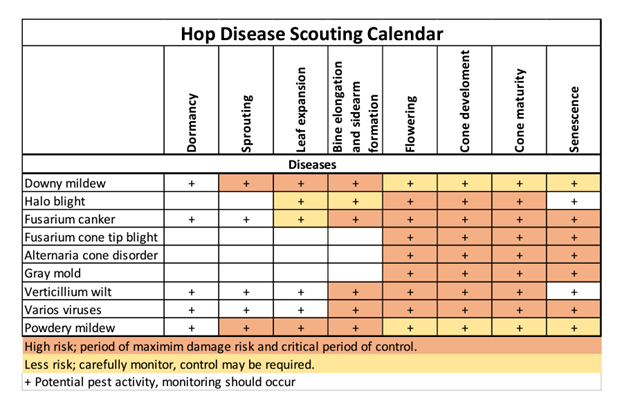
Hopyards remain in a critical disease control period through flowering and cone development. Michigan hops are susceptible to several fungal diseases that favor the region’s temperate and moist climate conditions. Hop downy mildew (Pseudoperonospora humuli), halo blight (Diaporthe humulicola) and powdery mildew (Podosphaera macularis) account for the bulk of disease-related crop loss in Michigan hops.
Managing these diseases requires a multifaceted approach that includes starting with clean plant material, monitoring the crop carefully, implementing horticultural and sanitation practices to reduce disease pressure and utilizing a targeted and preventative fungicide program. Growers should familiarize themselves with each pathogen and the non-chemical management strategies clarified in the pest management section of the MSU Hop Pest Management Webpage. You can also review Tim Miles' disease presentation from the June 6 Hop Chat.
For disease management fungicide options, refer to page 13 of the Michigan Hop Management Guide. These recommendations are primarily based on research by Michigan State University scientists over several years. These ratings can help growers determine which fungicides are likely to be most effective at disease suppression and take into account pesticide use patterns like the preharvest interval. These ratings may not accurately reflect the performance of these fungicides in all situations. Fungicide efficacy can be impacted by fungicide use history, application equipment, environmental conditions and hop variety.
In general, most fungicides provide around 10-14 days of efficacy, but heavy rainfall can decrease longevity. It should also be noted that fungicidal modes of action should be tank mixed or rotated to prevent resistance development over time. To reduce the development of resistance with systemic fungicides:
- Regardless of if it is allowable based on the label, do not make more than three applications per season of the same mode of action (indicated by the FRAC code).
- Do not make two consecutive applications of the same FRAC code.
- Rotate between fungicides in a different FRAC code that have proven efficacy on the target pathogen.
Insects
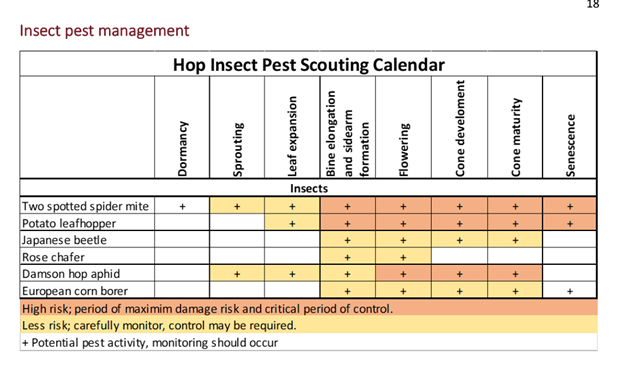
There is a lot going on with insects this week! Continue to scout for European corn borer (eggs, larvae and adults may be present). Potato leafhopper remains active, two-spotted spider mite pressure is high, rose chafer is active and Japanese beetle is being reported.
European corn borer larvae damage vascular tissue, disrupt the flow of nutrients and water, and impede plant development. In hop, European corn borer larvae can be found in leaf petioles, sidearms, cone petioles (strigs) and bines. Their location and prevalence in the plant dictates the severity of damage. The most severe damage observed in Michigan hops occurs when hopyards are infested by first generation flight in June during bine elongation and subsequent sidearm and cone development stages. Focus on scouting for adult moths and eggs to allow for corrective management before larvae enter the bine. For information on European corn borer management, refer to the MSU Extension article "Be on the lookout for European corn borer in hops."
Like many plants, hops are sensitive to the saliva of potato leafhopper, which is injected by the insect while feeding. Damage to leaf tissue can reduce photosynthesis, which can impact production, quality, and cause death in baby plants. To learn more about potato leafhopper, refer to the Hop Potato Leafhopper Factsheet. For information on insecticide selection, refer to the Michigan Hop Management Guide.
Two-spotted spider mite populations are building, due in part to hot conditions across much of the state. Growers should carefully monitor mite pressure as two-spotted spider mite thrive under hot and dry conditions. Two-spotted spider mite is a significant pest of hop in Michigan and can cause complete economic crop loss when high numbers occur. Feeding decreases the photosynthetic ability of the leaves and causes direct mechanical damage to the hop cones. Leaves take on a bronzed and white appearance and can defoliate under high pressure. Intense infestations weaken plants, reducing yield and quality. Dry, hot weather provides ideal conditions for outbreaks. Scout carefully for mites season-long and treat while populations are at low levels, when mites are most effectively managed. Refer to the two spotted spider mite fact sheet for more information on identification and management. For information on miticide selection, refer to the Michigan Hop Management Guide.
Rose chafer and Japanese beetle are generalist pests that can impact a variety of crops, including hops. They aggregate to mate and feed on plant tissue. While there are no established treatment thresholds on hop in Michigan, both beetle pests cause simple mechanical damage, so established plants can sustain a significant amount of leaf feeding with no negative implications to the plant or crop. Young plants with limited leaf area may require more aggressive management. For information on insecticide selection, refer to the Michigan Hop Management Guide.
Stay connected!
For more information from Michigan State University Extension on hop production practices, sign up for the Hops & Barley MSU Extension Newsletter, attend the free MSU Hop Chat Series and continue to visit the MSU Extension Hops website or MSU Hops News Facebook.
If you are unsure of what is causing symptoms in your field, submit a sample to MSU Plant and Pest Diagnostics. Visit the webpage for specific information about how to collect, package, ship and take pictures of plant samples for diagnosis. If you have any doubt about what or how to collect a good sample, please contact the lab at 517-432-0988 or pestid@msu.edu.
Become a licensed pesticide applicator
All growers using pesticides can benefit from getting a pesticide applicator license, even if not legally required. Understanding pesticides and the associated regulations can help you protect yourself, others and the environment. Michigan pesticide applicator licenses are administered by the Michigan Department of Agriculture and Rural Development. You can read all about the process by visiting the Pesticide FAQ webpage. Michigan State University offers a number of resources to assist people pursuing their license, including an online study/continuing education course and study manuals.
This work is supported by the Crop Protection and Pest Management Program (grant no 2024-70006-43569) from the USDA National Institute of Food and Agriculture. Any opinions, findings, conclusions or recommendations expressed in this publication are those of the author(s) and do not necessarily reflect the view of the U.S. Department of Agriculture.